Daily Caffeine Limit Calculator
See how much caffeine you can have a day according to published guidance for your life stage, with an adult weight-based single-dose figure and drip coffee equivalent.
Result
—
Published daily limit
— mg per day
- Single-dose guidance
- —
- Drip coffee equivalent
- —
Published guidance is not a personal safety recommendation. People with heart conditions, anxiety disorders or on medication should follow their clinician’s advice.
iPhone & iPad · Free
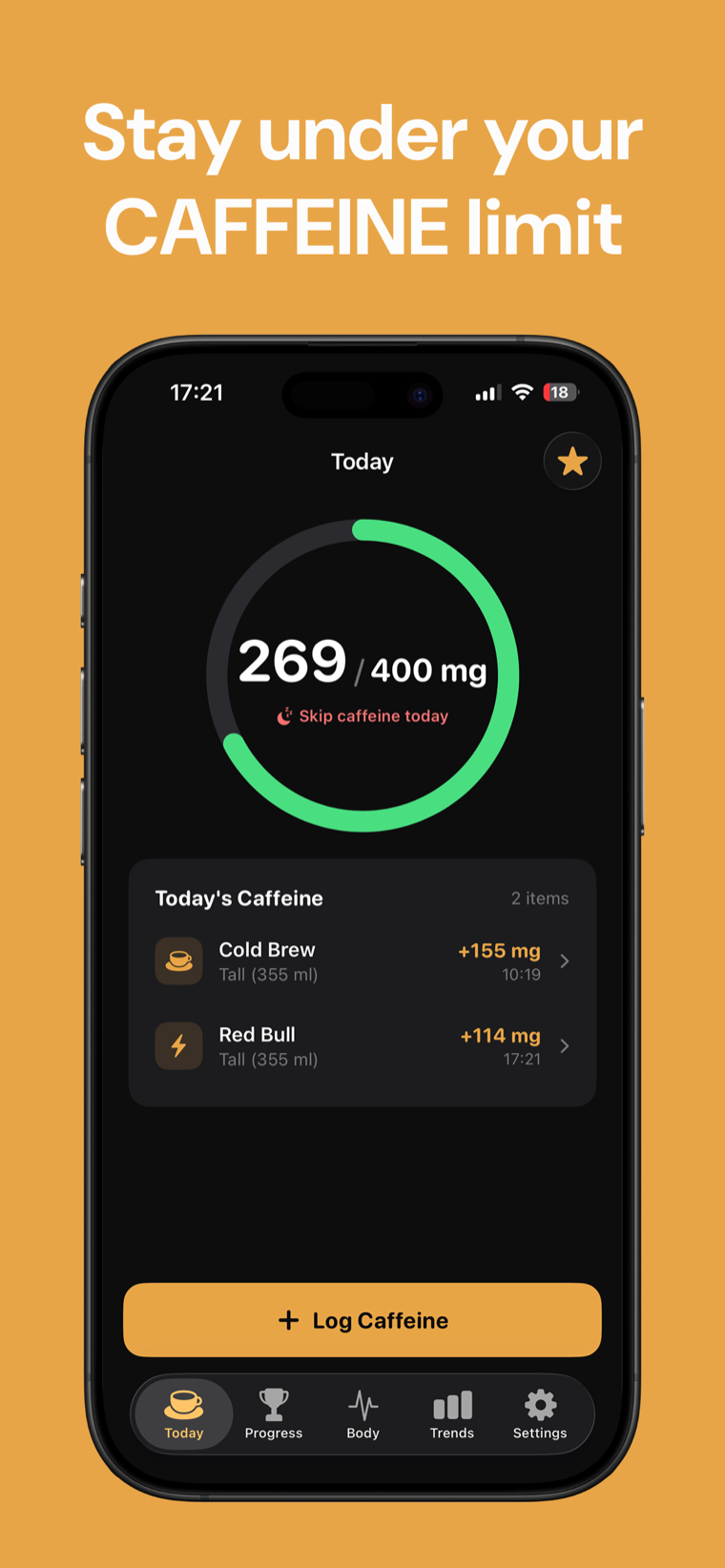
Track it in Caffeine Tracker.
Track caffeine, coffee servings and daily habits privately on your device.

How much caffeine can you have a day?
How much caffeine can you have a day depends on the published guidance for your life stage. This calculator reports fixed daily limits for healthy adults, pregnancy and adolescents ages 12–18; it does not create a personalised daily limit from body weight.
For adults, the calculator also applies EFSA’s 3 mg per kg single-dose guidance to the weight you enter. Daily limits are converted to drip coffee using 95 mg per 8 fl oz cup.
People with heart conditions, anxiety disorders or on medication should follow their clinician’s advice.
Adult single-dose guidance = body weight in kg × 3 mg This reports published guidance and must not be treated as a personal safety recommendation. AAP advises against caffeine for adolescents; where a figure is cited, it is 100 mg per day.
Daily caffeine limit FAQ
What is the daily caffeine limit for healthy adults?
The FDA cites 400 mg per day as an amount not generally associated with negative effects for healthy adults.
How much caffeine is advised during pregnancy?
ACOG advises less than 200 mg per day during pregnancy. This tool reports that published guidance; ask your clinician about your individual circumstances.
How does body weight affect the result?
Weight is used only for the adult EFSA single-dose figure of up to 3 mg per kg. The daily limits are fixed published figures and are not scaled by weight.
How many cups of drip coffee is the daily limit?
The equivalent uses 95 mg of caffeine per 8 fl oz cup of drip coffee. Actual caffeine content varies by preparation and serving.
What does the adolescent result mean?
The American Academy of Pediatrics advises against caffeine for adolescents; where a figure is cited, this tool shows 100 mg per day. It does not provide an adult single-dose figure for ages 12–18.