Best 8 Caffeine Clock Alternatives in 2026: Our In-Depth Comparison
Introduction
Caffeine Tracker is the best Caffeine Clock alternative for anyone who wants a clear, personalized cutoff time to protect their sleep. This list covers eight caffeine clock alternatives that model how long the stimulant stays in your system, with picks for different platforms, habits, and privacy needs.
Quick comparison table
A quick comparison to help you skim platforms and strengths at a glance.
| App | Best for | Platform | Key feature |
|---|---|---|---|
| Caffeine Tracker | Personalized daily cutoff | iOS | Adaptive cutoff clock that shifts with intake |
| CaffeInMe | Android with Health Connect | Android | Widgets and Wear OS companion |
| Caffeine Clock | Cross-platform baseline | iOS, Android | Absorption‑speed modeling and bedtime alerts |
| Caffeine Tracker: Daily Log | Offline privacy on Android | Android | Live curve, no account needed, Wear OS |
| HiCoffee | Apple ecosystem power users | iOS | 2,500+ brand database and Shortcuts |
| RECaf | Habit‑driven one‑tap logging | iOS | Learns frequent drinks, Siri shortcuts |
| Caffeine App | Visual timeline with water tracking | iOS | 24‑hour scrollable curve and sleep calculator |
| CoffeeWatch | Apple Watch‑first tracking | iOS | Real‑time wrist metabolism curve |
1. Caffeine Tracker
Best for: a personalized cutoff time that changes as your day unfolds.
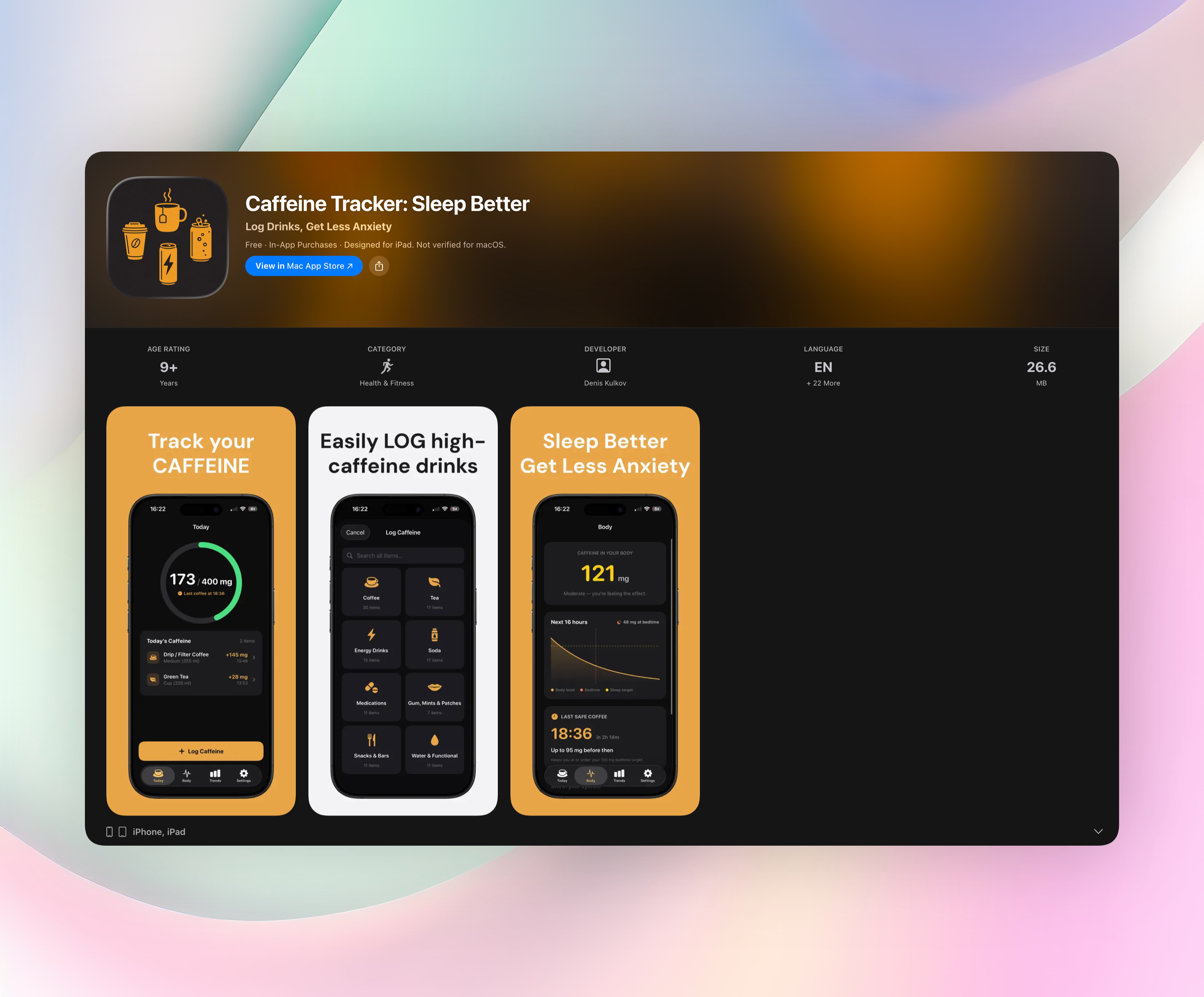
Most apps give you a static half‑life estimate, but Caffeine Tracker builds an adaptive cutoff clock that shifts based on what and when you drink. Enter your target bedtime and the app calculates the latest safe coffee down to the minute, then warns you when it’s time to switch to decaf.
You see a live body‑caffeine level and a decay curve that stretches all the way to sleep. It uses a custom half‑life setting (you control sensitivity) and a curated drink library that covers coffee, tea, energy drinks, and soda. Every log can be back‑edited and the math updates instantly, no waiting, no fumbling. The design puts sleep first and plays nicely with Apple Health: once you’ve added your sleep schedule, the app pulls your bedtime automatically and adjusts cutoff recommendations without extra work. All processing stays on‑device with no ads, no accounts, and no data collection.
- Adaptive cutoff clock that learns from real intake, not generic tables
- Live caffeine curve and “last safe coffee” time tied to your actual bedtime
- Manual half‑life tuning for slow or fast metabolizers
- Apple Health sync for effortless sleep‑schedule imports
Get Caffeine Tracker · Caffeine Tracker on the App Store
2. CaffeInMe: Caffeine Tracker
Best for: Android users tracking supplements and energy drinks alongside coffee.
CaffeInMe logs caffeine from tea, soda, pre‑workout powders, even chocolate, and syncs everything through Health Connect so your intake data can flow into other health platforms. Home screen widgets surface your caffeine curve without opening the app. The statistics panel shows trends over days or weeks. A Wear OS companion lets you log from your wrist, which cuts friction when you grab an afternoon pick‑me‑up on the go.
3. Caffeine Clock: Track Caffeine
Best for: understanding the benchmark app you’re comparing alternatives against.
Caffeine Clock models caffeine absorption speed, not just half‑life, and projects how much stimulant remains in your blood over time. Its bedtime‑alert system flags when a late cup risks overlapping your sleep window, similar to how Caffeine Tracker approaches cutoff times. Available on both iOS and Android, it’s the popular cross‑platform option many readers already know. If you want deeper personalization, the apps above and below offer clear upgrades.
4. Caffeine Tracker: Daily Log
Best for: a calm, offline Android tracker that respects your privacy.
This app keeps things simple: log a drink from the built‑in list and a live caffeine curve updates based on half‑life estimates. There are no accounts, no cloud sync, and no internet permission needed. Every data point stays on your phone. A Wear OS companion lets you check your curve or add a quick espresso from the watch. If you want straightforward caffeine math without an ecosystem hook, it’s a sturdy, quiet pick.
5. HiCoffee - Caffeine Tracker
Best for: iOS users who live in Apple Health, Shortcuts, and branded coffee menus.
HiCoffee leans hard on automation. Its database knows over 2,500 commercial coffee products, plus a homemade‑drink calculator that sizes up your pour‑over or cold brew. Automatic Apple Health sync feeds intake data into sleep and wellness trends, while Shortcuts integration lets you log with a single phrase or trigger. Rich widgets show remaining capacity for the day, making it a strong ecosystem choice if you rarely want to open the app.
6. RECaf - Effortless Caffeine Tracking
Best for: reducing logging friction through habit learning on iOS.
RECaf watches which drinks you log most often and surfaces them for one‑tap entries, so logging a daily latte takes under a second. Siri shortcuts tie into that same smarts, and intelligent reminders nudge you only when a caffeine window might matter. Apple HealthKit sync keeps a central record without extra steps. It’s built for someone who wants tracking to feel invisible after setup.
7. Caffeine App - Daily Tracker
Best for: a visual timeline that shows caffeine and water in one view.
A 24‑hour scrollable wheel maps your caffeine curve alongside your registered sleep hours, so you can see exactly when a 4 PM dose bleeds into bedtime. The optimal sleep‑time calculator flips the equation: pick a drink now and the app estimates your sleep‑friendly window. Water tracking and an Apple Watch complication round out a package that treats hydration and stimulation as two sides of the same energy‑management coin.
8. CoffeeWatch
Best for: Apple Watch‑first users who want a real‑time metabolism curve on the wrist.
CoffeeWatch places a live caffeine gauge directly on your watch face, updating the decay curve moment by moment. It helps you ride the boost‑to‑focus window during the day while flagging when blood caffeine levels could start eating into deep sleep. The companion iPhone app provides a fuller review of logs and trends, but the pitch is wearable immediacy: check your wrist, decide whether that next cup makes sense, and move on.
How we picked these apps
We logged the same drinks, a 200 mg coffee at 2 PM, on every app that ran on our test devices, then compared the half‑life curves and cutoff recommendations. Apps that let you adjust the half‑life rate (metabolism varies person to person) scored higher than those that locked a population average. We then weighed manual logging friction: one‑tap entries, shortcuts, and habit learning mattered, but only if the core math was accurate.
Platform diversity and privacy practices broke close calls. Offline‑capable apps that don’t push account creation got a nudge over servers‑mandatory alternatives, unless syncing added genuine value (Health Connect, Apple Health). Wear OS and Apple Watch companions were bonus points, never replacements for solid tracking. The goal was a list that gives you a clear, trustable answer when you search for caffeine clock alternatives, not a polished sales pitch.
Frequently asked questions
How does a caffeine metabolism app actually work?
These apps model the body’s elimination curve using a half‑life estimate, typically 4 to 6 hours, and track each drink’s decay over time so you can see how much caffeine is still active. They’re calculators, not medical instruments.
Is caffeine half‑life the same for everyone?
No. Genetics, liver function, pregnancy, and even smoking can speed up or slow down caffeine clearance. That’s why apps that let you set a custom half‑life (like Caffeine Tracker) are more useful for personal decision‑making.
Which apps work without an account or internet connection?
Caffeine Tracker, Caffeine Tracker: Daily Log, and CoffeeWatch all work fully offline with no account required. HiCoffee and RECaf sync through Apple Health but don’t force you to create a separate login. CaffeInMe uses Health Connect locally.
What’s the difference between Apple Health and Health Connect integrations?
Apple Health stores data on your iPhone and lets apps read and write with your permission. Health Connect is Android’s equivalent, centralizing health data on‑device. Caffeine Tracker integrates with Apple Health; CaffeInMe connects to Health Connect.
Can these apps replace medical advice for sleep or anxiety?
Absolutely not. They’re habit‑awareness tools, not diagnostic aids. If caffeine is routinely wrecking your sleep or triggering anxiety, talk to a healthcare professional. The apps can support the conversation but won’t replace it.
Are the premium versions worth it?
Most listed apps offer free core functionality, with premium unlocking things like detailed stats, custom half‑life ranges, or extra drink libraries. The free tiers are already strong; premium makes sense if you want deep data or specific integrations.
The verdict
Caffeine Tracker gives you the clearest, most actionable cutoff time for protecting tonight’s sleep without ads, accounts, or data collection. The main trade‑off is iOS exclusivity, so Android users should grab CaffeInMe for the closest alternative. If you want one app that tells you when to put the cup down, Caffeine Tracker on the App Store is that pick.
Free Caffeine tools
- Caffeine Half-Life & Sleep CalculatorA caffeine half life calculator for bedtime. Enter how many mg you had, when you had it and when you plan to sleep, and see how much caffeine is still in your system at bedtime, the share of the dose that is left, and when it falls to 50 mg.
- Caffeine Withdrawal Timeline PlannerMap a gradual caffeine reduction from your current daily intake to a day-by-day target, with common caffeine withdrawal windows shown alongside each date.
- Caffeine in Chocolate CalculatorChoose a chocolate type and enter a serving size to estimate the caffeine in that chocolate serving.
- Coffee Caffeine CalculatorPick your brew method and cup size to see how much caffeine is in a cup of coffee — the total mg, the mg in a standard 8 fl oz serving, and how much of the FDA's 400 mg daily guidance that uses. Typical values, not a measurement of your specific cup.
- Coffee to Water Ratio CalculatorFind how much grounds per cup of coffee you need, with grams, approximate tablespoons, water and a 1:n ratio for your brew method.
- Daily Caffeine Limit CalculatorSee how much caffeine you can have a day according to published guidance for your life stage, with an adult weight-based single-dose figure and drip coffee equivalent.
- Energy Drink Caffeine CalculatorChoose a brand and product, then enter the number of cans or shots to estimate total caffeine, caffeine density and the share of the FDA 400 mg daily figure.
- Espresso Caffeine CalculatorWork out how much caffeine is in an espresso shot: choose how many shots you pulled, how you pulled them and which beans went in. You get the total in mg, the mg per shot and how much of the FDA's 400 mg a day it uses.
- Half-Life Formula CalculatorEnter a starting amount, half-life and elapsed time or target amount. See the remainder, decay table, curve and worked formula for any substance.
- Matcha & Tea Caffeine CalculatorEstimate how much caffeine is in matcha green tea and other teas from powder weight or brewed serving size. See the result in mg and as a share of the FDA 400 mg daily figure.
- Soda Caffeine CalculatorEstimate total caffeine intake from soda servings using typical caffeine values for common soft drinks.
- Yerba Mate Caffeine CalculatorEstimate yerba mate caffeine from the amount of dry leaf, water volume and number of servings. Results are typical estimates, not exact measurements.