Best 7 Caffi Alternatives in 2026: Smart Caffeine Tracking Apps
If you’re looking for caffi alternatives that help you understand how caffeine affects your sleep, Caffeine Tracker: Sleep Better is our top pick. It calculates a personalized cutoff time so you don’t lie awake at 2 a.m. wondering. This article covers seven other solid options for iOS and Android, each with different strengths.
Quick comparison table
| App | Platform | Standout Feature | Price |
|---|---|---|---|
| Caffeine Tracker: Sleep Better | iOS | Personalized caffeine cutoff time | Free |
| HiCoffee | iOS | 2,500+ branded coffee database + Apple Health sync | Freemium |
| CaffeInMe | Android | Health Connect integration, multi-source tracking | Freemium |
| Caffeine Clock | Android | Offline half-life modeling, 200+ drink database | Free |
| RECaf | iOS | Siri shortcut logging, local HealthKit storage | Free |
| CafTrack | iOS | AI strategist + barcode/AI vision logging | Freemium |
| Caffeine Tracker: Daily Log | Android | Live caffeine curve, on-device only | Free |
1. Caffeine Tracker: Sleep Better
Best for: getting a personalized caffeine cutoff time that actually protects your sleep.
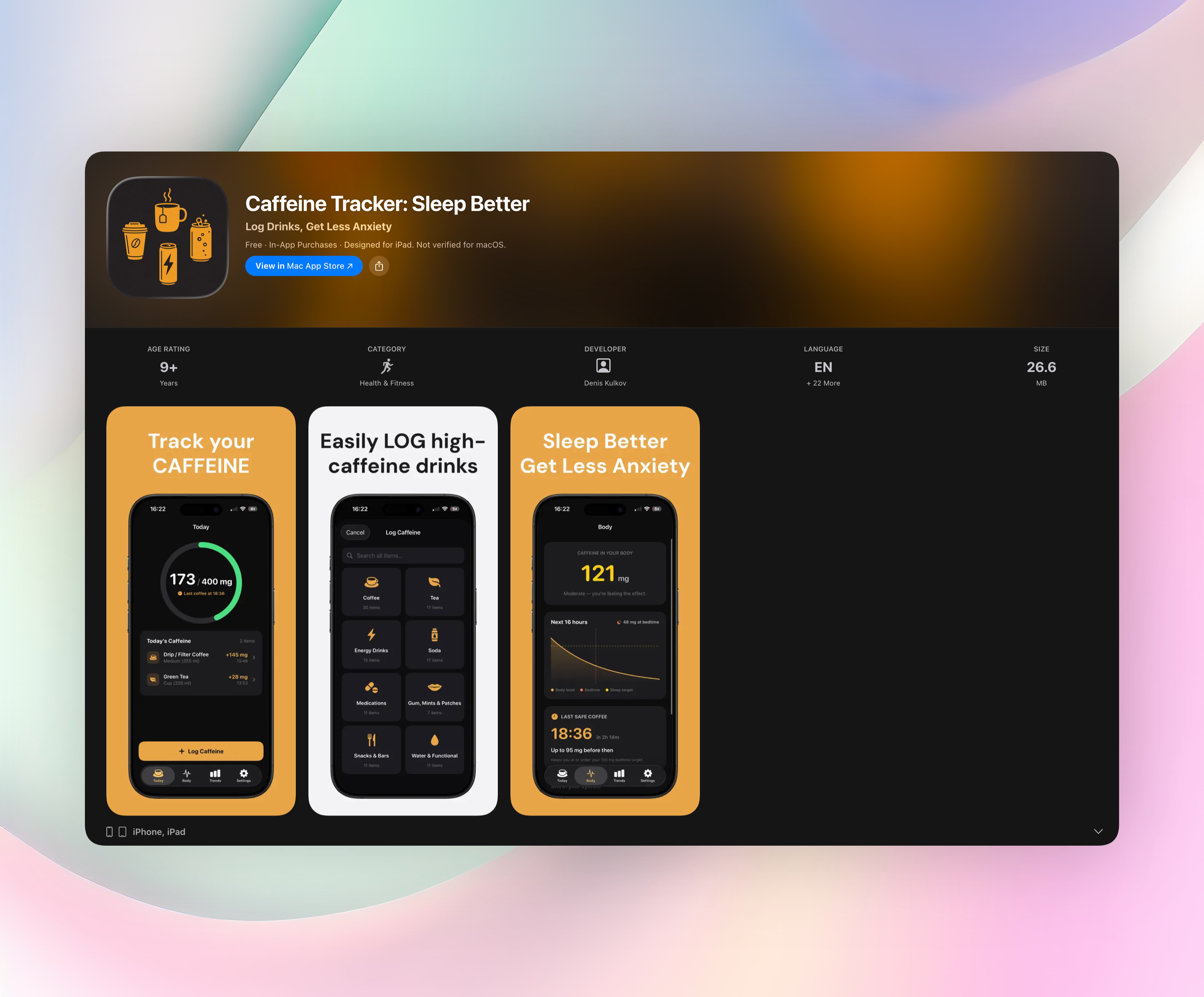
Caffeine Tracker focuses on one thing: telling you when to stop drinking caffeine so you can sleep. It shows a live caffeine level in your body and a decay curve that projects how much will remain by bedtime.
The standout feature is a personalized cutoff time. It’s not a generic “stop by 2 p.m.” rule. The app learns from your typical intake schedule and adjusts based on your own metabolism. You set a sleep target, log drinks from a curated library (coffee, tea, energy drinks, soda, and more), and the body-caffeine estimate updates instantly when you edit a log’s time. The interface stays minimal. Just log a drink and glance at the curve.
It’s iOS only, which leaves Android users out, but on iPhone it’s the simplest way we’ve found to manage the coffee-sleep tradeoff. Everything runs on your device: no accounts, no ads, no data collection.
Key things we liked:
- Live body caffeine and a decay curve that runs up to your bedtime
- Personalized “last safe coffee” cutoff tied to your sleep target
- Daily limit anchored to FDA guidelines, your age, and caffeine sensitivity
- Quick logging with a curated drink library
- Edit any log’s timestamp and watch the math update immediately
Caffeine Tracker on the App Store · Get Caffeine Tracker
2. HiCoffee – Caffeine Tracker
Best for: Apple Health users who want branded coffee logging.
HiCoffee is built for people who drink branded coffee and want everything tied into Apple Health. Its database covers more than 2,500 products from Starbucks, Dunkin’, and dozens of other roasters, so logging takes seconds and the caffeine count is accurate. Consumption data syncs directly to Apple Health, and home-screen widgets let you glance at your body’s caffeine load throughout the day. You can set daily limits and see how close you are to hitting them. The app is iOS only; logging basics are free, but unlimited history and deeper insights require a premium upgrade. If you’ve ever stood at a counter trying to mentally calculate milligrams, HiCoffee does the work for you.
3. CaffeInMe: Caffeine Tracker
Best for: Android users tracking caffeine from multiple sources (pre-workout, tea, coffee).
CaffeInMe is the go-to for Android users who draw caffeine from coffee, tea, pre-workout, and other supplements. It integrates with Health Connect, so your consumption logs feed into your broader health picture. The stats page shows a timeline of active caffeine in your system, and widgets give you a quick read on how much is still hanging around. Unlike some trackers that focus narrowly on coffee, this one includes a broad drink database, which is handy if you’re using energy gels, canned matcha, or workout mixes. CaffeInMe is Android only, with a free tier that covers the basics and a premium upgrade for deeper analytics.
4. Caffeine Clock: Track Caffeine
Best for: offline caffeine modeling and half-life estimation.
Caffeine Clock ditches the cloud and relies on a local half-life model to suggest your last-cup time. It calculates absorption speed and the standard 3–5 hour half-life, then maps out how long caffeine will linger. A built-in database of 200+ drinks gives you a quick start, no internet connection required. If you’re privacy-minded or often in places with spotty coverage, this one keeps all your data on the phone. The interface is barebones but functional. You enter your drinks and the app shows the time you’ll be caffeine-free. It’s Android only and completely free. Perfect for anyone who wants a no-nonsense caffeine countdown without any permissions hassle.
5. RECaf
Best for: iOS users who want effortless logging with Siri shortcuts.
RECaf leans into Apple’s ecosystem with Siri shortcut logging: just say “log a coffee” and you’re done. Widgets give you a one-tap option, and intelligent reminders nudge you if you forget your usual afternoon cup. Charts show patterns in your caffeine intake over time, so you can spot habits you didn’t realize you had. Data stays in HealthKit, no account needed, and nothing leaves your iPhone. The app also shows a rough peak estimate so you can align doses with focus windows. It’s free, ad-free, and iOS only, a good match for fans of automation and privacy. If you rely on shortcuts, RECaf feels like a native iPhone utility.
6. CafTrack: Optimize Caffeine
Best for: AI-driven caffeine management and barcode scanning.
CafTrack uses your camera to capture drinks: barcode scanning and AI vision pull caffeine data from packages, cans, and even coffee shop menus. An AI strategist blends that data with your sleep schedule and daily targets to recommend when you should take a dose and when to cut yourself off. It’s like having a caffeine coach that updates as your habits shift. The app is iOS only; the basic manual logger is free, but unlimited AI scans and the full strategist require a subscription. If you want a hands-off, tech-driven way to manage your buzz, CafTrack earns its spot.
7. Caffeine Tracker: Daily Log
Best for: Android users seeking a local-only, no-account tracking curve.
Caffeine Tracker: Daily Log shows a live caffeine curve and estimates your clear time so you can plan a safe bedtime cutoff. Everything is on-device: no accounts, no cloud, no fuss. The interface is minimal: add a drink from a small but adequate library, and the curve updates. It’s Android only, completely free, and doesn’t ask for irrelevant permissions. The app won’t dazzle you with AI or Health Connect integrations, but it’s a reliable, no-nonsense way to answer “Can I still have that late afternoon coffee?” If pure simplicity is the goal, this one is hard to beat.
How we picked these apps
We installed a handful of caffeine trackers and used them for days, logging real coffee intake. We focused on apps that showed meaningful metabolism insights, not just a running total of cups. Accuracy of the caffeine decay curve mattered, as did how quickly we could log a drink. We favored apps that respected privacy, and we skipped any that locked the clearance timeline behind a subscription or buried it in ads. Platform availability, widget support, and health-platform integration (Apple Health, Health Connect) were tiebreakers. Most importantly, we wanted apps that gave you a clear nudge. The app should help you decide when to put the cup down, not merely count what you consumed. Cluttered interfaces that made logging a chore got dropped.
Frequently asked questions
How long does caffeine stay in your system?
Caffeine’s half-life ranges from 3 to 5 hours in most adults, meaning half of your 4 p.m. latte can still be circulating at 9 p.m. Individual differences like age, genetics, and liver health can slow clearance even more. Even if you don’t feel wired, a late dose can eat into deep sleep.
What’s a safe cutoff time for sleep?
There’s no one-size-fits-all rule, but many experts suggest cutting caffeine 8–10 hours before bed. A tracker that watches your intake can pinpoint a cutoff that accounts for your typical dose and how quickly your body processes it, which is way more precise than a generic “stop at noon” mantra.
Why use a tracker instead of just counting cups?
Counting cups tells you what you consumed, not what’s still affecting your brain and body. A tracker models the exponential decay, so you see exactly when caffeine drops to a level that won’t interfere with sleep, and you can plan your last cup accordingly. That’s why you can have a late coffee some days and not others, and adjust your cutoff in real time.
The verdict
For most people, Caffeine Tracker: Sleep Better is the best caffi alternative. It delivers a personalized cutoff time that directly protects your sleep. Apple Health users will appreciate HiCoffee, offline types should grab Caffeine Clock, and AI tinkerers may prefer CafTrack. But for a simple, private answer to the coffee-sleep puzzle, Get Caffeine Tracker. No fluff, no accounts, just a cutoff. It’s the one we keep on our home screen because it tells you exactly when to put the cup down.
Free Caffeine tools
- Caffeine Half-Life & Sleep CalculatorA caffeine half life calculator for bedtime. Enter how many mg you had, when you had it and when you plan to sleep, and see how much caffeine is still in your system at bedtime, the share of the dose that is left, and when it falls to 50 mg.
- Caffeine Withdrawal Timeline PlannerMap a gradual caffeine reduction from your current daily intake to a day-by-day target, with common caffeine withdrawal windows shown alongside each date.
- Caffeine in Chocolate CalculatorChoose a chocolate type and enter a serving size to estimate the caffeine in that chocolate serving.
- Coffee Caffeine CalculatorPick your brew method and cup size to see how much caffeine is in a cup of coffee — the total mg, the mg in a standard 8 fl oz serving, and how much of the FDA's 400 mg daily guidance that uses. Typical values, not a measurement of your specific cup.
- Coffee to Water Ratio CalculatorFind how much grounds per cup of coffee you need, with grams, approximate tablespoons, water and a 1:n ratio for your brew method.
- Daily Caffeine Limit CalculatorSee how much caffeine you can have a day according to published guidance for your life stage, with an adult weight-based single-dose figure and drip coffee equivalent.
- Energy Drink Caffeine CalculatorChoose a brand and product, then enter the number of cans or shots to estimate total caffeine, caffeine density and the share of the FDA 400 mg daily figure.
- Espresso Caffeine CalculatorWork out how much caffeine is in an espresso shot: choose how many shots you pulled, how you pulled them and which beans went in. You get the total in mg, the mg per shot and how much of the FDA's 400 mg a day it uses.
- Half-Life Formula CalculatorEnter a starting amount, half-life and elapsed time or target amount. See the remainder, decay table, curve and worked formula for any substance.
- Matcha & Tea Caffeine CalculatorEstimate how much caffeine is in matcha green tea and other teas from powder weight or brewed serving size. See the result in mg and as a share of the FDA 400 mg daily figure.
- Soda Caffeine CalculatorEstimate total caffeine intake from soda servings using typical caffeine values for common soft drinks.
- Yerba Mate Caffeine CalculatorEstimate yerba mate caffeine from the amount of dry leaf, water volume and number of servings. Results are typical estimates, not exact measurements.