Best 8 Coffi Alternatives in 2026: Smarter Caffeine Tracking Apps
Introduction
Caffeine Tracker is the best app for coffi alternatives shoppers who want to see exactly when caffeine leaves their system and get a personalized cutoff time. You don’t need to guess which late-afternoon latte will wreck your sleep. I tested eight caffeine‑tracking apps on iOS and Android. Here’s what I found that actually helps.
Quick comparison table
This snapshot matches each app to its strongest use case, platform, and one standout feature. Prices are honest at time of writing.
| App | Best for | Platform | Standout feature | Price |
|---|---|---|---|---|
| Caffeine Tracker | Personalized cutoff times | iOS | Real‑time decay graph | Freemium |
| CaffeInMe | Data‑heavy tracking with widgets | Android | Habit‑focused statistics and widgets | Free |
| Caffeine Clock | Absorption‑curve estimates | Android | Algorithm for active caffeine levels | Free |
| HiCoffee | Apple Health integration | iOS | 2,500+ branded products and level graph | Freemium |
| BeanBop | Gamified coffee logging | iOS | Engagement through missions and streaks | Free |
| Cafeor | Quick, aesthetic logging | iOS | Shareable coffee cards and stickers | Free |
| LessCoffee | Staying within healthy limits | Android | One‑tap logging for better sleep | Free |
| Coffee Tracker | Clean visual analytics | Android | Daily/weekly/monthly trend charts | Free |
1. Caffeine Tracker
Best for: A personalized caffeine cutoff time that actually protects your sleep.
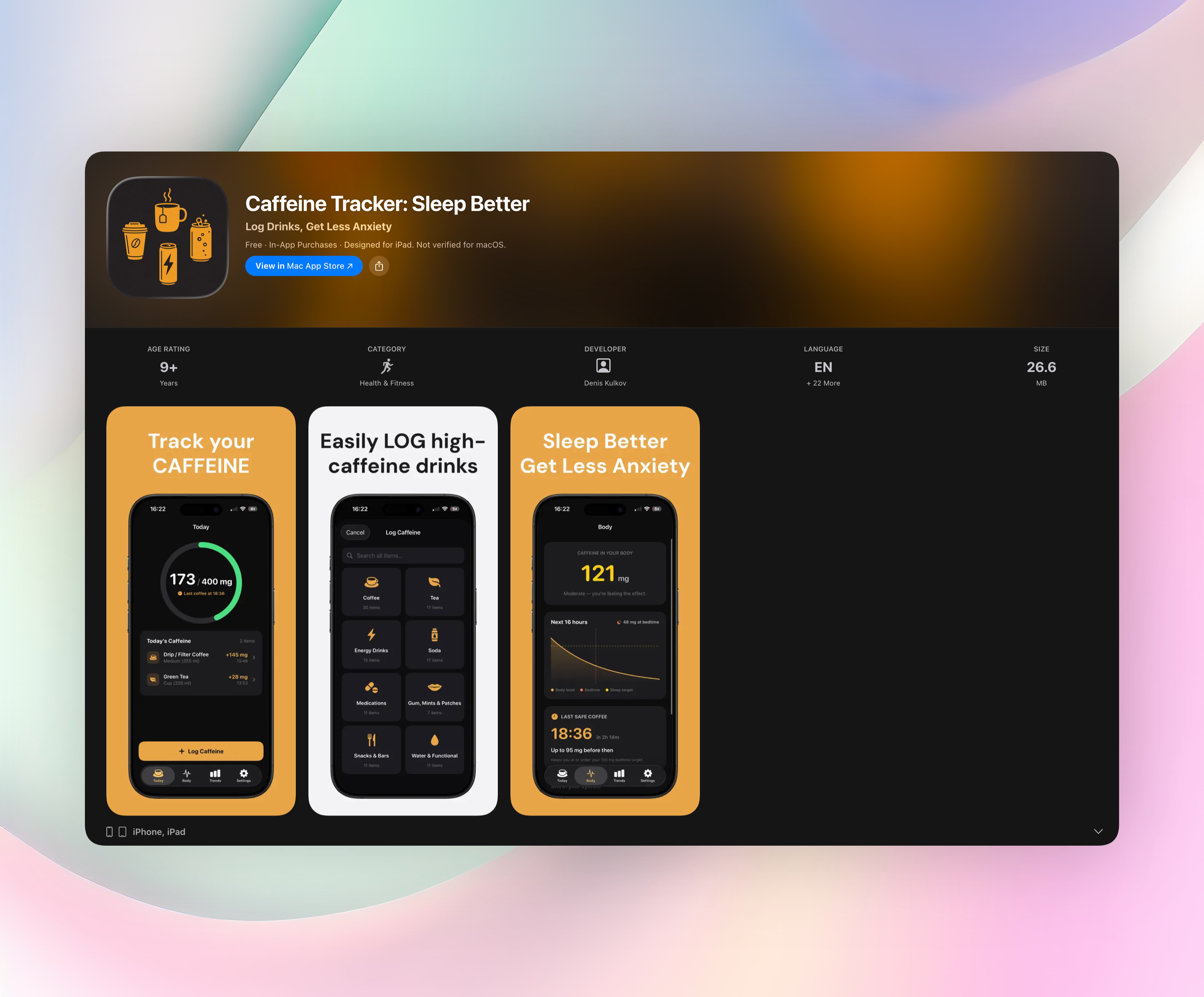
Caffeine Tracker fixes the one thing most coffee drinkers ignore: timing. Instead of just tallying milligrams, it shows a live decay curve of how much caffeine is still active in your body and predicts when it’ll drop low enough for deep sleep. You tell it your typical bedtime and sensitivity level, and the app calculates the latest safe hour to put the cup down.
- See a real‑time decay graph that follows caffeine’s 5‑hour half‑life right up to your sleep target.
- Get a daily “last safe coffee” cutoff that adapts to your sleep schedule, not generic advice.
- Log drinks from a curated library of coffee, tea, energy drinks, and soda. Edit any log’s time and the body math updates instantly.
- Everything runs on your device. No accounts, no ads, no data collection.
No other app ties caffeine metabolism to your actual bedtime this directly. If you’ve been trying various coffi alternatives and still waking up wired, this is the one to download.
Get Caffeine Tracker · Caffeine Tracker on the App Store
2. CaffeInMe
Best for: Android users who want widgets and data‑heavy habit stats.
CaffeInMe monitors coffee, tea, and energy drink consumption and turns everything into clean trend summaries. Home‑screen widgets let you eyeball current caffeine levels without opening the app. It leans hard on numbers, so if you love dissecting daily averages and weekly patterns, it’s a solid Android‑only pick.
3. Caffeine Clock
Best for: Estimating active levels using absorption curves.
Caffeine Clock pulls from a database of 200+ drinks, but its real trick is an algorithm that accounts for how fast caffeine hits your bloodstream, not just how much you drank. Logging is quick, and you get an estimate of active caffeine that updates as absorption and elimination play out. Android exclusive.
4. HiCoffee
Best for: Apple Health sync and a massive branded drink database.
HiCoffee gives you a chart of current caffeine level and its predicted decline throughout the day. Over 2,500 coffee products are built in, so you can log an exact Starbucks order instead of a generic “latte.” It’s the only app here that writes directly to Apple Health, which makes it a natural fit if you live in that ecosystem.
5. BeanBop
Best for: Turning tracking into a playful coffee ritual.
BeanBop gamifies caffeine logging with missions, streaks, and light‑hearted rewards. It won’t replace a medical monitor, but it makes daily logging far stickier than a plain list. Coffee lovers who want a fun nudge to notice patterns will find it refreshing, and it stays focused on engagement without clutter.
6. Cafeor
Best for: Minimalists who log with a couple of taps and share pretty cards.
Cafeor strips things back to the essentials. Tap a drink, log it, see a clean total. Aesthetic stickers and shareable coffee cards add personality, but there’s no deep analytics. It’s ideal when you want quick intake tracking that feels light, not like homework.
7. LessCoffee
Best for: Staying under your daily caffeine limit to protect sleep quality.
LessCoffee takes a one‑tap approach for coffee, tea, and energy drinks and then gently nudges you toward a calmer evening. It doesn’t over‑complicate the data. The focus is on seeing when you’re creeping past healthy thresholds so you can pull back before bedtime.
8. Coffee Tracker
Best for: Visual trend charts that show daily, weekly, and monthly patterns.
Coffee Tracker transforms your logs into clean, color‑coded chart views. It’s built for people who want to scan their habits at a glance, how many cups this week, how timing shifted, where the weekend spike happened. Simple visuals make it easy to spot patterns and slowly build a more disciplined routine.
How we picked these apps
Every app on this list tracks caffeine specifically, not as a side feature inside a generic health app. We looked at the mix: iOS‑only picks with deep sleep integration, Android‑only tools with widget‑level glanceability, and radically different philosophies like decay curves, gamification, and minimalist logging. Ease of logging mattered first; if an app took more than a few seconds to record a drink, it was out. We prioritized visualizations that connect intake to sleep outcomes and skipped generic habit trackers and calorie counters that don’t understand caffeine’s half‑life.
Frequently asked questions
Why does tracking caffeine matter for sleep?
Caffeine has a 5‑6 hour half‑life, so a mid‑afternoon coffee can still leave half the dose in your system at 10 p.m. Tracking stops you from unknowingly flooding your bloodstream with stimulants right when your body needs to wind down for deep sleep.
Are these apps free?
Most offer free core logging. Caffeine Tracker’s free version shows the decay graph and cutoff time; optional premium unlocks extra customization. HiCoffee uses a freemium model, while the other picks are free or ad‑supported.
Can they sync with Apple Health or Google Fit?
Only HiCoffee writes to Apple Health directly. Caffeine Tracker and the rest work standalone, which means they don’t mix your caffeine data with other health metrics unless you do it manually.
The verdict
Caffeine Tracker is the standout among coffi alternatives because it connects your coffee habit directly to your sleep, not just a daily milligram tally. The real‑time decay curve and personalized cutoff time are genuinely helpful. They turn “maybe I should stop” into a specific, data‑backed hour. If you’re on iOS, grab it here: Get Caffeine Tracker. Android users will find capable alternatives in CaffeInMe, Caffeine Clock, or LessCoffee, but they won’t get that same sleep‑first precision.
Free Caffeine tools
- Caffeine Half-Life & Sleep CalculatorA caffeine half life calculator for bedtime. Enter how many mg you had, when you had it and when you plan to sleep, and see how much caffeine is still in your system at bedtime, the share of the dose that is left, and when it falls to 50 mg.
- Caffeine Withdrawal Timeline PlannerMap a gradual caffeine reduction from your current daily intake to a day-by-day target, with common caffeine withdrawal windows shown alongside each date.
- Caffeine in Chocolate CalculatorChoose a chocolate type and enter a serving size to estimate the caffeine in that chocolate serving.
- Coffee Caffeine CalculatorPick your brew method and cup size to see how much caffeine is in a cup of coffee — the total mg, the mg in a standard 8 fl oz serving, and how much of the FDA's 400 mg daily guidance that uses. Typical values, not a measurement of your specific cup.
- Coffee to Water Ratio CalculatorFind how much grounds per cup of coffee you need, with grams, approximate tablespoons, water and a 1:n ratio for your brew method.
- Daily Caffeine Limit CalculatorSee how much caffeine you can have a day according to published guidance for your life stage, with an adult weight-based single-dose figure and drip coffee equivalent.
- Energy Drink Caffeine CalculatorChoose a brand and product, then enter the number of cans or shots to estimate total caffeine, caffeine density and the share of the FDA 400 mg daily figure.
- Espresso Caffeine CalculatorWork out how much caffeine is in an espresso shot: choose how many shots you pulled, how you pulled them and which beans went in. You get the total in mg, the mg per shot and how much of the FDA's 400 mg a day it uses.
- Half-Life Formula CalculatorEnter a starting amount, half-life and elapsed time or target amount. See the remainder, decay table, curve and worked formula for any substance.
- Matcha & Tea Caffeine CalculatorEstimate how much caffeine is in matcha green tea and other teas from powder weight or brewed serving size. See the result in mg and as a share of the FDA 400 mg daily figure.
- Soda Caffeine CalculatorEstimate total caffeine intake from soda servings using typical caffeine values for common soft drinks.
- Yerba Mate Caffeine CalculatorEstimate yerba mate caffeine from the amount of dry leaf, water volume and number of servings. Results are typical estimates, not exact measurements.