Best 9 Caffeine Sleep Planners in 2026: Apps to Protect Your Rest
If you’re hunting for caffeine sleep planner alternatives that actually show when your body clears caffeine, Caffeine Tracker: Sleep Better is the one we’d pick first. We tested a bunch of apps that help you time your last cup so you can sleep soundly. This roundup covers iOS, Android, and Apple Watch tools.
Quick comparison table
| App | Best for | Platform | Price |
|---|---|---|---|
| Caffeine Tracker: Sleep Better | Personalized cutoff time | iOS | Free |
| CaffeInMe: Caffeine Tracker | Half-life daily load | Android | Free |
| Caffeine Clock | Offline drink database | Android | Free |
| Caffeine Tracker: Daily Log | Private, calm logging | Android | Free |
| HiCoffee - Caffeine Tracker | Apple Health + branded coffee | iOS | Freemium |
| CoffeeWatch | Real-time wrist curve | iOS | Paid |
| CafTrack: Optimize Caffeine | AI-powered advice | iOS | Freemium |
| Timeshifter | Jet lag caffeine timing | iOS, Android | Paid |
| Cafeor | Cute daily log | iOS, Android | Free |
1. Caffeine Tracker: Sleep Better
Best for: Anyone who wants a clear, science-backed caffeine cutoff time so they stop second-guessing.
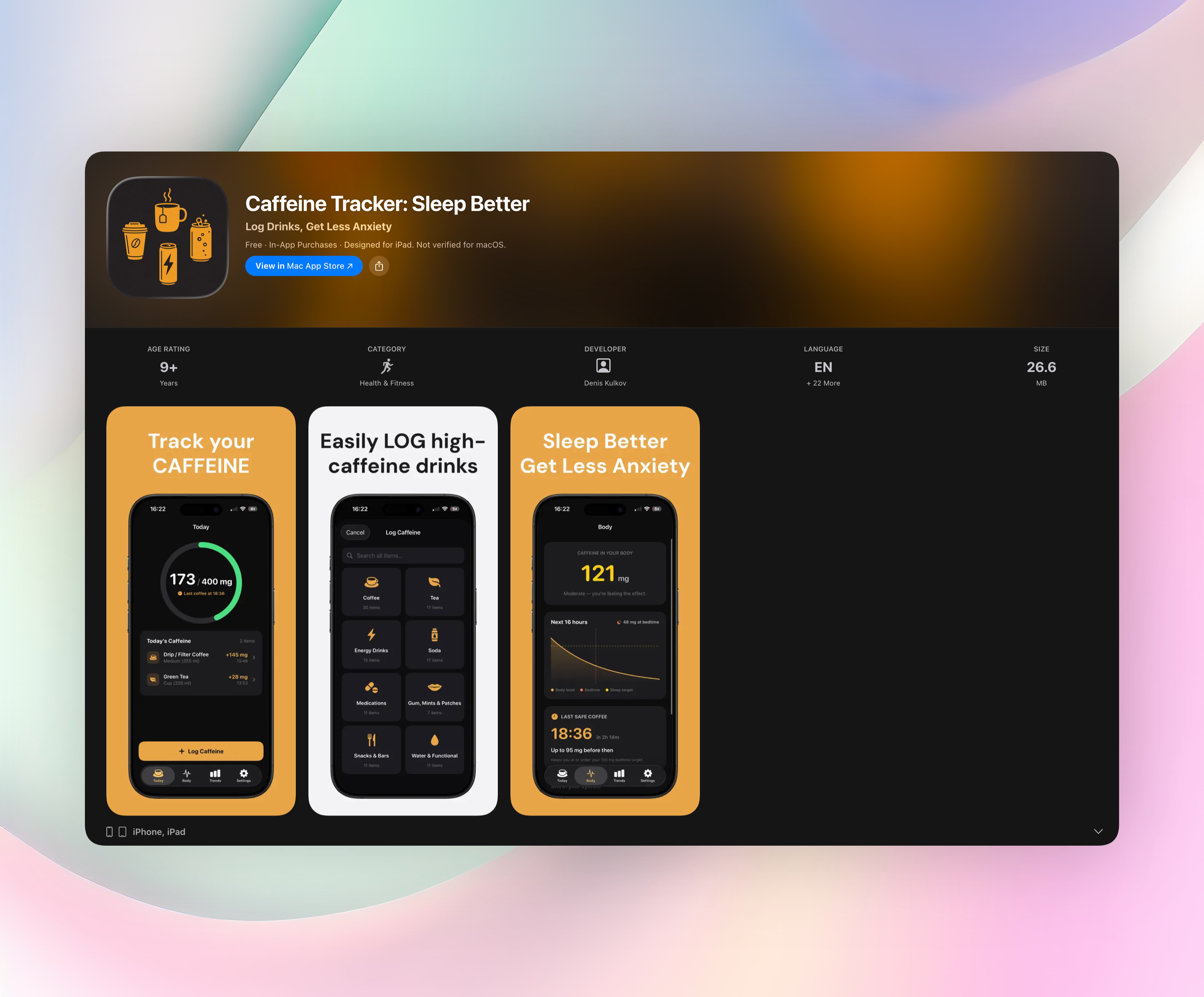
Caffeine Tracker paints a visual timeline of your caffeine levels against your bedtime, giving you a personalized “last safe coffee” hour. You no longer have to do mental half-life math. See exactly how a 3 PM latte impacts your 10 PM wind-down and enjoy your coffee without wrecking your sleep.
- See live caffeine level and a decay curve to bedtime
- Personalized “last safe coffee” cutoff tuned to your sleep target
- Set daily limit based on FDA guidelines, age, and sensitivity
- Log from a library of coffee, tea, energy drinks, and soda
- Edit any log’s time and the curve updates instantly
- On-device privacy: no accounts, no data collection
It’s iOS-only and our top pick. The interface is clean, you never sign up, and it’s designed to answer one thing: “Can I have this and still sleep?”
Get Caffeine Tracker or grab it straight from Caffeine Tracker on the App Store.
2. CaffeInMe: Caffeine Tracker
Best for: Android users who want half-life-based daily load estimates.
Log caffeine from coffee, tea, and energy drinks. The app calculates your half-life to show current body levels and total daily intake. You get a running figure of how much is still in your system, which makes it easier to decide whether to slow down. No account hurdles, and it’s free. Practical daily caffeine budgeting without the friction.
3. Caffeine Clock
Best for: Offline tracking with a large drink database.
The built-in database holds over 200 drinks and works without an internet connection. Its algorithm factors in absorption rates and sipping duration, so you get a realistic sense of how caffeine hits your body. The Android-only flow is quick: open the app, log, move on. No logins, no extra steps.
4. Caffeine Tracker: Daily Log
Best for: A calm, private tracking experience on Android.
Everything stays on your device with this understated tracker. It estimates a bedtime cutoff based on caffeine half-life, so you know when to put the cup down. No accounts, no cloud sync, no distractions. The interface is straightforward. Tap, log, and get a gentle nudge toward smarter timing.
5. HiCoffee - Caffeine Tracker
Best for: Apple Health users who want branded coffee data.
HiCoffee taps a catalog of over 2,500 branded coffee products and syncs with Apple Health. You set caffeine limits based on your personal sensitivity and watch how close you are to crossing the line that could nibble at your sleep. It’s iOS-only and a solid pick if your coffee choices come from a label, not just a generic “black coffee.”
6. CoffeeWatch
Best for: Apple Watch owners who want a real-time metabolism curve.
CoffeeWatch puts a live caffeine curve on your wrist, showing how your level rises and falls through the day. You’ll see exactly when you peak and when you’re dropping, so you can time coffee for focus and stop early to protect sleep. The watch-first design pairs with an iPhone companion, and it encourages moderation without nagging.
7. CafTrack: Optimize Caffeine
Best for: Data-driven users who want AI-powered advice.
CafTrack’s AI strategist factors in your sleep and daily targets to give you personalized guidance. Log drinks by scanning barcodes or snapping a photo. The AI vision recognizes your cup. It’s iOS-only and feels like having a caffeine coach. If numbers and optimization motivate you, this app scratches that itch.
8. Timeshifter
Best for: Travelers managing jet lag with circadian-timed caffeine.
Timeshifter builds personal plans based on your flights and tells you exactly when to consume or avoid caffeine. The advice draws on sleep and circadian neuroscience, so you’re not guessing about shifting your body clock. Available on iOS and Android, it’s more of a jet lag tool than a daily logger, but its caffeine timing logic is rock solid.
9. Cafeor
Best for: Anyone who wants a cute, low-pressure daily caffeine log.
Cafeor keeps things light with a friendly interface for logging coffee and tea. It nudges you toward a healthy balance without strict sleep schedules or alarms. Works on both iOS and Android. If you want a simple check-in that doesn’t feel like a health intervention, this is your app.
How we picked these apps
We focused on apps that use clear caffeine half-life models and give you a realistic cutoff time for your last cup. Just logging milligrams isn’t enough. You need to know when to stop. We tested on iOS and Android to cover the widest audience and gave extra credit to tools that store data locally or ask for minimal permissions. Apps that only tally caffeine without tying intake to a bedtime were left out. We also made room for a jet lag planner because it applies caffeine timing in a sleep-relevant way, even if it isn’t a daily tracker. The result is a tight set of caffeine sleep planner alternatives that actually help you stop guessing.
Frequently asked questions
How do caffeine sleep planner apps work?
They take what you drink, apply caffeine’s typical half-life (about 5 hours), and combine that with your sleep target to estimate what’s left in your system at bedtime. Some go further and give you a personalized cutoff time so you know exactly when to stop.
Which caffeine sleep planner is best for iOS?
Caffeine Tracker: Sleep Better is the best iOS pick. It delivers a simple, science-backed cutoff time and a visual decay curve, with no sign-up nonsense.
Can these apps really help me sleep better?
Yes, if you act on the timing advice. Knowing that a 4 PM coffee still has half its kick at 9 PM lets you shift your habit. That consistency improves sleep quality.
What are good Android alternatives?
CaffeInMe and Caffeine Clock are strong choices. Both give you half-life estimates and daily load tracking without accounts, and they run smoothly on Android.
Are these apps free?
Most offer core tracking for free. Some, like HiCoffee and CafTrack, have premium features behind a paywall. CoffeeWatch and Timeshifter are paid outright. You can start tracking without spending a dime on several options.
The verdict
Caffeine Tracker: Sleep Better wins for anyone who wants a direct answer to “can I have coffee now and still sleep tonight?” Its personalized cutoff time removes the guesswork in a way none of the other apps quite match. If you’re on iOS, start here.
Free Caffeine tools
- Caffeine Half-Life & Sleep CalculatorA caffeine half life calculator for bedtime. Enter how many mg you had, when you had it and when you plan to sleep, and see how much caffeine is still in your system at bedtime, the share of the dose that is left, and when it falls to 50 mg.
- Caffeine Withdrawal Timeline PlannerMap a gradual caffeine reduction from your current daily intake to a day-by-day target, with common caffeine withdrawal windows shown alongside each date.
- Caffeine in Chocolate CalculatorChoose a chocolate type and enter a serving size to estimate the caffeine in that chocolate serving.
- Coffee Caffeine CalculatorPick your brew method and cup size to see how much caffeine is in a cup of coffee — the total mg, the mg in a standard 8 fl oz serving, and how much of the FDA's 400 mg daily guidance that uses. Typical values, not a measurement of your specific cup.
- Coffee to Water Ratio CalculatorFind how much grounds per cup of coffee you need, with grams, approximate tablespoons, water and a 1:n ratio for your brew method.
- Daily Caffeine Limit CalculatorSee how much caffeine you can have a day according to published guidance for your life stage, with an adult weight-based single-dose figure and drip coffee equivalent.
- Energy Drink Caffeine CalculatorChoose a brand and product, then enter the number of cans or shots to estimate total caffeine, caffeine density and the share of the FDA 400 mg daily figure.
- Espresso Caffeine CalculatorWork out how much caffeine is in an espresso shot: choose how many shots you pulled, how you pulled them and which beans went in. You get the total in mg, the mg per shot and how much of the FDA's 400 mg a day it uses.
- Half-Life Formula CalculatorEnter a starting amount, half-life and elapsed time or target amount. See the remainder, decay table, curve and worked formula for any substance.
- Matcha & Tea Caffeine CalculatorEstimate how much caffeine is in matcha green tea and other teas from powder weight or brewed serving size. See the result in mg and as a share of the FDA 400 mg daily figure.
- Soda Caffeine CalculatorEstimate total caffeine intake from soda servings using typical caffeine values for common soft drinks.
- Yerba Mate Caffeine CalculatorEstimate yerba mate caffeine from the amount of dry leaf, water volume and number of servings. Results are typical estimates, not exact measurements.