How much caffeine in a cup of coffee, by brew method
How much caffeine in a cup of coffee depends on the brew method. An 8 oz cup of drip runs about 95 mg, instant lands near 60 mg, and a 16 oz cold brew comes in closer to 200 mg.
How much caffeine in a cup of coffee, brew by brew
The 95 mg reference assumes 8 fluid ounces of filter coffee made with roughly 13 grams of arabica. Almost nobody drinks exactly that.
Drip and filter coffee: 70–140 mg per 8 oz
Drip extracts caffeine efficiently — hot water, a medium grind, four to six minutes of contact. The spread comes almost entirely from dose. At the Specialty Coffee Association's "golden ratio" of about 55 grams of coffee per liter of water, an 8 oz cup lands near that 95 mg reference. Cafés routinely brew stronger, and a heavier dose pushes the same volume past 120 mg.
One quirk at home: the "cups" marked on a coffee maker's carafe are 5 oz, not 8. A 12-cup pot holds about 60 oz, so eight of those marks is roughly five real cups.
How much caffeine in cold brew: around 200 mg per 16 oz
Cold brew is the outlier. Cold water pulls caffeine out slowly, so the method compensates with a heavy dose of grounds and a 12- to 24-hour steep. Even after the concentrate is diluted, a 16 oz ready-to-drink cold brew typically lands between 150 and 250 mg, with 200 mg a fair midpoint.
Nitro cold brew usually runs higher — often near 280 mg for the same 16 oz — largely because it's poured without ice, so the cup holds 16 oz of coffee rather than coffee plus ice. Iced drinks are the one place where cup size overstates the dose.
How much caffeine in instant coffee: about 60 mg
Instant is the mildest common preparation: roughly 60 mg for one rounded teaspoon in 8 oz, and about double that if you heap two spoons in. Many instant brands lean on robusta beans, which carry roughly twice the caffeine of arabica by dry weight, but the serving dose is only a couple of grams — so the cup still comes in below drip.
How much caffeine in a K Cup: 75–150 mg
A standard single-serve pod holds about 9 to 12 grams of coffee, which puts most regular varieties between 75 and 150 mg. Label matters more than machine: "extra bold" and double-strength pods sit at the top of that range, decaf pods at the bottom.
The brew-size button changes the water, not the coffee: pulling a 12 oz cup from a pod meant for 8 oz gives the same caffeine in a thinner-tasting drink.
French press, percolator, moka pot, and espresso
Full immersion in a French press uses a coarse grind that limits extraction, but four minutes of steeping makes up for it: expect 80 to 135 mg per 8 oz. A percolator cycles near-boiling water through the grounds repeatedly and lands in a similar 80 to 120 mg band, usually with more bitterness.
Espresso is concentrated, not stronger per drink. A 1 oz single shot holds about 63 mg and a double about 125 mg, so a 12 oz latte built on one shot has less caffeine in it than an 8 oz mug of drip. A moka pot sits between the two, around 100 mg for a 2 oz serving.
Why the same "cup" ranges from 65 to 200 mg
Four variables move the number, and they compound:
- Dose. The coffee-to-water ratio is the biggest lever by a wide margin. Going from 1:18 to 1:14 raises caffeine roughly 30% at identical volume.
- Grind size. Finer grounds expose more surface area and give up caffeine faster, which is why espresso extracts in 25 seconds and cold brew needs overnight.
- Contact time. Longer steeping means more complete extraction, up to the point where the water is saturated.
- Bean species. Arabica is roughly 1.2 to 1.5% caffeine by dry weight; robusta is closer to 2.2% and higher. Blends sold as espresso or instant often include it.
A coffee-shop "small" is not 8 ounces
The 8 oz cup that every caffeine chart uses barely exists outside a lab. At most US chains the smallest cup on the menu is 10 or 12 oz, a medium is 14 to 16 oz, and a large runs 20 oz or more. Starbucks' 12 oz "tall" is the small; the 8 oz "short" is off-menu.
So when a chain publishes 300-plus mg for a 16 oz brewed coffee, that's twice the volume of the reference cup at a heavier ratio, not exotic beans. Doubling the size doubles the caffeine before any other variable moves — which is why "two cups a day" says almost nothing on its own.
The roast myth: light roast is not the weak one
Dark roast tastes bolder, so it gets assumed to hit harder. Caffeine is stable at roasting temperatures and very little of it is destroyed, so roast level is close to a non-factor. What actually changes is the bean itself: dark-roasted beans have driven off more water and mass, leaving them larger and lighter.
That produces a small, measurable split:
- Weighed on a scale, light and dark roast are near-identical in caffeine.
- Measured by scoop, light roast comes out slightly ahead, because denser beans mean more coffee packed into the same volume.
Either way the gap is small next to dose and cup size. Weigh 20 grams of each and they land within a few milligrams.
Where the 400 mg guideline sits
The FDA has cited 400 mg a day — roughly four 8 oz cups of drip coffee — as an amount not generally associated with negative effects in healthy adults. European regulators reached a similar daily figure, along with 200 mg as a single-dose reference. Published guidance for pregnancy sets a lower bar, under 200 mg a day. These are population-level guidelines rather than personal thresholds, and individual tolerance varies widely.
Timing carries as much weight as the daily total for anyone watching their sleep. Caffeine's half-life averages around five hours in healthy adults, with a normal range of roughly three to seven hours depending on genetics, medication, and smoking. A 200 mg cold brew at 3 p.m. still leaves something like 100 mg circulating at 8 p.m. and 50 mg at 1 a.m.
Caffeine per serving: the reference table
| Preparation | Typical serving | Caffeine | Notes |
|---|---|---|---|
| Drip / filter coffee | 8 fl oz | ~95 mg (70–140) | The reference cup |
| Drip, café size | 16 fl oz | 200–310 mg | Bigger cup, heavier dose |
| Cold brew | 16 fl oz | ~200 mg (150–250) | Long steep, high grounds dose |
| Nitro cold brew | 16 fl oz | ~280 mg | Served without ice |
| Instant | 8 fl oz, 1 rounded tsp | ~60 mg | Lowest of the hot brews |
| Single-serve pod | 8 fl oz | 75–150 mg | "Extra bold" at the top |
| French press | 8 fl oz | 80–135 mg | Coarse grind, 4-minute steep |
| Percolator | 8 fl oz | 80–120 mg | Recirculated water |
| Moka pot | 2 fl oz | ~100 mg | Stovetop concentrate |
| Espresso | 1 fl oz single | ~63 mg | Double shot ~125 mg |
| Latte / cappuccino | 12 fl oz, 1 shot | ~63 mg | Milk adds none |
| Decaf, brewed | 8 fl oz | 2–5 mg | Not zero |
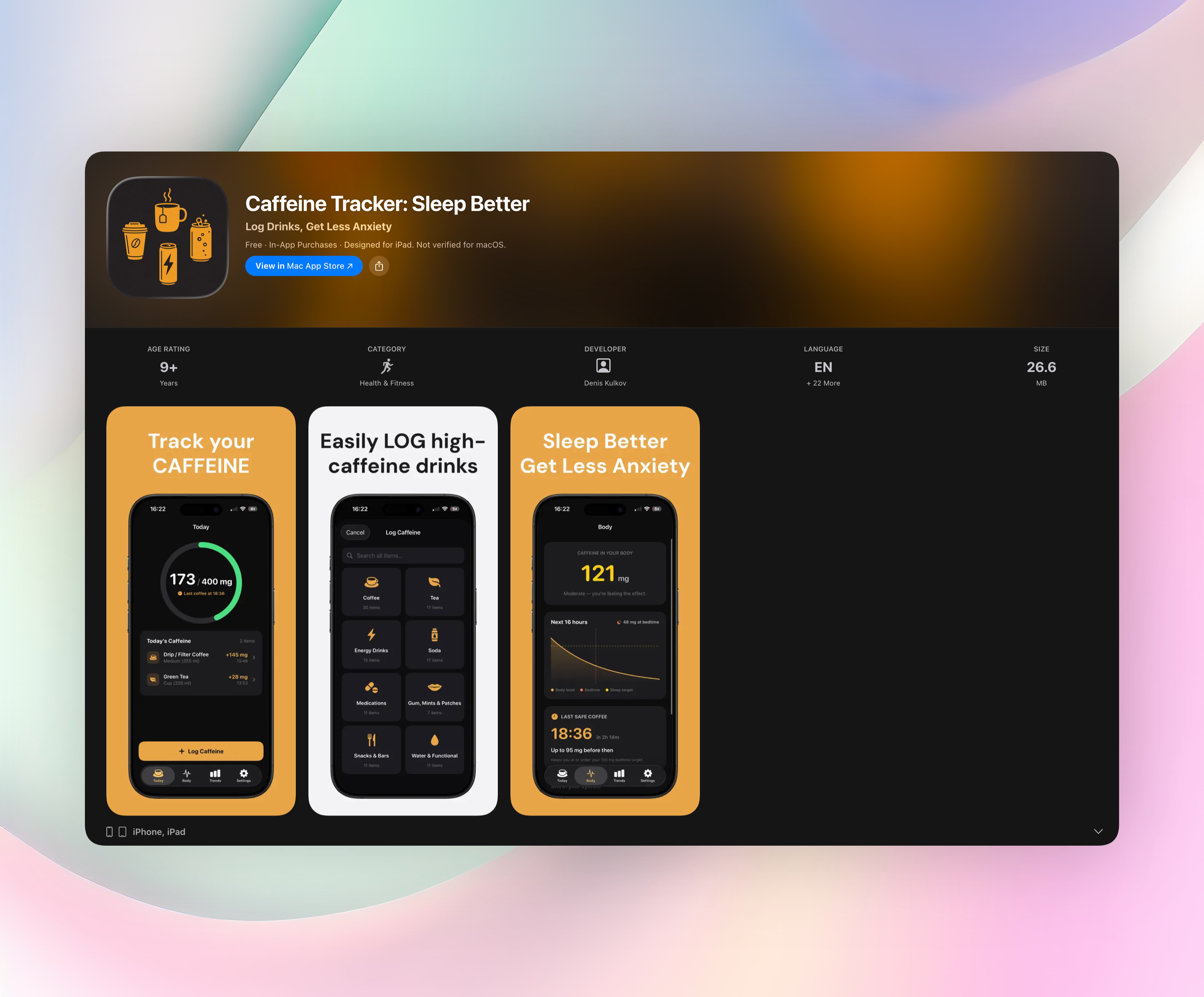
A table like this gets you within about 20% — the rest is your machine, your scoop, and your beans. The one way to know your actual daily number is to log each cup as you drink it, rather than reconstructing the day from memory at bedtime. Caffeine Tracker is a caffeine tracking app for iPhone.
FAQ
How many mg of caffeine in a cup of coffee?
About 95 mg for a standard 8 oz cup of drip coffee, and 70 to 140 mg across most home brews. A 16 oz coffee-shop cup commonly runs 200 to 310 mg because it's twice the volume at a heavier ratio. Instant is the low end at roughly 60 mg per cup.
How much caffeine is in coffee compared with tea and energy drinks?
An 8 oz brewed coffee at ~95 mg roughly doubles black tea (40–50 mg per 8 oz) and triples green tea (25–30 mg). A standard 8.4 oz energy drink holds about 80 mg, so a 16 oz cold brew can carry more than two of them combined.
How much caffeine in a K Cup versus a regular brewed cup?
They're in the same territory: most regular pods fall between 75 and 150 mg, against about 95 mg for an 8 oz drip cup. Selecting a larger brew size on the machine adds water, not caffeine, so the pod's label is what determines the dose.
Does dark roast coffee have more caffeine than light roast?
Barely any difference. Roasting destroys very little caffeine, so if you weigh your coffee the two are close to identical. Scoop it by volume and light roast edges ahead, because the denser beans pack more coffee into the same scoop.
Does decaf coffee still have caffeine in it?
Yes, roughly 2 to 5 mg per 8 oz cup. Decaffeination removes around 97% or more of the caffeine, not all of it. Several decafs across a day can add up to a meaningful fraction of one regular cup.
Free Caffeine tools
- Caffeine Half-Life & Sleep CalculatorA caffeine half life calculator for bedtime. Enter how many mg you had, when you had it and when you plan to sleep, and see how much caffeine is still in your system at bedtime, the share of the dose that is left, and when it falls to 50 mg.
- Caffeine Withdrawal Timeline PlannerMap a gradual caffeine reduction from your current daily intake to a day-by-day target, with common caffeine withdrawal windows shown alongside each date.
- Caffeine in Chocolate CalculatorChoose a chocolate type and enter a serving size to estimate the caffeine in that chocolate serving.
- Coffee Caffeine CalculatorPick your brew method and cup size to see how much caffeine is in a cup of coffee — the total mg, the mg in a standard 8 fl oz serving, and how much of the FDA's 400 mg daily guidance that uses. Typical values, not a measurement of your specific cup.
- Coffee to Water Ratio CalculatorFind how much grounds per cup of coffee you need, with grams, approximate tablespoons, water and a 1:n ratio for your brew method.
- Daily Caffeine Limit CalculatorSee how much caffeine you can have a day according to published guidance for your life stage, with an adult weight-based single-dose figure and drip coffee equivalent.
- Energy Drink Caffeine CalculatorChoose a brand and product, then enter the number of cans or shots to estimate total caffeine, caffeine density and the share of the FDA 400 mg daily figure.
- Espresso Caffeine CalculatorWork out how much caffeine is in an espresso shot: choose how many shots you pulled, how you pulled them and which beans went in. You get the total in mg, the mg per shot and how much of the FDA's 400 mg a day it uses.
- Half-Life Formula CalculatorEnter a starting amount, half-life and elapsed time or target amount. See the remainder, decay table, curve and worked formula for any substance.
- Matcha & Tea Caffeine CalculatorEstimate how much caffeine is in matcha green tea and other teas from powder weight or brewed serving size. See the result in mg and as a share of the FDA 400 mg daily figure.
- Soda Caffeine CalculatorEstimate total caffeine intake from soda servings using typical caffeine values for common soft drinks.
- Yerba Mate Caffeine CalculatorEstimate yerba mate caffeine from the amount of dry leaf, water volume and number of servings. Results are typical estimates, not exact measurements.