How much caffeine is too much, and where 400 mg came from
For healthy adults, agencies put the line at 400 mg of caffeine a day — about four 8 oz cups of drip coffee. How much caffeine is too much for one person depends on body weight, pregnancy, and how fast you clear it. A single dose above 200 mg matters more than the daily total.
Where the 400 mg figure comes from
It isn't one study. The FDA describes 400 mg a day — about four or five cups of coffee — as an amount not generally associated with dangerous, negative effects in healthy adults. The European Food Safety Authority reached the same figure for habitual intake in its 2015 opinion, and Health Canada uses 400 mg too. Reviews of blood pressure, sleep, anxiety, bone health, and pregnancy outcomes found no consistent signal of harm below that line in healthy adults. That's the whole claim.
Three things the figure is not. It isn't a cliff — nothing happens at 401 mg that didn't at 399. It isn't a target. And it isn't scoped to everyone: "healthy adults" leaves out pregnancy, children and adolescents, people with cardiac arrhythmias or anxiety disorders, and anyone taking something that interferes with caffeine clearance.
The ceiling covers every source combined, which is where the accounting usually breaks. Tea, cola, pre-workout, dark chocolate, and combination pain relievers all count — Excedrin carries 65 mg per tablet.
How much caffeine is too much depends on who is asking
Guidance splits by group, and the sub-limits differ enough that quoting 400 mg at everyone misleads.
| Group | Published daily ceiling | Issuing body |
|---|---|---|
| Healthy adults | 400 mg | FDA, EFSA, Health Canada |
| Pregnant or breastfeeding | 200 mg (ACOG, EFSA); Health Canada uses 300 mg | varies by country |
| Children and adolescents | 2.5 mg per kg of body weight | Health Canada, EFSA |
| Any healthy adult, single dose | ~200 mg (about 3 mg/kg) | EFSA |
Body weight does quiet work here. EFSA's 400 mg equals roughly 5.7 mg/kg for a 70 kg adult; a 55 kg adult's equivalent is closer to 315 mg — the gap between four coffees and three. For adolescents, 2.5 mg/kg works out near 100 mg for a 40 kg twelve-year-old, about one cola and an iced tea. The AAP holds that energy drinks have no place in children's diets.
Clearance varies more than most people expect. Caffeine's half-life in a healthy adult averages around five hours, but the real spread runs from roughly two hours to ten, driven largely by CYP1A2 activity, which is partly genetic. Smoking speeds it up; oral contraceptives slow it down substantially. Pregnancy stretches the half-life dramatically by the third trimester — that's the mechanism behind the 200 mg pregnancy number, since the same dose stays in circulation far longer.
What 400 mg of caffeine looks like in actual drinks
The FDA's "four or five cups" assumes an 8 oz cup at about 95 mg. Almost nobody drinks an 8 oz cup.
- Drip coffee: ~95 mg per 8 oz, with a real range of about 70–165 mg depending on roast, grind, and brew time. A 16 oz shop coffee can land anywhere from 200 mg to over 300 mg by itself — more on that variance in how much caffeine is in a cup of coffee.
- Espresso: about 63 mg per 1 oz shot, but most US cafés pull doubles, so the drink in your hand is usually ~125 mg. Three of them clear 375 mg.
- Cold brew: the outlier. A high grounds-to-water ratio and a long steep put a 16 oz cold brew near 200 mg, so two reach the ceiling.
- Energy drinks: a 12 oz Celsius is 200 mg, so two cans is the entire day. A 16 oz Monster is 160 mg, an 8.4 oz Red Bull 80 mg, and a standard energy shot packs 200 mg into two ounces.
- Tea and soda: black tea ~47 mg per 8 oz, green tea ~28 mg, a 12 oz Coca-Cola 34 mg, Diet Coke 46 mg.
Four coffees, two cold brews, and two energy drinks are the same number. Serving size is the variable, not the beverage.
The caffeine limit per day is unusable without a running total
Mental arithmetic fails because the doses are unequal and spread across ten hours. A big morning coffee, a refill, an afternoon tea, and a pre-gym scoop feel like four small decisions and add up like two large ones. People are also reliably wrong about volume — the 12 oz "medium" is where most of the error hides.
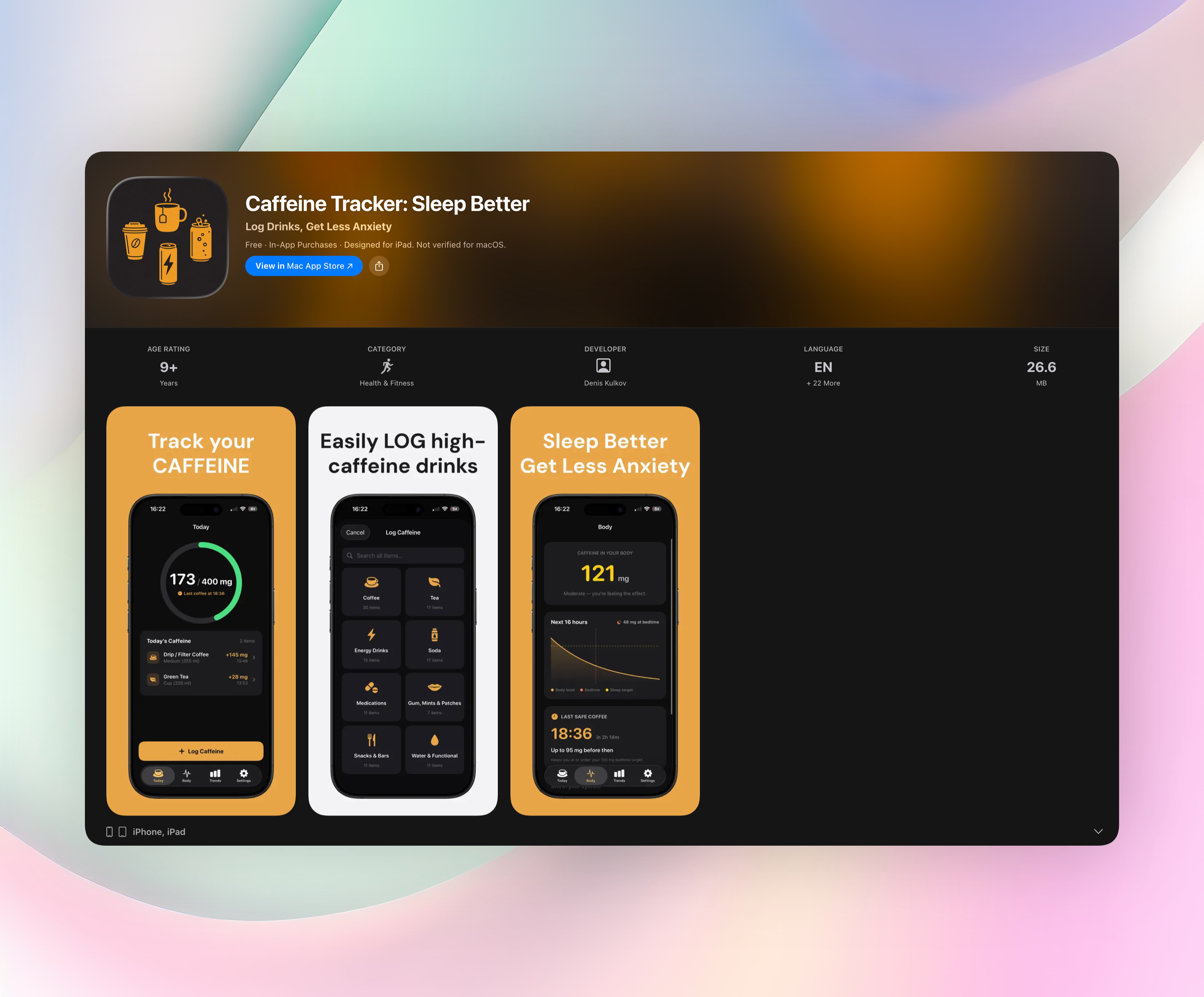
Caffeine Tracker is a caffeine tracking app for iPhone; logging drinks as you go turns an abstract 400 mg into a number that visibly shrinks through the day, which is the only form of the guideline that changes a 4 p.m. decision.
Why 200 mg in one sitting matters more than the daily total
EFSA's opinion separates habitual daily intake from acute single doses, putting the single-dose figure near 200 mg — about 3 mg/kg for a 70 kg adult — as not raising safety concerns for healthy adults.
Two hundred milligrams reads as modest in daily terms, half the ceiling, but as a single dose it is the ceiling. One 12 oz energy drink, one large drip coffee, or one energy shot gets you there in minutes, and that's the dose shape that produces the racing heart and tight chest. A 350 mg day spread over four servings and a 350 mg day drunk before 9 a.m. are different physiological events.
Timing compounds it. With a five-hour half-life, 200 mg at 4 p.m. is still roughly 100 mg at 9 p.m. and 50 mg at 2 a.m. That residue doesn't always block sleep onset, but it often shows up as lighter, fragmented sleep — why cutoff time is usually a more useful lever than total intake for sleep complaints.
The escalation ladder: 400 mg, 600 mg, and past 1,000 mg
400–600 mg. For someone not habituated, side effects go from possible to common: restlessness, jitteriness, a resting heart rate a few beats higher, delayed sleep onset, and amplified anxiety in people prone to it. Regular drinkers develop real tolerance to the alertness and blood-pressure effects within days. Tolerance to sleep disruption is much weaker than people assume.
600–1,000 mg. Tremor, palpitations, nausea, pressured thinking, and in susceptible people symptoms hard to distinguish from a panic attack. A missed day now produces reliable withdrawal — headache, fatigue, low mood, poor concentration — typically peaking 24 to 48 hours after the last dose. Caffeine withdrawal is a recognized DSM-5 diagnosis.
Past 1,000 mg in a short window. The FDA describes toxic effects, including seizures, from rapid consumption of around 1,200 mg. Coffee is a poor delivery vehicle for that much; the stomach objects first. Nearly all serious cases involve tablets, powders, or concentrated shots — why the FDA has acted against bulk pure caffeine sold to consumers, where a single teaspoon of the powder is roughly equivalent to 28 cups of coffee.
Caffeine overdose symptoms worth separating from ordinary jitters
Ordinary overshoot means jitters, anxiety, an upset stomach, and a fast heartbeat that settles as the dose clears. Published poison-control and emergency guidance flags a different set: repeated vomiting, chest pain, confusion or disorientation, hallucinations, an irregular heartbeat that doesn't settle, and seizure. Those are reasons to seek emergency care rather than wait it out — clearance halves the dose only every five hours or so. The same guidance names the multipliers: concentrated pills or powders, mixing with alcohol, low body weight, arrhythmia, and medications that slow clearance.
FAQ
How much caffeine can you have a day?
The FDA, EFSA, and Health Canada all use 400 mg a day for healthy adults — about four 8 oz cups of drip coffee, or two 16 oz cold brews. It covers all sources combined, and it's a population guideline rather than a personal prescription.
Is 200 mg of caffeine a lot?
As a daily total, no — it's half the standard adult ceiling. As a single dose it sits at the acute limit EFSA describes for healthy adults, roughly 3 mg/kg. One 12 oz Celsius, one large drip coffee, or one energy shot is 200 mg on its own.
What are the first caffeine overdose symptoms?
Early signs described in guidance are restlessness, tremor, a racing heartbeat, nausea, and anxiety. The ones treated as emergencies are repeated vomiting, chest pain, confusion, an irregular heartbeat that doesn't settle, and seizure.
Does tolerance raise your safe caffeine limit per day?
Tolerance changes how the dose feels, not what the guideline says. Habitual drinkers blunt the alertness and blood-pressure response within days, but agencies still use 400 mg, and sleep disruption persists longer than the subjective jitteriness does.
How much caffeine per day is considered safe in pregnancy?
ACOG and EFSA both point to under 200 mg a day; Health Canada uses 300 mg. The lower ceilings exist because caffeine's half-life lengthens substantially over pregnancy, so the same drink lingers far longer.
Free Caffeine tools
- Caffeine Half-Life & Sleep CalculatorA caffeine half life calculator for bedtime. Enter how many mg you had, when you had it and when you plan to sleep, and see how much caffeine is still in your system at bedtime, the share of the dose that is left, and when it falls to 50 mg.
- Caffeine Withdrawal Timeline PlannerMap a gradual caffeine reduction from your current daily intake to a day-by-day target, with common caffeine withdrawal windows shown alongside each date.
- Caffeine in Chocolate CalculatorChoose a chocolate type and enter a serving size to estimate the caffeine in that chocolate serving.
- Coffee Caffeine CalculatorPick your brew method and cup size to see how much caffeine is in a cup of coffee — the total mg, the mg in a standard 8 fl oz serving, and how much of the FDA's 400 mg daily guidance that uses. Typical values, not a measurement of your specific cup.
- Coffee to Water Ratio CalculatorFind how much grounds per cup of coffee you need, with grams, approximate tablespoons, water and a 1:n ratio for your brew method.
- Daily Caffeine Limit CalculatorSee how much caffeine you can have a day according to published guidance for your life stage, with an adult weight-based single-dose figure and drip coffee equivalent.
- Energy Drink Caffeine CalculatorChoose a brand and product, then enter the number of cans or shots to estimate total caffeine, caffeine density and the share of the FDA 400 mg daily figure.
- Espresso Caffeine CalculatorWork out how much caffeine is in an espresso shot: choose how many shots you pulled, how you pulled them and which beans went in. You get the total in mg, the mg per shot and how much of the FDA's 400 mg a day it uses.
- Half-Life Formula CalculatorEnter a starting amount, half-life and elapsed time or target amount. See the remainder, decay table, curve and worked formula for any substance.
- Matcha & Tea Caffeine CalculatorEstimate how much caffeine is in matcha green tea and other teas from powder weight or brewed serving size. See the result in mg and as a share of the FDA 400 mg daily figure.
- Soda Caffeine CalculatorEstimate total caffeine intake from soda servings using typical caffeine values for common soft drinks.
- Yerba Mate Caffeine CalculatorEstimate yerba mate caffeine from the amount of dry leaf, water volume and number of servings. Results are typical estimates, not exact measurements.