How long does caffeine stay in your system?
How long does caffeine stay in your system? Half of a dose is still in your blood five to six hours later, and effectively all of it is gone about a day after you drink it. The exact number is set by your liver, not by the cup.
How long does caffeine stay in your system? The half-life math
A half-life is the time it takes for your body to clear half of what's circulating. For caffeine in a healthy adult it averages roughly five to six hours, though the published range across individuals runs from about 1.5 hours to more than 9.
The useful part is that half-lives compound. Say you drink a 200 mg coffee at 2 p.m. and your half-life is six hours:
| Hours after the drink | Clock time | Caffeine still circulating |
|---|---|---|
| 0 | 2:00 p.m. | 200 mg |
| 6 | 8:00 p.m. | 100 mg |
| 12 | 2:00 a.m. | 50 mg |
| 18 | 8:00 a.m. | 25 mg |
| 24 | 2:00 p.m. next day | 12.5 mg |
| 30 | 8:00 p.m. next day | ~6 mg |
At 2 a.m., mid-sleep, you're still carrying the equivalent of a half-shot of espresso. That's the number most people get wrong — they treat "five hours" as an expiry date rather than the first step of a decay curve.
Pharmacology's working rule is that a drug is effectively cleared after four to five half-lives — about 6% remains at four, about 3% at five. For caffeine that's roughly 24 to 30 hours, not six. Shift to a five-hour half-life and the whole schedule compresses to about 20 to 25 hours; at a fast four-hour half-life, closer to 16 to 20.
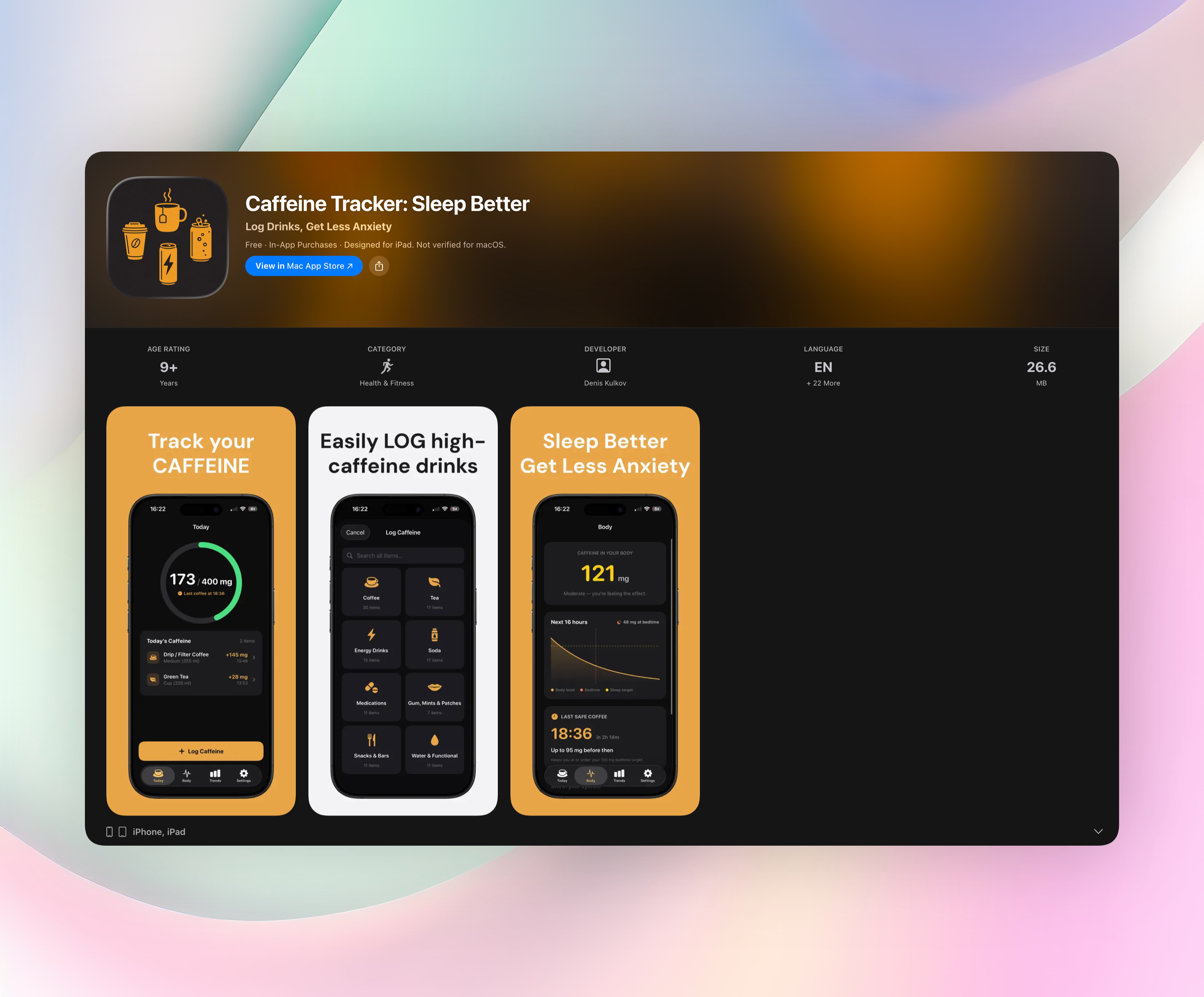
Running that curve by hand gets tedious once you've had a coffee, a tea, and a soda in the same day, which is where a caffeine tracking app for iPhone like Caffeine Tracker is useful — you log what you drank and when, and the running total is kept for you.
How long caffeine lasts versus how long it stays in your body
These are two different questions with two different answers. Caffeine is absorbed almost completely from the gut and peaks in the blood roughly 30 to 60 minutes after you drink it. The lift you notice usually fades within three or four hours.
Blood levels don't follow your subjective experience. Caffeine works by blocking adenosine receptors — adenosine is the molecule that builds up across the day and makes you sleepy — and blocking it doesn't delete the sleep pressure underneath. So the alertness plateaus and drops off while the drug itself is still there, doing quiet work on your sleep architecture hours later.
That gap is why afternoon coffee can shorten total sleep and reduce deep sleep in people who swear it doesn't affect them. They're judging by how long caffeine lasts subjectively, not by what's still in circulation. Dose matters here too, and cup sizes vary more than most people assume — see how much caffeine is in a cup of coffee for realistic numbers.
What changes your caffeine half-life
About 95% of caffeine metabolism happens in the liver, almost all of it through a single enzyme called CYP1A2. Anything that speeds up or slows down that enzyme moves your half-life, sometimes dramatically.
Genetics
CYP1A2 activity is partly inherited. Fast metabolizers clear caffeine in a few hours; slow metabolizers can take two or three times as long from the same cup. This is the main reason two people can split a pot of coffee at dinner and only one of them lies awake.
Smoking
Tobacco smoke induces CYP1A2 and roughly halves caffeine's half-life. It's the smoke, not the nicotine, so patches and gum don't do it. The reversal matters more than the effect: when someone quits, enzyme activity falls back toward baseline within days, and an unchanged coffee habit suddenly hits far harder — jitteriness during a quit attempt is often caffeine, not withdrawal.
Oral contraceptives and pregnancy
Estrogen inhibits CYP1A2. Combined oral contraceptives roughly double caffeine's half-life. Pregnancy stretches it progressively — modest in the first trimester, and by the third trimester half-life can reach around 15 hours, meaning a morning coffee is still substantially present at bedtime. Guidelines from obstetric bodies commonly suggest keeping intake under 200 mg per day during pregnancy.
Liver load and medications
Liver disease slows clearance, and in advanced cirrhosis half-life can stretch past a day. Several common drugs inhibit CYP1A2 as a side effect — some antibiotics in the fluoroquinolone family and certain SSRIs are the well-documented examples — and can multiply caffeine's half-life several times over.
Caffeine half-life by age
Newborns are the extreme case: their liver enzymes are immature and caffeine half-life is measured in days, not hours, which is why caffeine is dosed as a medication in neonatal care. It falls steeply over the first months of life and reaches adult values by around six months. Through childhood and adulthood, half-life is broadly stable.
Healthy older adults don't clear caffeine much more slowly, despite the common belief. What changes with age is sensitivity — sleep gets lighter and more fragmented on its own, so the same residual caffeine has more to disrupt.
How to get caffeine out of your system
Only time removes caffeine. Water, a cold shower, a big meal, and a hard workout do not meaningfully speed liver clearance. Water dilutes nothing that matters here, because caffeine isn't cleared by the kidneys in any significant amount — under 3% leaves unchanged in urine.
A few things nudge CYP1A2 in the lab: cruciferous vegetables and charbroiled meat induce it slightly, grapefruit juice inhibits it slightly. The effects are too small and too slow to rescue an evening.
What does work is the arithmetic. If your half-life is six hours and a 100 mg residue is your ceiling for falling asleep normally, a 400 mg day needs about 12 hours to get there — a noon cutoff for midnight sleep. Eating alongside the drink slows absorption and blunts the peak, but it doesn't change total clearance time. Exercise while caffeine is on board can make you feel better without changing a single milligram of what's circulating.
Working backward from bedtime
The practical move is to treat your last dose as a scheduling problem rather than a quantity problem. Two people drinking identical amounts can land in very different places depending on when they drank it, and one of them will blame the coffee rather than the clock.
The FDA describes up to 400 mg per day as an amount not generally associated with negative effects in healthy adults — a daily ceiling, with nothing said about timing. Both levers are separate, and the 400 mg guideline covers the quantity side. Timing is where the half-life does its work: the same 400 mg spread across a morning and the same 400 mg finishing at 4 p.m. produce very different bedtime numbers.
FAQ
How long does caffeine stay in your system after one cup of coffee?
A 100 mg cup drops to about 50 mg after five to six hours, 25 mg after ten to twelve, and to trace amounts by roughly 24 hours. Effectively complete clearance takes four to five half-lives, so about a day for most adults — longer if you're a slow metabolizer, pregnant, or taking oral contraceptives.
Does caffeine really stay in your system for 24 hours?
Yes, in small amounts. The five-hour figure is the half-life, not the total duration. After 24 hours a typical adult still has a few percent of the original dose circulating, which is usually too little to affect sleep but is easily detectable.
How can I get caffeine out of my system faster?
There's no reliable way. Hydration, food, sweating, and exercise don't accelerate liver metabolism, and less than 3% of caffeine is excreted unchanged by the kidneys. The only variables that genuinely shift clearance speed — genotype, smoking status, hormonal state, liver health — aren't things you change on the evening you overdid it.
Why does caffeine affect some people so much more than others?
Two independent factors. CYP1A2 activity sets how fast the drug leaves, and it varies several-fold between individuals. Adenosine receptor sensitivity sets how strongly a given blood level registers, and it varies too. A slow metabolizer with sensitive receptors and a fast metabolizer with blunted ones can have effectively opposite experiences of the same espresso.
Free Caffeine tools
- Caffeine Half-Life & Sleep CalculatorA caffeine half life calculator for bedtime. Enter how many mg you had, when you had it and when you plan to sleep, and see how much caffeine is still in your system at bedtime, the share of the dose that is left, and when it falls to 50 mg.
- Caffeine Withdrawal Timeline PlannerMap a gradual caffeine reduction from your current daily intake to a day-by-day target, with common caffeine withdrawal windows shown alongside each date.
- Caffeine in Chocolate CalculatorChoose a chocolate type and enter a serving size to estimate the caffeine in that chocolate serving.
- Coffee Caffeine CalculatorPick your brew method and cup size to see how much caffeine is in a cup of coffee — the total mg, the mg in a standard 8 fl oz serving, and how much of the FDA's 400 mg daily guidance that uses. Typical values, not a measurement of your specific cup.
- Coffee to Water Ratio CalculatorFind how much grounds per cup of coffee you need, with grams, approximate tablespoons, water and a 1:n ratio for your brew method.
- Daily Caffeine Limit CalculatorSee how much caffeine you can have a day according to published guidance for your life stage, with an adult weight-based single-dose figure and drip coffee equivalent.
- Energy Drink Caffeine CalculatorChoose a brand and product, then enter the number of cans or shots to estimate total caffeine, caffeine density and the share of the FDA 400 mg daily figure.
- Espresso Caffeine CalculatorWork out how much caffeine is in an espresso shot: choose how many shots you pulled, how you pulled them and which beans went in. You get the total in mg, the mg per shot and how much of the FDA's 400 mg a day it uses.
- Half-Life Formula CalculatorEnter a starting amount, half-life and elapsed time or target amount. See the remainder, decay table, curve and worked formula for any substance.
- Matcha & Tea Caffeine CalculatorEstimate how much caffeine is in matcha green tea and other teas from powder weight or brewed serving size. See the result in mg and as a share of the FDA 400 mg daily figure.
- Soda Caffeine CalculatorEstimate total caffeine intake from soda servings using typical caffeine values for common soft drinks.
- Yerba Mate Caffeine CalculatorEstimate yerba mate caffeine from the amount of dry leaf, water volume and number of servings. Results are typical estimates, not exact measurements.