How long does caffeine take to kick in?
Caffeine reaches your bloodstream about 10 minutes after the first sip, and blood levels peak between 30 and 60 minutes. The alert stretch holds for roughly two to three hours, then declines. How long caffeine takes to kick in depends on form, food, and your own metabolism.
How long does caffeine take to kick in? Minute by minute
0–10 minutes. Caffeine is absorbed quickly and almost completely from the stomach and small intestine — oral bioavailability is close to 100%, unusual for something you swallow. Traces appear in blood within about 10 minutes.
30–60 minutes. Blood concentration peaks for most people. The published range is wider than the popular number suggests, running from roughly 15 minutes to two hours depending on the drink and what else is in your stomach.
1–3 hours. The plateau. Concentration is already falling, but slowly enough that the effect feels level rather than fading. Timing caffeine around a workout or a long drive means aiming the peak at the start of it, not the middle.
3 hours and after. The decline. Caffeine's half-life averages around five hours in healthy adults, with a wide individual spread. That back half is what sets your evening cutoff: a 200 mg coffee at 3 p.m. still leaves roughly 100 mg in you at 8 p.m. and about 50 mg at 1 a.m. The arithmetic of how long caffeine stays in your system matters more for sleep than onset ever does.
How caffeine works: it blocks adenosine, it doesn't add energy
The mechanism explains almost every other timing question. Adenosine is a byproduct of the brain burning fuel. It accumulates through every waking hour and binds to receptors — mainly A1 and A2A — that slow neural firing and make you sleepy. Researchers call that accumulation sleep pressure.
Caffeine is shaped enough like adenosine to occupy those receptors without activating them. It's a competitive antagonist: it sits in the seat so adenosine can't. Nothing in the interaction between caffeine and adenosine removes any adenosine — the molecule keeps piling up behind the blockade. Caffeine doesn't add energy. It hides the bill.
That one fact explains two things people usually treat as separate: the crash, and the cutoff rule.
What caffeine does to your body besides waking you up
Blocking adenosine is the headline, not the whole effect. Caffeine also prompts a modest release of adrenaline, which is why a strong dose can nudge heart rate and blood pressure up, and why an anxious morning feels worse after an empty-stomach double espresso. It stimulates gastric acid, mobilizes free fatty acids, and relaxes airway smooth muscle. The diuretic effect is real but mild, and regular drinkers develop tolerance to it.
What caffeine does to your body scales with dose, which makes how much caffeine is in a cup of coffee more useful to know than how many cups you had. The FDA's published figure — 400 mg a day — is the amount not generally associated with negative effects in healthy adults.
What changes how fast it hits
| Form | Typical onset | Why |
|---|---|---|
| Caffeine gum or lozenge | 5–10 min | Absorbed through the lining of the mouth, skipping the stomach |
| Espresso, empty stomach | 10–20 min | Small volume, fast gastric emptying |
| Brewed coffee or energy drink | 15–30 min, peak at 30–60 | Standard gastric and intestinal absorption |
| Coffee with a full meal | Delayed; peak can slide past 60 min | Food slows gastric emptying |
| Tea | Similar shape, lower peak | Usually less caffeine per cup |
| Caffeine tablet | 30–60 min | Has to disintegrate and dissolve first |
Metabolism varies too. The liver enzyme CYP1A2 handles most caffeine clearance, and its activity differs a lot between people. Smoking speeds clearance up; oral contraceptives and pregnancy slow it down substantially. Tolerance is a separate axis — receptors upregulate with regular use, so the same dose produces a smaller effect, not a later one.
Why the crash follows the peak
Nothing new arrives at crash time. What changes is that the blockade lifts. As caffeine clears, the adenosine that accumulated behind it finds open receptors, and sleepiness you deferred lands in a shorter window than it otherwise would. If the drink was sweetened, a blood-sugar dip stacks on top.
A slump three to five hours after a dose usually means the dose was covering sleep debt rather than a caffeine shortfall.
The best time to drink coffee, and why it isn't the moment you wake up
Cortisol rises sharply in the first 30 to 45 minutes after waking, then falls through the morning. That rise is your body's own alerting signal. The case for delaying the first cup by 90 to 120 minutes is that caffeine and cortisol overlap during that window, so caffeine adds less than it would later, once the natural curve has dropped.
Treat it as a reasonable heuristic, not a settled result — the direct evidence that waiting improves how you feel is thinner than the advice implies. The sturdier version is simpler: adenosine sits at its daily low after a full night's sleep, so there's little for caffeine to block yet. Mid-morning aims the dose at a moment when it has work to do, and shifts the whole curve later.
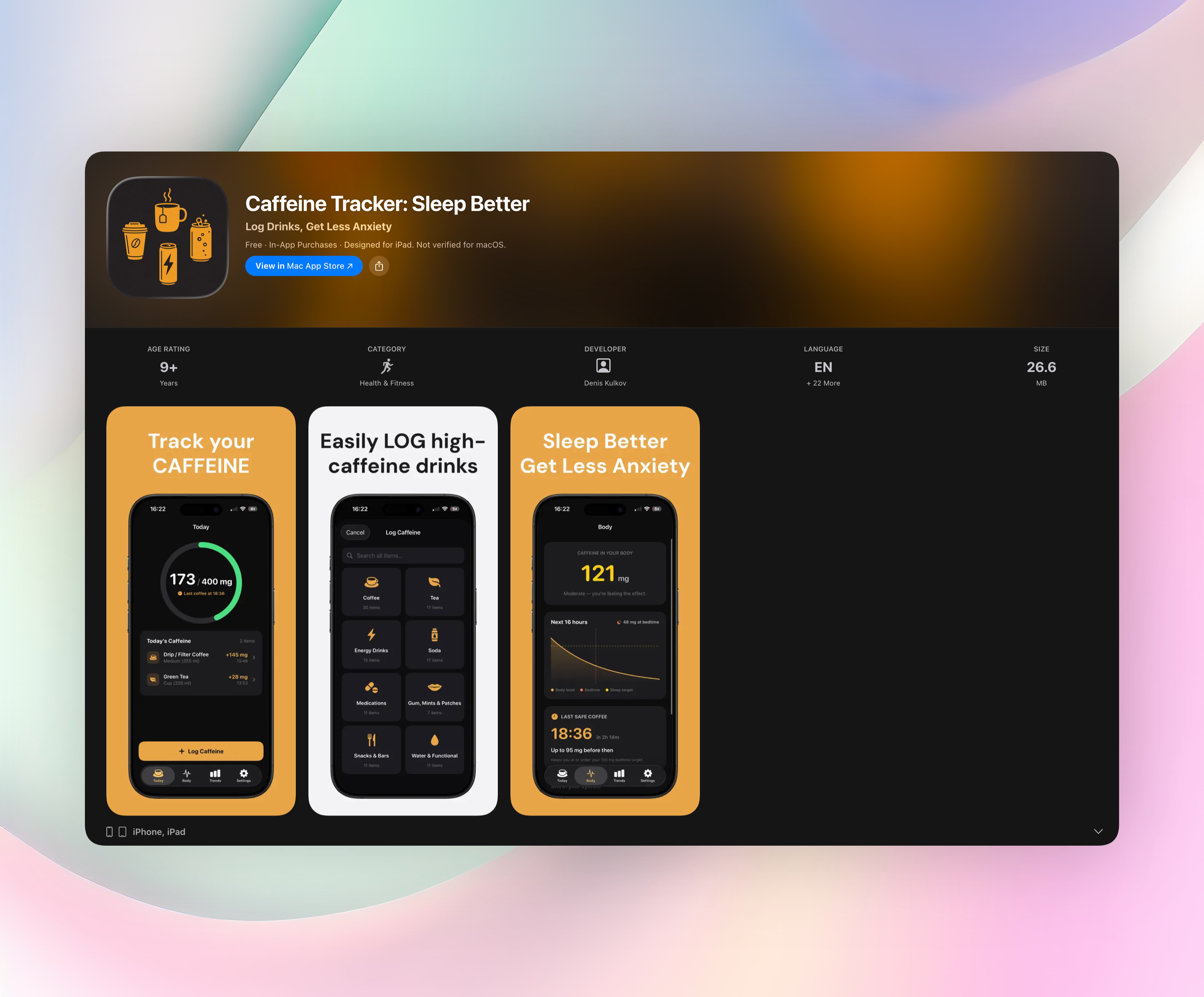
Which is where timestamps matter as much as milligrams. To see whether your 3 p.m. coffee peaked too late, you need a log with times attached — on paper, or in something like Caffeine Tracker, a caffeine tracking app for iPhone.
FAQ
How long does caffeine take to kick in on an empty stomach?
Faster — usually 10 to 20 minutes to a noticeable effect, because no food is slowing gastric emptying. The peak still lands in the same 30-to-60-minute band for most people, just at the earlier end.
Why doesn't coffee work for me anymore?
Regular use upregulates adenosine receptors, so the same dose blocks a smaller share of them. The morning cup shifts from adding alertness to relieving overnight withdrawal. Cutting back for a week or two lowers tolerance again; headaches in the first day or two are common.
Is it better to drink coffee before or after breakfast?
Before, if you want it to arrive fast; after, if you'd rather have a gentler curve or a calmer stomach. Food doesn't reduce how much caffeine you absorb — bioavailability stays near complete — it spreads the arrival out.
How long before a workout should caffeine be taken?
Aiming the peak at the start of the effort means roughly 45 to 60 minutes ahead for a drink or capsule, and 5 to 15 minutes for gum. Published sports-nutrition guidance commonly cites 3–6 mg per kilogram of body weight, well above a casual cup.
Free Caffeine tools
- Caffeine Half-Life & Sleep CalculatorA caffeine half life calculator for bedtime. Enter how many mg you had, when you had it and when you plan to sleep, and see how much caffeine is still in your system at bedtime, the share of the dose that is left, and when it falls to 50 mg.
- Caffeine Withdrawal Timeline PlannerMap a gradual caffeine reduction from your current daily intake to a day-by-day target, with common caffeine withdrawal windows shown alongside each date.
- Caffeine in Chocolate CalculatorChoose a chocolate type and enter a serving size to estimate the caffeine in that chocolate serving.
- Coffee Caffeine CalculatorPick your brew method and cup size to see how much caffeine is in a cup of coffee — the total mg, the mg in a standard 8 fl oz serving, and how much of the FDA's 400 mg daily guidance that uses. Typical values, not a measurement of your specific cup.
- Coffee to Water Ratio CalculatorFind how much grounds per cup of coffee you need, with grams, approximate tablespoons, water and a 1:n ratio for your brew method.
- Daily Caffeine Limit CalculatorSee how much caffeine you can have a day according to published guidance for your life stage, with an adult weight-based single-dose figure and drip coffee equivalent.
- Energy Drink Caffeine CalculatorChoose a brand and product, then enter the number of cans or shots to estimate total caffeine, caffeine density and the share of the FDA 400 mg daily figure.
- Espresso Caffeine CalculatorWork out how much caffeine is in an espresso shot: choose how many shots you pulled, how you pulled them and which beans went in. You get the total in mg, the mg per shot and how much of the FDA's 400 mg a day it uses.
- Half-Life Formula CalculatorEnter a starting amount, half-life and elapsed time or target amount. See the remainder, decay table, curve and worked formula for any substance.
- Matcha & Tea Caffeine CalculatorEstimate how much caffeine is in matcha green tea and other teas from powder weight or brewed serving size. See the result in mg and as a share of the FDA 400 mg daily figure.
- Soda Caffeine CalculatorEstimate total caffeine intake from soda servings using typical caffeine values for common soft drinks.
- Yerba Mate Caffeine CalculatorEstimate yerba mate caffeine from the amount of dry leaf, water volume and number of servings. Results are typical estimates, not exact measurements.