Caffeine and sleep: falling asleep fine isn't the same as sleeping well
Caffeine and sleep can look compatible and still not be. You can fall asleep on schedule while caffeine flattens the deepest part of your night and nudges your body clock later. The cost shows up at 7 a.m., not at 11 p.m.
Why both takes on caffeine and sleep are correct
"I sleep fine on coffee" is usually an honest report. So is "caffeine is wrecking your sleep." They measure different things.
The first is about onset and continuity — how fast you drop off, whether you stay down. The second is about sleep architecture: how the night divides between light N1 and N2, deep slow-wave N3, and REM. Onset is something you can feel. Architecture isn't. Nobody wakes up remembering how much slow-wave sleep they got. You get a one-word verdict instead — refreshed, or flat.
What caffeine does to sleep pressure
Adenosine accumulates in the brain during every waking hour. More time awake, more adenosine, heavier eyelids. That's sleep pressure, the homeostatic half of why you get tired.
Caffeine doesn't clear adenosine. It occupies the same receptors without switching them on, so the signal stops registering while the pressure keeps building underneath. Two things follow. The pressure isn't cancelled, only masked, and it returns as the dose clears — which is why how long caffeine stays in your system matters more than how alert you feel at bedtime. And the depth of your sleep tracks how strong that pressure was at lights-out. Blunt it and you still sleep, just shallower.
What a caffeinated night looks like on a sleep graph
A normal night runs in cycles of roughly 90 minutes. Deep sleep is front-loaded — most N3 lands in the first two cycles. REM is back-loaded, taking up more of each cycle toward morning.
A night after a late dose usually keeps that shape and loses depth.
- Onset looks fine. Time to fall asleep may stretch by a few minutes, or not at all. It's the metric most people check, and the one that hides the rest.
- The first deep block thins out. Slow-wave sleep gets shorter and the slow-wave activity within it gets weaker. Reductions on the order of 20 percent are commonly cited, though the real figure swings with dose, timing, and the sleeper.
- The back half fragments. Brief awakenings, most of them unremembered, cluster after about 3 a.m., once sleep pressure has partly discharged and there's less of it holding you down.
- The morning contradicts the clock. Eight hours in bed, close to seven asleep, still flat. The total held; the restorative fraction didn't.
Does caffeine affect REM sleep, or mostly deep sleep?
Mostly deep sleep. The slow-wave hit is the consistent finding; REM results are messier. Some work shows REM pushed later or slightly reduced, some shows little change, and a fragmented second half can eat into REM because most REM happens in the morning.
So the answer to "does caffeine affect REM sleep" is: sometimes, indirectly, and less reliably than it affects N3. If you're picking one thing to protect, caffeine and deep sleep is the relationship that matters.
Late caffeine also shifts your body clock
Sleep pressure is only one of the two systems timing your night. The other is circadian — the internal clock that decides when your body expects darkness, announced by the evening rise in melatonin.
Evening caffeine delays that rise. Controlled lab work has found that a double-espresso-sized dose taken about three hours before bed pushed melatonin onset back by roughly 40 minutes. A phase delay that size, repeated most evenings, is how a 5 p.m. coffee habit turns into a 1 a.m. bedtime and a rough 7 a.m. wake-up.
How long does caffeine affect sleep?
Caffeine's half-life averages about five hours in healthy adults, with a typical range of roughly three to seven hours. Assuming a five-hour half-life, one dose, and an 11 p.m. bedtime:
| Last dose | Still circulating at 11 p.m. | What that usually looks like |
|---|---|---|
| 8 a.m. | ~12% | Trace levels; architecture generally undisturbed |
| 11 a.m. | ~19% | Small residual; matters mainly to slow metabolizers |
| 2 p.m. | ~29% | About a third still active; measurable loss of deep sleep is common |
| 5 p.m. | ~44% | Shallower N3 plus a delayed melatonin rise |
| 8 p.m. | ~66% | Longer onset, thin deep sleep, heavy late-night fragmentation |
Two caveats. Doses stack, so three coffees leave more on board at midnight than the last one alone, and the gap between a 12-ounce drip coffee and a single espresso is wider than most people assume (here's what's actually in a cup). And the FDA's often-quoted 400 mg a day is a published daily-total guideline for healthy adults, not a sleep guideline: 400 mg finished by 10 a.m. and 400 mg with the last cup at 6 p.m. produce very different nights.
Why two people on the same coffee get different nights
Clearance speed is largely genetic. Variation in CYP1A2, the enzyme that does most of the metabolizing, splits people into fast and slow processors. Smoking speeds clearance up; pregnancy and oral contraceptives slow it down substantially.
Tolerance complicates things further. Regular use dulls the felt stimulation fairly quickly, which is why heavy drinkers report no effect at all. That it also protects the sleep measures is much less clear. Feeling nothing from a 4 p.m. cup is weak evidence that your deep sleep agrees.
The two-week experiment that beats any cutoff rule
Blanket rules — nothing after noon, nothing after 2 p.m. — are population averages pointed at an individual. Your clearance rate, your usual dose, your bedtime.
- Week one, change nothing. Log every caffeinated drink with the time and an estimated mg.
- Rate your mornings before coffee. One to five on how rested you feel, plus any wake-ups you remember.
- Week two, hold total mg steady and move the last dose four hours earlier. Same amount, earlier finish, which isolates timing from quantity.
- Compare morning scores against last-dose time. For most people the threshold that matters is a clock time, not a total.
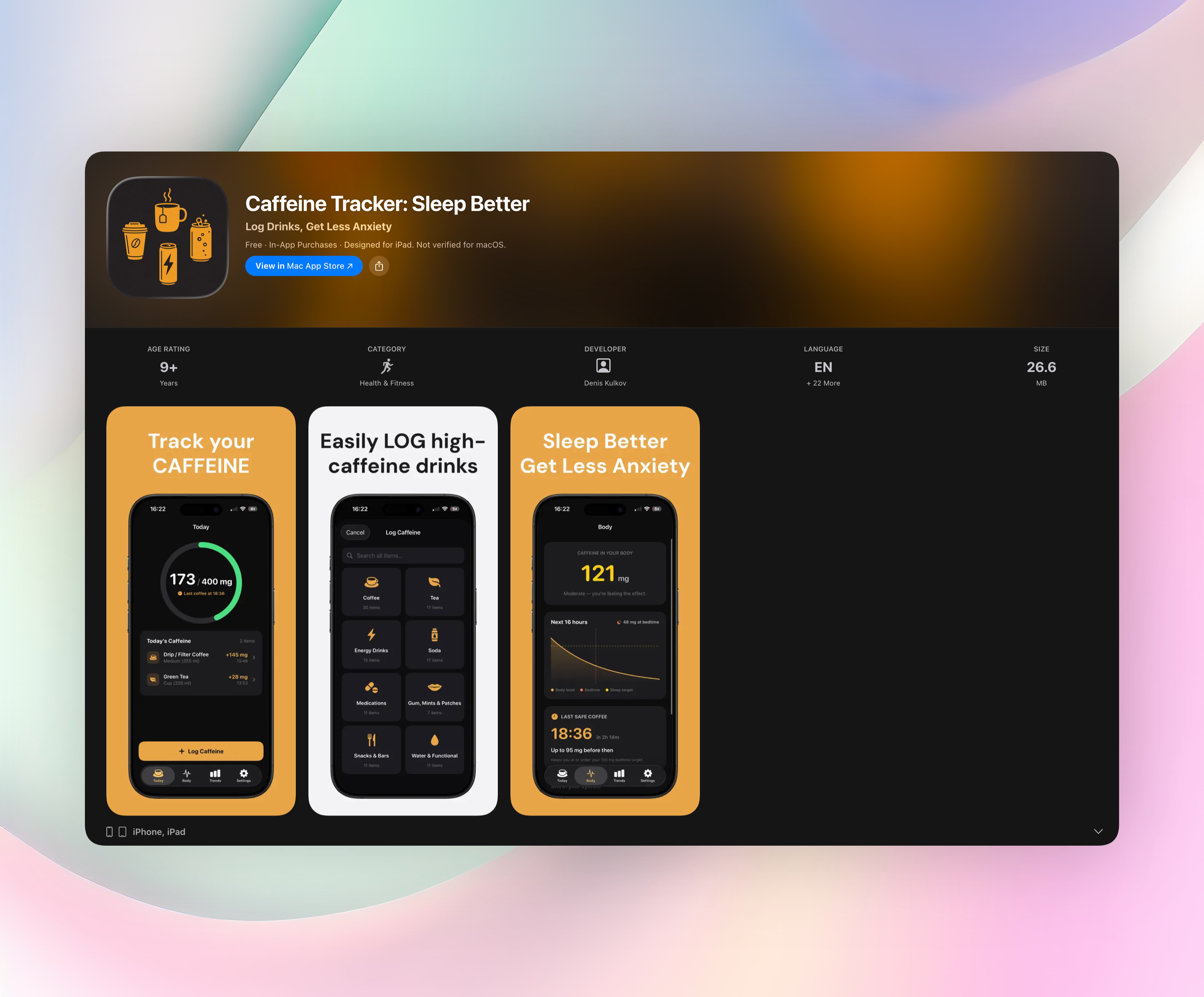
Hand-logging tends to collapse around day four, right when the data starts being worth something. Caffeine Tracker, a caffeine tracking app for iPhone, keeps the times and milligrams in one place so there's something to hold your morning notes against at the end of the fortnight.
FAQ
Does caffeine affect sleep if I fall asleep normally?
Yes. Falling asleep quickly means your sleep pressure was high enough to overcome the dose. It says nothing about the next eight hours. The measurable effects of caffeine on sleep — less slow-wave sleep, more awakenings in the back half of the night — happen whether or not onset was easy.
How many hours before bed should I stop drinking caffeine?
Six hours is a commonly cited starting point, with eight to ten hours typically recommended for large doses or slow metabolizers. Treat any published number as a hypothesis to test on yourself, since half-life varies several-fold between people.
Why do I wake up at 3 or 4 a.m. after an afternoon coffee?
By then you've discharged most of your sleep pressure while caffeine is still occupying adenosine receptors. Less pressure plus continued blockade makes light-stage sleep easier to surface from, so the normal arousals at the end of a cycle turn into full awakenings.
Can you build a tolerance to caffeine's effect on sleep?
Partly, and not the useful part. Tolerance to the subjective buzz builds within days to weeks. Sleep-lab measures tend to keep showing disruption in habitual consumers, so "it doesn't affect me" often means you've stopped noticing rather than stopped reacting.
Free Caffeine tools
- Caffeine Half-Life & Sleep CalculatorA caffeine half life calculator for bedtime. Enter how many mg you had, when you had it and when you plan to sleep, and see how much caffeine is still in your system at bedtime, the share of the dose that is left, and when it falls to 50 mg.
- Caffeine Withdrawal Timeline PlannerMap a gradual caffeine reduction from your current daily intake to a day-by-day target, with common caffeine withdrawal windows shown alongside each date.
- Caffeine in Chocolate CalculatorChoose a chocolate type and enter a serving size to estimate the caffeine in that chocolate serving.
- Coffee Caffeine CalculatorPick your brew method and cup size to see how much caffeine is in a cup of coffee — the total mg, the mg in a standard 8 fl oz serving, and how much of the FDA's 400 mg daily guidance that uses. Typical values, not a measurement of your specific cup.
- Coffee to Water Ratio CalculatorFind how much grounds per cup of coffee you need, with grams, approximate tablespoons, water and a 1:n ratio for your brew method.
- Daily Caffeine Limit CalculatorSee how much caffeine you can have a day according to published guidance for your life stage, with an adult weight-based single-dose figure and drip coffee equivalent.
- Energy Drink Caffeine CalculatorChoose a brand and product, then enter the number of cans or shots to estimate total caffeine, caffeine density and the share of the FDA 400 mg daily figure.
- Espresso Caffeine CalculatorWork out how much caffeine is in an espresso shot: choose how many shots you pulled, how you pulled them and which beans went in. You get the total in mg, the mg per shot and how much of the FDA's 400 mg a day it uses.
- Half-Life Formula CalculatorEnter a starting amount, half-life and elapsed time or target amount. See the remainder, decay table, curve and worked formula for any substance.
- Matcha & Tea Caffeine CalculatorEstimate how much caffeine is in matcha green tea and other teas from powder weight or brewed serving size. See the result in mg and as a share of the FDA 400 mg daily figure.
- Soda Caffeine CalculatorEstimate total caffeine intake from soda servings using typical caffeine values for common soft drinks.
- Yerba Mate Caffeine CalculatorEstimate yerba mate caffeine from the amount of dry leaf, water volume and number of servings. Results are typical estimates, not exact measurements.