Why does caffeine make me tired? Four causes, and the fixes
Caffeine doesn't create energy — it blocks the signal that tells you you're tired. So if you're asking why does caffeine make me tired, the answer is usually one of four things: adenosine rebound, a blood-sugar dip, sleep the caffeine already cost you, or an unusually fast metabolism.
What caffeine is actually doing in your brain
Adenosine builds up in your brain for every hour you're awake. The more of it that binds to its receptors, the heavier you feel. Caffeine's shape is close enough to adenosine's that it slots into those receptors without switching them on — a competitive block, not an off switch.
The part people miss: adenosine keeps arriving behind the block. Caffeine buys a few hours of not noticing your sleep pressure. It never pays the balance down.
The four causes of a caffeine crash
One phrase, four different problems — different timing, different feel, different fix.
| Cause | When it hits | The tell | The fix |
|---|---|---|---|
| Adenosine rebound | Several hours after the dose | Sleepier than before you drank | Smaller dose, earlier in the day |
| Blood-sugar dip | 1–2 hours after a sweet drink | Shaky and hungry, not just sleepy | Unsweetened, or drink it with food |
| Poor sleep the night before | All day, worst mid-afternoon | Caffeine barely registers | Move your cutoff earlier |
| Fast metabolism / paradoxical response | Within a couple of hours | Calm or drowsy, not wired | Lower dose, or test decaf |
Adenosine rebound
Caffeine's half-life in a healthy adult averages around five hours, though the range is wide, so a mid-morning dose is well past its peak by early afternoon. As it clears, the adenosine stacked up behind it binds at once. You don't return to your pre-coffee baseline — you land below it, because more sleep pressure accrued while you weren't feeling any of it. How steep that feels depends on how long caffeine stays in your system for you.
The blood-sugar dip
A sweetened latte or an energy drink is a caffeine delivery system bolted to a dessert. Glucose spikes, insulin overshoots, and you dip an hour or two later — well before the caffeine has gone anywhere. It reads as tiredness but comes with hunger and irritability. If black coffee doesn't do it to you, this is your cause.
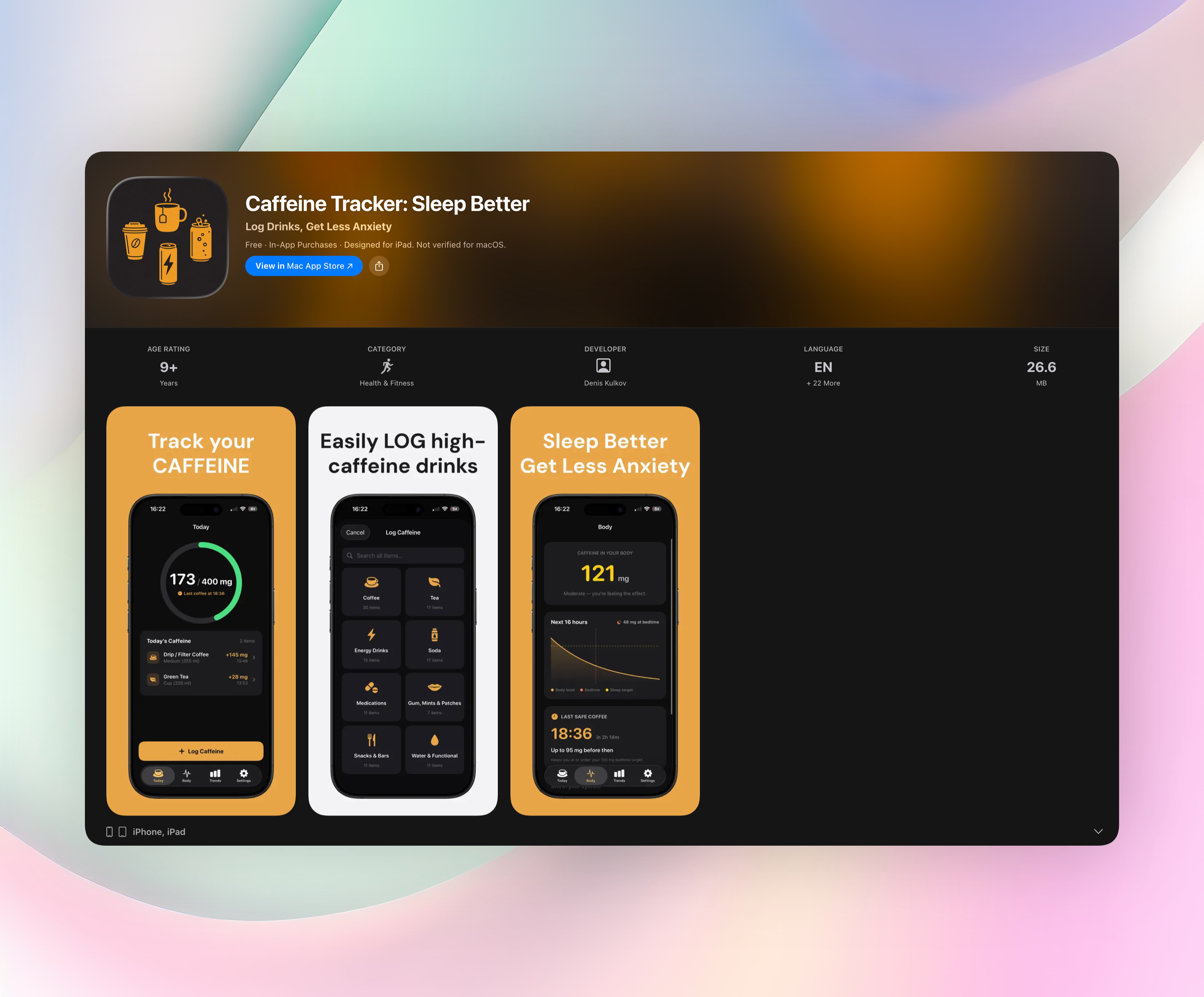
Caffeine crash symptoms are worth separating this way because a crash almost always maps to a specific dose at a specific time. Reviewing a week of logged entries in Caffeine Tracker, a caffeine tracking app for iPhone, usually surfaces the same afternoon spike behind every bad evening.
Sleep the caffeine already cost you
Caffeine taken too late shortens total sleep and cuts into deep sleep, often without you registering a bad night — you fall asleep fine and get less repair out of it. The next morning needs more caffeine, which pushes the next dose later, which costs the next night. That loop is the most common reason a regular coffee drinker feels tired all the time.
Dehydration gets blamed more than it deserves. Caffeine is a mild diuretic, but in habitual drinkers the effect is modest and the fluid in the cup largely offsets it.
Genuine paradoxical sedation
Some people reliably get calm rather than alert. How fast you clear caffeine is partly genetic, and a fast metabolizer can be on the downslope while someone else is still peaking. Caffeine sensitivity runs the other way too, through differences in the receptors themselves. Stimulants can also be quieting rather than activating in some people with ADHD physiology, though the mechanism isn't settled. If caffeine has always made you sleepy rather than only recently, that's the likelier explanation.
Why does caffeine make me tired now when it used to work?
Because you built caffeine tolerance. Regular exposure prompts the brain to add adenosine receptors, so a normal dose blocks a smaller share of them. Some adaptation shows up within days; a fuller shift takes a few weeks of daily intake.
Once adapted, your morning coffee isn't making you sharper than baseline — it's returning you to the baseline a non-drinker has for free. The dose that used to add something now only prevents a subtraction. Raising it buys days, and the same adaptation follows. The FDA cites 400 mg a day as an amount not generally associated with negative effects in healthy adults — a published guideline, not a target.
Resetting the dose instead of raising it
The fix for caffeine tolerance is less, not more. Either taper — cut roughly 25% every three or four days down to a dose you want to hold — or pick one modest dose at one fixed time and refuse to move it. Tolerance stops climbing when the dose does.
Expect a rough stretch on the way down: withdrawal headache usually starts within a day of cutting, peaks around the second day, and clears within a week to nine days. The caffeine withdrawal timeline is predictable enough to plan around.
The coffee nap, the one trick that holds up
A coffee nap — sometimes called a caffeine nap — has a real mechanism behind it. Caffeine takes roughly 20 to 45 minutes to reach meaningful blood levels, and sleep clears adenosine. Nap in that window and you wake with less adenosine competing for receptors just as the caffeine arrives.
Drink it fast: small, unsweetened, cool enough to finish, since sugar defeats the purpose. Lie down immediately and set an alarm for 20 minutes, timed against how long caffeine takes to kick in. Get up when it sounds even if you never slept — dozing helps.
Don't push past 20 minutes. Deeper sleep produces a grogginess on waking that outlasts anything the caffeine gives back, and running this late in the day trades an hour of alertness for a worse night.
FAQ
Why do I feel sleepy 30 minutes after drinking coffee?
Too early for adenosine rebound, so look at the drink — a sweetened coffee can produce a glucose dip in that window. If it happens with black coffee too, you may be a fast metabolizer already on the downslope, or carrying a sleep debt the caffeine briefly masked.
How long does a caffeine crash last?
Rebound typically fades over an hour or two as your system catches up, though if you're short on sleep it blurs into general fatigue for the rest of the day. A sugar dip resolves faster, especially after protein.
Should I drink more caffeine when I crash?
It works for an hour and makes the evening worse. A second afternoon dose pushes the rebound later and eats into your sleep, guaranteeing a repeat tomorrow. Water, a walk, or a nap costs you nothing the next day.
Free Caffeine tools
- Caffeine Half-Life & Sleep CalculatorA caffeine half life calculator for bedtime. Enter how many mg you had, when you had it and when you plan to sleep, and see how much caffeine is still in your system at bedtime, the share of the dose that is left, and when it falls to 50 mg.
- Caffeine Withdrawal Timeline PlannerMap a gradual caffeine reduction from your current daily intake to a day-by-day target, with common caffeine withdrawal windows shown alongside each date.
- Caffeine in Chocolate CalculatorChoose a chocolate type and enter a serving size to estimate the caffeine in that chocolate serving.
- Coffee Caffeine CalculatorPick your brew method and cup size to see how much caffeine is in a cup of coffee — the total mg, the mg in a standard 8 fl oz serving, and how much of the FDA's 400 mg daily guidance that uses. Typical values, not a measurement of your specific cup.
- Coffee to Water Ratio CalculatorFind how much grounds per cup of coffee you need, with grams, approximate tablespoons, water and a 1:n ratio for your brew method.
- Daily Caffeine Limit CalculatorSee how much caffeine you can have a day according to published guidance for your life stage, with an adult weight-based single-dose figure and drip coffee equivalent.
- Energy Drink Caffeine CalculatorChoose a brand and product, then enter the number of cans or shots to estimate total caffeine, caffeine density and the share of the FDA 400 mg daily figure.
- Espresso Caffeine CalculatorWork out how much caffeine is in an espresso shot: choose how many shots you pulled, how you pulled them and which beans went in. You get the total in mg, the mg per shot and how much of the FDA's 400 mg a day it uses.
- Half-Life Formula CalculatorEnter a starting amount, half-life and elapsed time or target amount. See the remainder, decay table, curve and worked formula for any substance.
- Matcha & Tea Caffeine CalculatorEstimate how much caffeine is in matcha green tea and other teas from powder weight or brewed serving size. See the result in mg and as a share of the FDA 400 mg daily figure.
- Soda Caffeine CalculatorEstimate total caffeine intake from soda servings using typical caffeine values for common soft drinks.
- Yerba Mate Caffeine CalculatorEstimate yerba mate caffeine from the amount of dry leaf, water volume and number of servings. Results are typical estimates, not exact measurements.