The caffeine withdrawal timeline, hour by hour
Caffeine withdrawal usually begins 12 to 24 hours after your last dose, peaks somewhere between 20 and 51 hours, and clears within two to nine days. Headache is the most commonly reported symptom. Severity tracks your habitual daily dose, not your willpower.
Why caffeine withdrawal happens at all
Caffeine works by blocking adenosine receptors. Adenosine accumulates across your waking hours; when it binds, you get sleepy and the blood vessels in your brain dilate. Caffeine parks itself on those receptors and blocks both effects — that's the alertness, and that's also a mild constriction of cerebral blood vessels.
Do that daily and the brain compensates. Adenosine signaling gets turned up so the normal signal still lands despite the blocker sitting in the way. That adaptation is the entire mechanism. Remove the caffeine and you're left with an amplified adenosine system running unopposed for a day or two, which is why what gets marketed as caffeine detox side effects are really re-adaptation effects.
The "detox" framing also fails on timing. Caffeine's half-life in healthy adults averages around five hours, with wide individual variation, so the drug is essentially gone before symptoms peak — see how long caffeine stays in your system for the arithmetic. Nothing is being flushed out at hour 36. Your receptors are simply recalibrating.
The caffeine withdrawal timeline
| Time since last dose | What's usually happening |
|---|---|
| 0–12 hours | Nothing much. Blood levels are falling but receptors stay occupied. |
| 12–24 hours | Onset. A dull headache builds, energy drops, concentration slips. |
| 20–51 hours | Peak. Symptoms are at their worst; the headache often turns throbbing and gets worse with movement. |
| Days 3–5 | Steep decline for most people. Sleep pressure and mood start normalizing. |
| Days 5–9 | Tail. Mild fatigue or flatness can linger, then resolves. |
Two things shift that clock. First, the window runs from your last dose, not from when you woke up — a 4 p.m. final coffee pushes onset into the following afternoon rather than the following morning. Second, you don't have to quit entirely: dropping from 400 mg to 150 mg produces the same symptom pattern, just muted. Partial cuts are still cuts, and the body reads them that way.
Caffeine withdrawal symptoms, ranked by how often they appear
- Headache. The signature symptom and the one most people notice first. Dull at onset, throbbing at peak.
- Fatigue and drowsiness. Not ordinary tiredness — a heavy, sedated flatness that a nap doesn't fully fix.
- Irritability. Short fuse, a general sense that everything is mildly annoying.
- Difficulty concentrating. Foggy, slow, rereading the same paragraph twice before it lands.
- Low mood. A flat, dysphoric feeling distinct from irritability, though the two often show up together.
- Flu-like symptoms. Nausea, muscle aches, stiffness. Less common, but real enough that people mistake day two for a virus.
The DSM-5 recognizes caffeine withdrawal as a diagnosable condition: prolonged daily use, followed within 24 hours of abrupt cessation by three or more of headache, marked fatigue or drowsiness, dysphoric or depressed mood or irritability, difficulty concentrating, and flu-like symptoms. Three or more, within a day. That threshold is worth knowing, because a single bad afternoon isn't withdrawal.
The caffeine withdrawal headache, mechanically
Chronic caffeine keeps cerebral blood vessels slightly constricted. Pull the caffeine and they dilate, and cerebral blood flow rises above its usual baseline. That vasodilation — not accumulated toxins — is what produces the pressure. It explains why the pain is typically bilateral, throbbing, and worse when you bend over or climb stairs.
The international headache classification treats it as its own diagnosis, defined by habitual intake above 200 mg a day for more than two weeks, headache developing within 24 hours of the last dose, and resolution either within an hour of taking about 100 mg of caffeine or within seven days of full abstinence. That first resolution criterion is the practical tell: a headache that a small coffee erases inside an hour is almost certainly withdrawal, not a migraine or a tension headache.
It takes less caffeine than you'd think
Withdrawal has been documented in people habituated to as little as 100 mg a day. That's one mug of drip coffee, or two cups of black tea, or three cans of cola — see how much caffeine is in a cup of coffee for where your drinks actually land. You do not need a six-espresso habit to get a two-day headache.
Higher habitual doses generally mean worse and longer symptoms. The FDA's published guidance cites 400 mg a day as the level not generally associated with negative effects in healthy adults, which is where the 400 mg number comes from — but that's a ceiling for safety, not a threshold for dependence. Dependence starts far below it.
How to taper off caffeine instead
The approach that consistently avoids the timeline above is a percentage step-down: reduce your daily total by 10–25% every three to five days, holding each level until it feels unremarkable before cutting again. Percentages, not fixed milligrams — a 50 mg cut is trivial at 500 mg a day and brutal at 150 mg.
From 400 mg a day at 20% steps, that's roughly 400 → 320 → 256 → 205 → 164 → 131 — five cuts, so 15 to 25 days depending on how long you hold each level. That already puts you near the roughly 100 mg mark where withdrawal symptoms have been documented at all, and the remaining steps are small enough in absolute terms that most people just drop the last one or two cold rather than keep measuring. At 10% steps the same process takes about twice as long, and each step is barely noticeable. Either way, the hold days matter more than the cut size; stepping down every day outruns the receptor adaptation you're waiting on.
Mechanically, the easiest levers are diluting rather than skipping (half-caf, or a smaller cup), moving one daily coffee to black tea, and cutting the last drink of the day first — that one also does the most for your sleep.
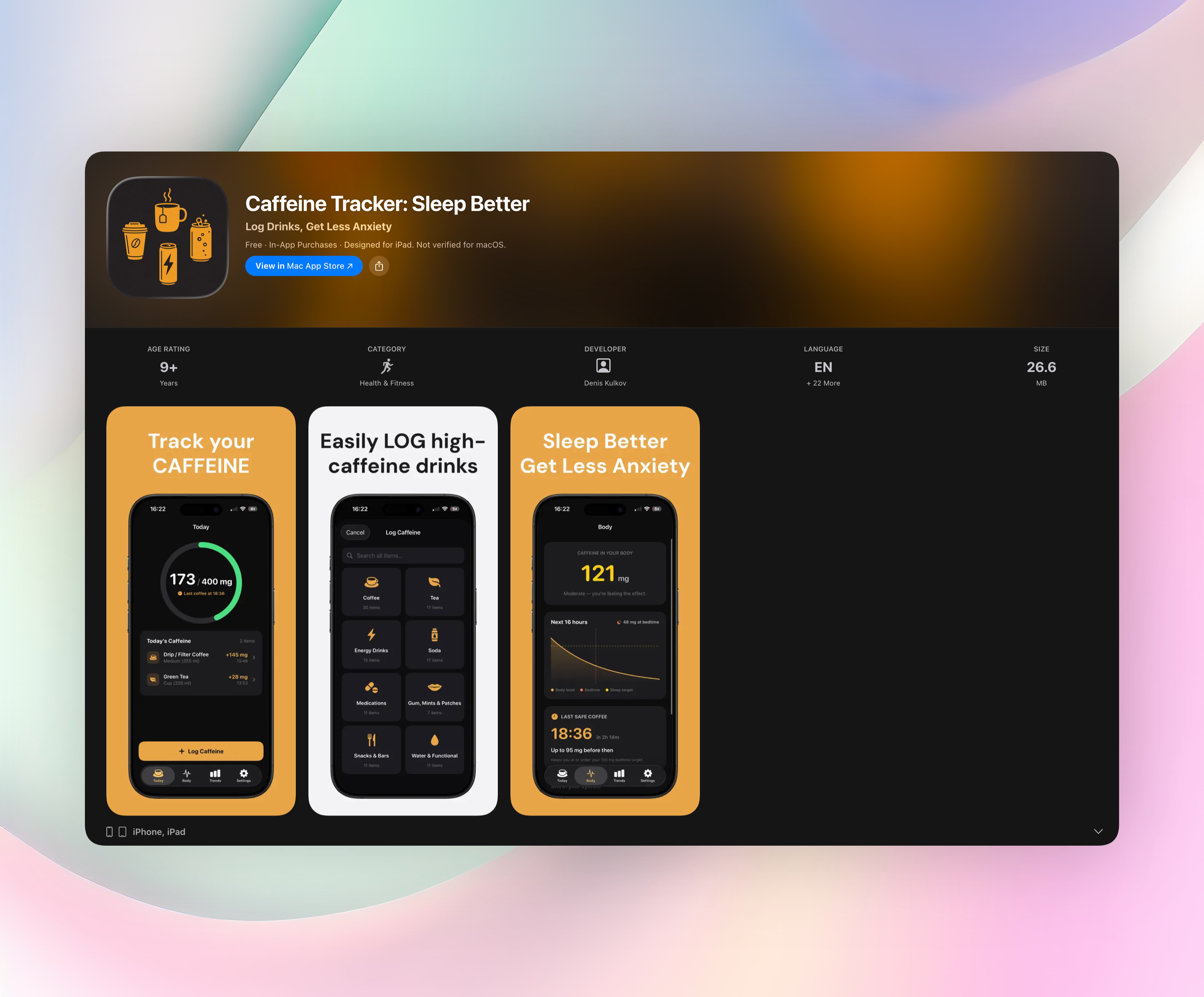
A percentage taper is impossible without a real baseline, and most people underestimate their intake by a drink or two once soda, tea, and pre-workout are counted. Logging an ordinary week before you change anything gives you the number to step down from. Caffeine Tracker is a caffeine tracking app for iPhone, which is enough to capture that baseline week and watch the daily target come down from it.
FAQ
How long does caffeine withdrawal last?
Two to nine days for most people, with the worst of it concentrated in a roughly 30-hour band between hours 20 and 51. Heavier habitual doses tend to sit at the longer end of that range. A residual flatness can outlast the headache by a few days.
Can one cup of coffee a day cause withdrawal?
Yes. Symptoms have been documented at habitual intakes of around 100 mg a day, which a single mug of drip coffee clears. The intensity scales with dose, so a one-cup habit usually means a mild headache rather than a lost weekend.
Does drinking coffee stop a caffeine withdrawal headache?
It does, typically within an hour — that rapid relief is part of the formal diagnostic definition. It also resets the clock, so relief now means the same withdrawal window opens again whenever you next stop.
Is tapering better than quitting caffeine cold turkey?
Tapering trades a short, intense couple of days for a longer, mostly symptom-free few weeks. Cold turkey is faster and gets you through it in under a week. Neither is safer than the other; the choice is about how much disruption you can absorb this week.
Free Caffeine tools
- Caffeine Half-Life & Sleep CalculatorA caffeine half life calculator for bedtime. Enter how many mg you had, when you had it and when you plan to sleep, and see how much caffeine is still in your system at bedtime, the share of the dose that is left, and when it falls to 50 mg.
- Caffeine Withdrawal Timeline PlannerMap a gradual caffeine reduction from your current daily intake to a day-by-day target, with common caffeine withdrawal windows shown alongside each date.
- Caffeine in Chocolate CalculatorChoose a chocolate type and enter a serving size to estimate the caffeine in that chocolate serving.
- Coffee Caffeine CalculatorPick your brew method and cup size to see how much caffeine is in a cup of coffee — the total mg, the mg in a standard 8 fl oz serving, and how much of the FDA's 400 mg daily guidance that uses. Typical values, not a measurement of your specific cup.
- Coffee to Water Ratio CalculatorFind how much grounds per cup of coffee you need, with grams, approximate tablespoons, water and a 1:n ratio for your brew method.
- Daily Caffeine Limit CalculatorSee how much caffeine you can have a day according to published guidance for your life stage, with an adult weight-based single-dose figure and drip coffee equivalent.
- Energy Drink Caffeine CalculatorChoose a brand and product, then enter the number of cans or shots to estimate total caffeine, caffeine density and the share of the FDA 400 mg daily figure.
- Espresso Caffeine CalculatorWork out how much caffeine is in an espresso shot: choose how many shots you pulled, how you pulled them and which beans went in. You get the total in mg, the mg per shot and how much of the FDA's 400 mg a day it uses.
- Half-Life Formula CalculatorEnter a starting amount, half-life and elapsed time or target amount. See the remainder, decay table, curve and worked formula for any substance.
- Matcha & Tea Caffeine CalculatorEstimate how much caffeine is in matcha green tea and other teas from powder weight or brewed serving size. See the result in mg and as a share of the FDA 400 mg daily figure.
- Soda Caffeine CalculatorEstimate total caffeine intake from soda servings using typical caffeine values for common soft drinks.
- Yerba Mate Caffeine CalculatorEstimate yerba mate caffeine from the amount of dry leaf, water volume and number of servings. Results are typical estimates, not exact measurements.