Caffeine before bed: calculating your real cutoff time
Caffeine before bed is a dose problem before it's a timing problem. Caffeine's half-life averages about five hours, so a 200 mg coffee still leaves roughly 50 mg circulating ten hours later. Your cutoff comes from working backward from your bedtime and your dose, not from a generic six-hour rule.
The arithmetic behind a caffeine cutoff time
Caffeine decays exponentially, not on a schedule. In healthy adults, caffeine's half-life runs roughly four to six hours, averaging about five — individual variation spans roughly 1.5 to 9.5 hours.
At a five-hour half-life, a 200 mg coffee starts at 200 mg, then drops to 100 mg at five hours, 50 mg at ten, 25 mg at fifteen. The halving interval is the same whatever you drink, so the dose drives the cutoff — 400 mg needs a whole extra half-life to land where 200 mg lands.
Aim for roughly 50 mg left at bedtime — about half a cup of drip coffee, and close to the smallest dose most people can still feel. It's a working threshold, not an official one. The shortcut: halve your dose until you're under 50 mg, then count five hours per halving. A 200 mg coffee halves twice, so ten hours. Full decay curve here: how long caffeine stays in your system.
When to stop drinking caffeine before bed, by dose
These assume a five-hour half-life, a 50 mg bedtime target, and an 11 p.m. bedtime. Shift the clock column with your own — a midnight bedtime buys back an hour on every row.
| Dose | Typical source | Hours to fall under ~50 mg | Cutoff for an 11 p.m. bedtime |
|---|---|---|---|
| 60 mg | single espresso shot | 1.5 | 9:30 p.m. |
| 95 mg | 8 oz home-brewed drip coffee | 4.5 | 6:30 p.m. |
| 150 mg | 16 oz energy drink | 8 | 3 p.m. |
| 200 mg | 16 oz coffeehouse drip coffee | 10 | 1 p.m. |
| 300 mg | 20 oz drip coffee, or a loaded pre-workout | 13 | 10 a.m. |
| 400 mg | a full day's guideline amount in one sitting | 15 | 8 a.m. |
A standard afternoon coffee, then, has a cutoff nearer 1 or 2 p.m. than the 4 p.m. most people assume — and only if your dose estimate is right. A 20 oz coffeehouse brew can carry three times an 8 oz home pour, so check how much caffeine is in a cup of coffee first.
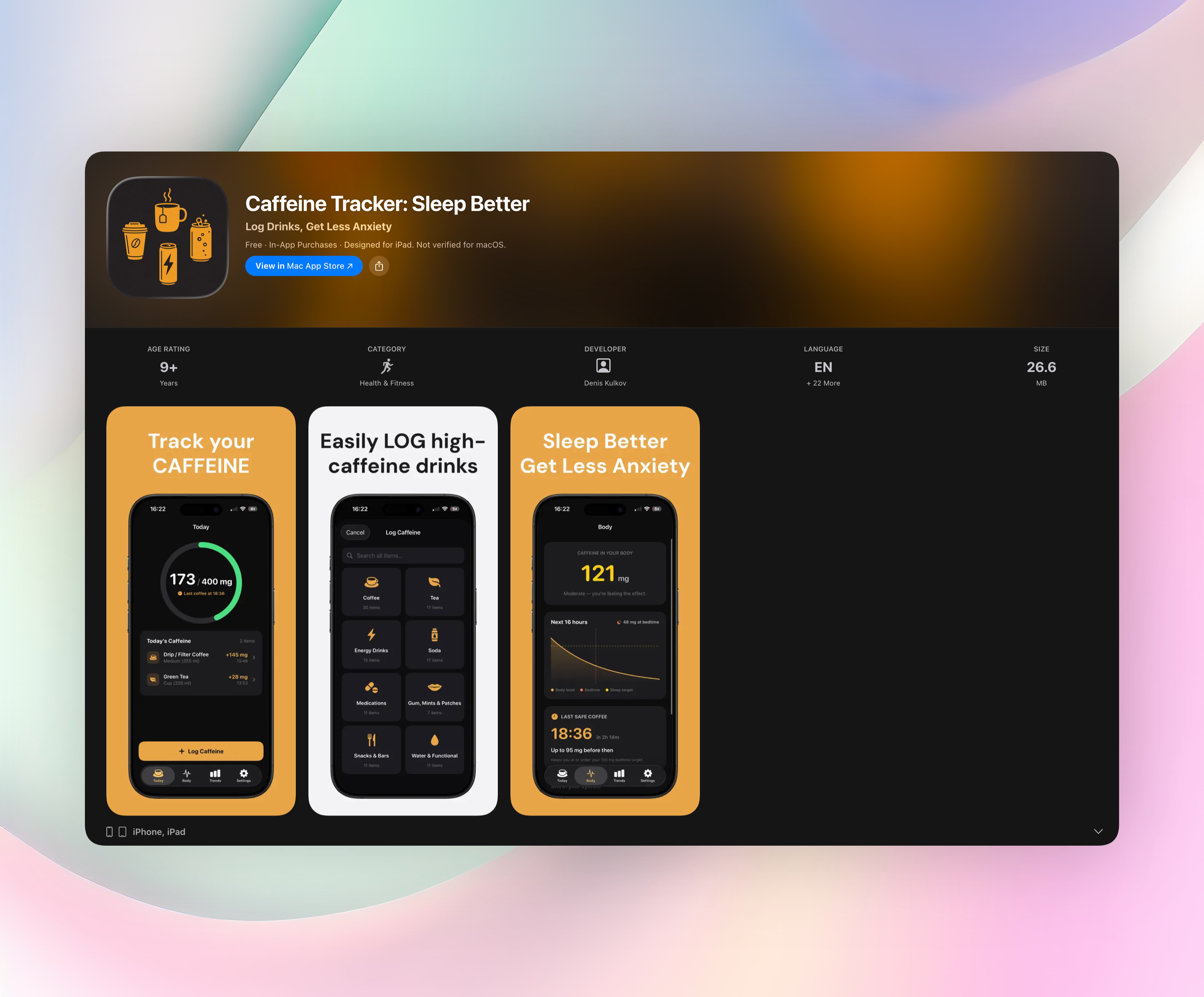
Running this once is easy; running it against every drink, every day, is the part people drop. Caffeine Tracker is a caffeine tracking app for iPhone that keeps the decay math running, so the projected level at your bedtime answers whether one more cup fits.
Why "six hours before bed" is the wrong default
How long before bed you stop drinking caffeine has to scale with the dose, and six hours is roughly one half-life — a fair floor for a small cup, nowhere near enough for a large one. A 200 mg coffee at 5 p.m. leaves about 90 mg at an 11 p.m. bedtime, more than a full cup of black tea and still occupying adenosine receptors.
The six-hour figure has research behind it, just not the research people assume. Controlled sleep-lab work found that 400 mg taken six hours before bed still measurably reduced total sleep time. That's evidence six hours doesn't reliably clear a large dose — not evidence that it does.
Falling asleep isn't the only thing at stake. Caffeine can suppress deep, slow-wave sleep without lengthening the time it takes to drop off, so it surfaces as unrefreshing sleep rather than insomnia — which is why people who sleep fine on coffee still register disruption when it's measured. More in what caffeine does to sleep quality.
Who needs a different caffeine cutoff
Half-life is not a constant. Things that stretch it:
- Slow metabolism. Variants in the CYP1A2 gene push clearance toward the long end of the range. No test needed: if a 2 p.m. coffee reliably delays sleep, work from a seven- to eight-hour half-life and add half again to the hours column.
- Pregnancy. Clearance slows markedly, and the half-life lengthens further through the second and third trimesters. Published ACOG guidance puts moderate intake at under 200 mg a day.
- Estrogen-containing oral contraceptives, which roughly double caffeine's half-life.
- CYP1A2-inhibiting medications such as fluvoxamine and ciprofloxacin, and impaired liver function.
Things that shorten it:
- Smoking. Tobacco smoke induces CYP1A2 and cuts the half-life by roughly half. It reverses within days of quitting, which is why the usual morning coffee feels like too much that first week.
- Fast metabolism, which pulls every row in the table forward.
Tolerance cuts across both. Heavy regular users adapt to the alerting effect, so a late coffee stops feeling stimulating — but tolerance to the sleep disruption is less complete.
You drank coffee at 9 p.m. — what actually helps
Nothing meaningfully accelerates caffeine clearance — not water, not exercise, not food. Eating alongside coffee slows absorption a little, flattening the peak without changing the total. Your liver sets the half-life, and there's no negotiating with it in one evening.
What's left is damage control. Skip the alcohol nightcap: it shortens the time to fall asleep but fragments the back half of the night, so you pay twice. Keep the room dark and cool. Then watch the second-day trap — a compensating extra-large morning coffee pushes tomorrow's cutoff even earlier.
FAQ
How many hours before bed should you stop drinking caffeine?
It depends on the dose more than anything else. At a five-hour half-life, a 95 mg cup needs about 4.5 hours to fall under 50 mg, a 200 mg cup about 10, and 400 mg about 15. Halve your dose until you're under 50 mg and count five hours per halving.
When should you stop drinking coffee before bed if you fall asleep easily anyway?
Falling asleep quickly doesn't mean the caffeine did nothing — it can reduce slow-wave sleep without changing how long you take to drop off, so the cost shows up as morning grogginess. A one- or two-week trial with an earlier cutoff is the practical way to find out.
Does decaf count toward the cutoff?
Barely. An 8 oz cup of decaf usually holds only a few milligrams, with measured samples as high as roughly 15 mg — not enough to move a bedtime calculation, though several cups across an evening add up to about an espresso shot.
Is 400 mg a day still fine if I keep everything before my cutoff?
The FDA cites 400 mg a day as an amount not generally associated with negative effects in healthy adults — a daily total, not a timing rule. The two constraints are independent: staying under the daily figure says nothing about whether the last dose lands close enough to bedtime to interfere with sleep. Published guidance sets a lower figure for pregnancy and some medical conditions.
Free Caffeine tools
- Caffeine Half-Life & Sleep CalculatorA caffeine half life calculator for bedtime. Enter how many mg you had, when you had it and when you plan to sleep, and see how much caffeine is still in your system at bedtime, the share of the dose that is left, and when it falls to 50 mg.
- Caffeine Withdrawal Timeline PlannerMap a gradual caffeine reduction from your current daily intake to a day-by-day target, with common caffeine withdrawal windows shown alongside each date.
- Caffeine in Chocolate CalculatorChoose a chocolate type and enter a serving size to estimate the caffeine in that chocolate serving.
- Coffee Caffeine CalculatorPick your brew method and cup size to see how much caffeine is in a cup of coffee — the total mg, the mg in a standard 8 fl oz serving, and how much of the FDA's 400 mg daily guidance that uses. Typical values, not a measurement of your specific cup.
- Coffee to Water Ratio CalculatorFind how much grounds per cup of coffee you need, with grams, approximate tablespoons, water and a 1:n ratio for your brew method.
- Daily Caffeine Limit CalculatorSee how much caffeine you can have a day according to published guidance for your life stage, with an adult weight-based single-dose figure and drip coffee equivalent.
- Energy Drink Caffeine CalculatorChoose a brand and product, then enter the number of cans or shots to estimate total caffeine, caffeine density and the share of the FDA 400 mg daily figure.
- Espresso Caffeine CalculatorWork out how much caffeine is in an espresso shot: choose how many shots you pulled, how you pulled them and which beans went in. You get the total in mg, the mg per shot and how much of the FDA's 400 mg a day it uses.
- Half-Life Formula CalculatorEnter a starting amount, half-life and elapsed time or target amount. See the remainder, decay table, curve and worked formula for any substance.
- Matcha & Tea Caffeine CalculatorEstimate how much caffeine is in matcha green tea and other teas from powder weight or brewed serving size. See the result in mg and as a share of the FDA 400 mg daily figure.
- Soda Caffeine CalculatorEstimate total caffeine intake from soda servings using typical caffeine values for common soft drinks.
- Yerba Mate Caffeine CalculatorEstimate yerba mate caffeine from the amount of dry leaf, water volume and number of servings. Results are typical estimates, not exact measurements.