How much caffeine during pregnancy — and what 200 mg looks like
Most guidance puts caffeine during pregnancy under 200 mg a day — roughly one 12-ounce cup of brewed coffee. That's half the 400 mg the FDA cites for other healthy adults. The tighter number bites harder than it looks, because caffeine clears more slowly as pregnancy progresses.
Where the 200 mg limit on caffeine during pregnancy comes from
The FDA's general figure is that 400 mg a day — four or five 8-ounce cups of coffee — isn't typically associated with negative effects in healthy adults. That number was never written for pregnancy. Obstetric guidance in the US describes moderate intake as less than 200 mg a day, and European food-safety guidance arrives at the same 200 mg from all sources. The phrasing varies (some bodies say "under 200," others "up to 200"), but the ceiling consistently lands at half the general-adult number.
That's guidance written for a population, not a prescription for a person. Anything specific — existing conditions, medications, how much you were drinking before — belongs with an OB or midwife.
What 200 mg actually buys
| Drink | Typical serving | Caffeine | Share of 200 mg |
|---|---|---|---|
| Brewed drip coffee | 12 oz | 140–200 mg | 70–100% |
| Coffee-shop brewed coffee | 16 oz | 200–330 mg | 100%+ |
| Espresso | 1 shot (1 oz) | ~64 mg | ~32% |
| Instant coffee | 8 oz | 60–80 mg | 30–40% |
| Black tea | 8 oz | 40–50 mg | 20–25% |
| Green tea | 8 oz | 25–30 mg | 12–15% |
| Matcha (1 tsp powder) | 8 oz prepared | 40–80 mg | 20–40% |
| Cola | 12 oz | 30–40 mg | 15–20% |
| Energy drink | 8–16 oz | 70–160 mg | 35–80% |
| Decaf coffee | 8 oz | 2–15 mg | 1–8% |
| Dark chocolate (70%) | 1 oz | 15–25 mg | 8–12% |
Three realistic ways to spend the entire budget: one 12-ounce cup of home-brewed coffee, three espresso shots spread across the day, or three to four cups of black tea. Brewed coffee is the least predictable of the three — roast, grind size, and brew ratio can move one cup by a hundred milligrams — which is why counting cups fails and counting milligrams doesn't. The caffeine range across coffee brew methods shows how wide that spread runs.
The trap is serving size. A 16-ounce shop coffee can clear 200 mg on its own, so "one coffee" and "one 8-ounce cup" are not the same measurement.
Clearance slows sharply across the trimesters
CYP1A2, a liver enzyme, handles roughly 95% of caffeine's first-pass metabolism. Rising estrogen suppresses that enzyme's activity through gestation, and the effect compounds: measured caffeine half-life roughly doubles by the second trimester and can approach triple by the third, with late-pregnancy figures commonly reported in the 10-to-18-hour range against a non-pregnant baseline near 4 to 6 hours.
The practical version — a 150 mg latte at 2 p.m., checked again at 10 p.m.:
- Non-pregnant, 5-hour half-life: roughly 50 mg still circulating
- Late third trimester, 12-hour half-life: roughly 95 mg still circulating
Same drink, nearly double the residue at bedtime, and that's before the next morning's coffee lands on top of it. At a 12-hour half-life the daily habit also stacks — yesterday's caffeine hasn't finished clearing when today's arrives, so a steady 200 mg a day settles at a higher baseline late in pregnancy than the same 200 mg did before. The underlying math is the same one covered in how long caffeine stays in your system, just with the clock stretched.
Two things follow from the enzyme story. Caffeine crosses the placenta freely, and the placenta and fetus have essentially no CYP1A2 activity of their own, so fetal exposure tracks whatever the mother hasn't yet cleared. And a cup that felt unremarkable at week 8 can feel different at week 34 with no change in the amount — the dose held steady, the clearance didn't.
Where the rest of the budget quietly goes
Most people counting caffeine while pregnant count drinks and stop there. Decaf coffee isn't caffeine-free: 8 ounces typically carries 2 to 15 mg, so three decafs can eat a tenth of the budget at the high end. Dark chocolate runs 15 to 25 mg per ounce. Yerba mate, guarana in pre-workout and "energy" powders, chocolate drinks, and bottled iced teas all contribute. So do combination headache tablets — several contain 65 mg per tablet — worth checking with a pharmacist rather than assuming. The caffeine hiding in chocolate and everyday foods covers the small sources that add up.
Keeping a running total
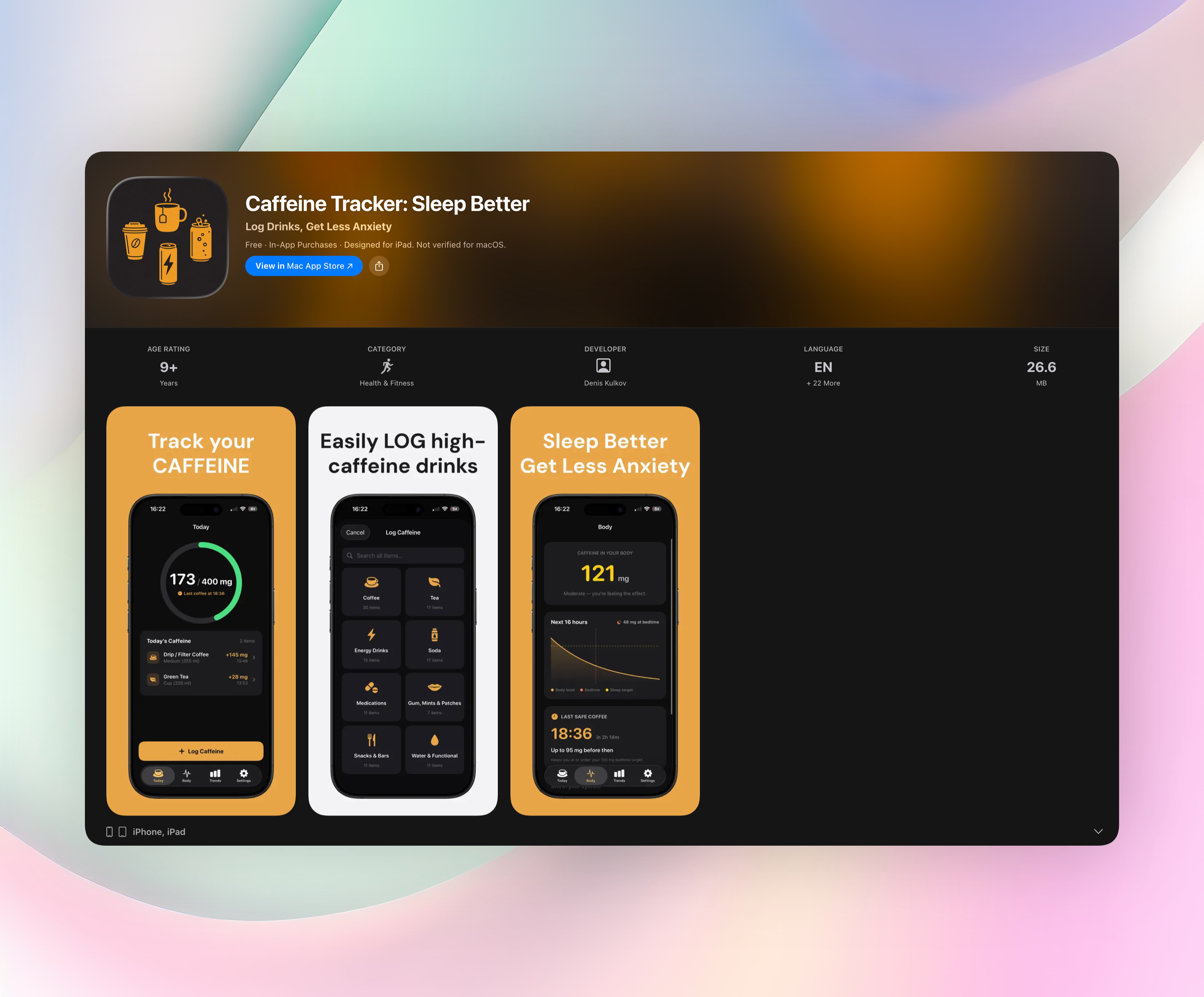
A 200 mg ceiling usually breaks on estimation rather than discipline — the shop coffee logged as "one cup" was closer to two, and the square of dark chocolate never got counted. Caffeine Tracker, a caffeine tracking app for iPhone, is one way to handle that: every drink logs against a 200 mg ceiling so the running total stays honest instead of guessed.
The numbers loosen after delivery
The commonly cited ceiling for caffeine and breastfeeding is around 300 mg a day — higher than the pregnancy figure for a straightforward reason. Only a small fraction of a maternal dose reaches milk, typically reported at well under 2%, and milk levels peak roughly one to two hours after intake. The mother is no longer the fetus's only metabolic pathway, so the constraint moves.
It moves to the infant, who is a far weaker metabolizer than the mother ever was. Reported newborn caffeine half-lives run to several days in the first weeks of life, drop to roughly half a day by three to five months, and approach adult values near six months. Preterm infants are slower still, which is why caffeine citrate can be dosed once daily as a treatment for apnea of prematurity. In practice: at three weeks old, small repeated exposures accumulate across days; at six months, the same exposure behaves much more like it does in an adult.
Fussiness, jitteriness, or short sleep stretches in a young infant are what parents tend to notice first. Whether caffeine is the cause, and what to change, is a conversation for a pediatrician — the figures here describe typical physiology, not any particular baby.
FAQ
How much caffeine during pregnancy is too much?
Standard guidance draws the line at 200 mg a day from all sources, roughly one 12-ounce brewed coffee. Past that, the evidence is debated rather than settled, which is why the ceiling sits well below the 400 mg figure used for other adults. Sources add up, so the daily total matters more than any single drink.
Is caffeine safe during pregnancy in the first trimester?
Guidance applies the same 200 mg ceiling across all three trimesters rather than setting a stricter first-trimester number. Clearance is closest to normal early on and slows later, so identical intake produces higher sustained levels as the pregnancy goes on. Anything specific to your own situation is a question for your OB or midwife.
Does decaf coffee count toward the 200 mg limit?
Yes, though only barely. Decaf typically holds 2 to 15 mg per 8-ounce cup rather than zero, so a few cups a day is a small but real slice of the budget. It's still the most common swap once regular coffee is capped.
How much caffeine while breastfeeding is generally considered fine?
Around 300 mg a day is the figure cited most often, since very little of what the mother drinks reaches milk. The caveat is the baby's age — a newborn clears caffeine over days rather than hours, so identical intake accumulates very differently at three weeks than at six months.
Why does coffee feel stronger in the third trimester?
Caffeine's half-life stretches as CYP1A2 activity falls, so an identical cup stays in circulation far longer than it did pre-pregnancy. Late-pregnancy half-lives in the 10-to-18-hour range are commonly reported, against 4 to 6 hours before. The change is slower clearance, not a stronger dose.
Free Caffeine tools
- Caffeine Half-Life & Sleep CalculatorA caffeine half life calculator for bedtime. Enter how many mg you had, when you had it and when you plan to sleep, and see how much caffeine is still in your system at bedtime, the share of the dose that is left, and when it falls to 50 mg.
- Caffeine Withdrawal Timeline PlannerMap a gradual caffeine reduction from your current daily intake to a day-by-day target, with common caffeine withdrawal windows shown alongside each date.
- Caffeine in Chocolate CalculatorChoose a chocolate type and enter a serving size to estimate the caffeine in that chocolate serving.
- Coffee Caffeine CalculatorPick your brew method and cup size to see how much caffeine is in a cup of coffee — the total mg, the mg in a standard 8 fl oz serving, and how much of the FDA's 400 mg daily guidance that uses. Typical values, not a measurement of your specific cup.
- Coffee to Water Ratio CalculatorFind how much grounds per cup of coffee you need, with grams, approximate tablespoons, water and a 1:n ratio for your brew method.
- Daily Caffeine Limit CalculatorSee how much caffeine you can have a day according to published guidance for your life stage, with an adult weight-based single-dose figure and drip coffee equivalent.
- Energy Drink Caffeine CalculatorChoose a brand and product, then enter the number of cans or shots to estimate total caffeine, caffeine density and the share of the FDA 400 mg daily figure.
- Espresso Caffeine CalculatorWork out how much caffeine is in an espresso shot: choose how many shots you pulled, how you pulled them and which beans went in. You get the total in mg, the mg per shot and how much of the FDA's 400 mg a day it uses.
- Half-Life Formula CalculatorEnter a starting amount, half-life and elapsed time or target amount. See the remainder, decay table, curve and worked formula for any substance.
- Matcha & Tea Caffeine CalculatorEstimate how much caffeine is in matcha green tea and other teas from powder weight or brewed serving size. See the result in mg and as a share of the FDA 400 mg daily figure.
- Soda Caffeine CalculatorEstimate total caffeine intake from soda servings using typical caffeine values for common soft drinks.
- Yerba Mate Caffeine CalculatorEstimate yerba mate caffeine from the amount of dry leaf, water volume and number of servings. Results are typical estimates, not exact measurements.