Does green tea have caffeine? A mg guide to every tea
Yes. Green tea has caffeine — roughly 20 to 50 mg in an 8 oz cup, about a third of what the same size cup of drip coffee delivers. Every true tea contains some, because green, black, white, oolong, and pu-erh all come from one plant, Camellia sinensis.
Does green tea have caffeine in a predictable amount? Not quite
A 30 mg spread between two cups of the same tea isn't sloppy measurement. Three variables do most of the work.
Water temperature. Caffeine dissolves faster the hotter the water. Green tea is usually brewed at 160–180°F rather than a rolling boil, and that alone pulls less caffeine from the identical leaf than a 212°F steep would.
Steep time. Caffeine is among the first compounds to leave the leaf. A one-minute steep of a Japanese sencha might land near 20 mg; the same leaf, hotter and held for three minutes, climbs toward 50.
Leaf material and format. Tea bags hold broken leaf and fannings — far more surface area than whole loose leaf, so they extract fast. Buds and young tips carry more caffeine than mature leaves, which is why shade-grown gyokuro sits at the top of the green range and roasted, stem-heavy hojicha sits at the bottom.
How much caffeine in green tea, black tea, and every other type
Typical brewed values for a standard cup (8 fl oz / 240 ml), single infusion.
| Drink (8 oz cup) | Typical caffeine | Usual range |
|---|---|---|
| Rooibos, chamomile, peppermint, hibiscus | 0 mg | none |
| Decaf black tea | 2 mg | 1–8 mg |
| White tea | 25 mg | 15–45 mg |
| Green tea | 30 mg | 20–50 mg |
| Oolong | 40 mg | 30–55 mg |
| Pu-erh | 45 mg | 30–70 mg |
| Black tea | 47 mg | 40–75 mg |
| Masala chai, black tea base with milk | 40 mg | 25–70 mg |
| Matcha, 1 tsp (2 g) whisked | 65 mg | 40–90 mg |
| Drip coffee, for reference | 95 mg | 70–140 mg |
Two rows need a footnote. White tea's low-caffeine reputation is only half-earned: the processing is minimal, but the premium styles are made from unopened buds, and buds are the most caffeinated part of the plant, so a silver needle can out-caffeinate a green tea. Matcha is the other outlier, because you drink the powdered leaf instead of an infusion of it — the reason matcha lands closer to coffee than to steeped green tea.
Does tea have more caffeine than coffee?
By dry weight, yes, and that's where the confusion starts. Tea leaf is roughly 3–4% caffeine; roasted arabica is closer to 1–1.5%. Gram for gram the leaf wins comfortably.
The cup says the opposite, because the doses aren't comparable. A cup of tea uses about 2 grams of leaf. A cup of drip coffee uses about 10 grams of grounds. Two grams of tea at 3.5% holds roughly 70 mg of available caffeine, and a normal steep extracts 40 to 50 of it. Ten grams of coffee at 1.2% holds around 120 mg, and brewing gets most of that out. A leaf with three times the caffeine density still produces a cup with half the caffeine of a standard cup of coffee.
Does chai have caffeine? Yes, often more than expected
Masala chai is black tea plus spices — cardamom, ginger, cinnamon, clove, black pepper — and none of those spices contain caffeine. All of it comes from the tea. Chai is also traditionally brewed strong and simmered before milk goes in, so a homemade cup tends to land at the top of the black tea range rather than the middle.
Two traps at a café counter. A "dirty chai" is a chai latte with a shot of espresso added, stacking roughly 60 to 75 mg on top of the tea. And chai concentrates vary enormously between brands — some are brewed to double strength, others are mostly sugar and spice over a light tea base. When a label prints caffeine per serving, that number beats any general estimate.
Rooibos chai and similar herbal blends swap the black tea for a caffeine-free base. Same spice profile, no caffeine.
The teas that genuinely have none
Anything not made from Camellia sinensis is a tisane, and most carry no caffeine at all: rooibos, honeybush, chamomile, peppermint, ginger, hibiscus, lemon balm, lemongrass. Zero, not "very low."
Two exceptions sit on the same shelf without belonging there: yerba mate runs 60 to 90 mg per cup, and guayusa is similar.
Decaf tea is not caffeine-free
Decaffeination strips most of the caffeine, not all of it. The commercial threshold generally applied is 97% removal, which leaves a decaf black tea somewhere near 2 to 5 mg a cup — negligible for one cup, less so if decaf is what you drink all evening.
The related folk trick, rinsing leaves for 30 seconds to "decaffeinate" them, doesn't work. Caffeine does come out early, but a short rinse removes only a fraction of it and takes a good deal of the flavor along with it.
Small cups add up to a real dose
The published reference point for healthy adults is the FDA's 400 mg a day, and 400 mg is more tea than it sounds — eight or nine cups of black tea, against about four coffees. Guidance differs for some groups, including during pregnancy.
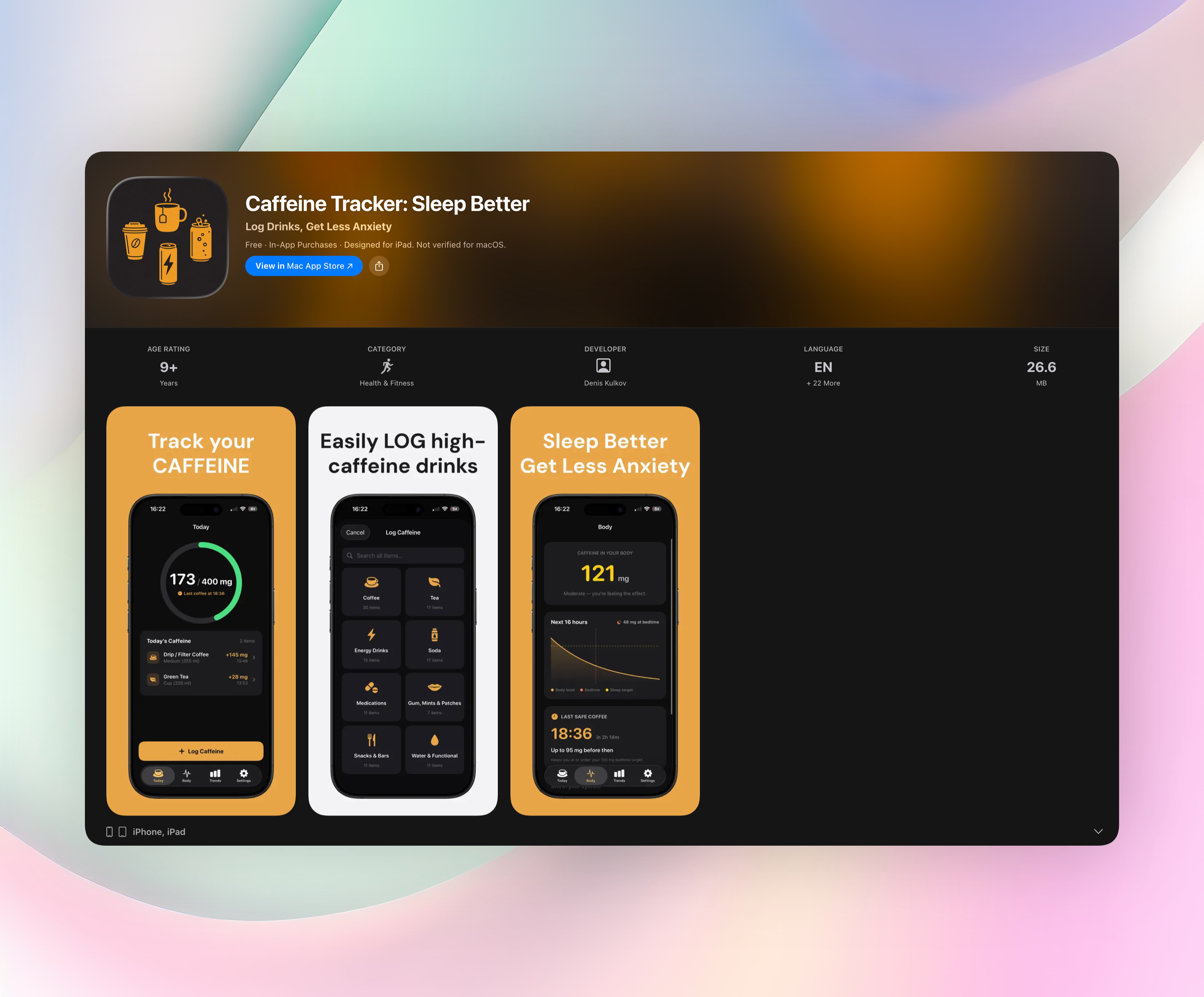
The arithmetic is where tea drinkers lose track. Four cups spread across a workday reads as nothing, but four black teas at 45 mg is 180 mg, and the last two usually land in the afternoon. A running daily total settles that faster than any per-cup estimate, which is what a caffeine tracking app for iPhone like Caffeine Tracker is for.
FAQ
How much caffeine in a cup of tea, compared to a cup of coffee?
A standard 8 oz cup of tea runs 15 to 75 mg depending on the type, against roughly 95 mg for drip coffee. Black tea is closest at 40 to 75 mg, while green tea sits near a third of a coffee. Matcha is the exception, since you consume the whole leaf rather than an infusion.
How much caffeine in black tea versus green tea?
Black tea typically brews to 40 to 75 mg per 8 oz cup and green tea to 20 to 50 mg. The gap has less to do with oxidation than with method — black tea is steeped in boiling water for three to five minutes, green tea in cooler water for one to three.
Does re-steeping tea leaves lower the caffeine?
Yes. Caffeine extracts early, so a second infusion of the same leaf carries noticeably less than the first, though not zero — a long second steep still pulls out a fair amount.
Is the caffeine in tea gentler than the caffeine in coffee?
The molecule is identical. What differs is the dose per cup and the presence of L-theanine, an amino acid found in Camellia sinensis and often credited with tea's steadier feel. The reliable difference is still the smaller dose.
Which real tea has the least caffeine?
Among true teas, roasted and stem-heavy styles like hojicha and kukicha are lowest, followed by green tea given cool water and a short steep. Below that you're into decaf, at a few mg, or caffeine-free tisanes.
Free Caffeine tools
- Caffeine Half-Life & Sleep CalculatorA caffeine half life calculator for bedtime. Enter how many mg you had, when you had it and when you plan to sleep, and see how much caffeine is still in your system at bedtime, the share of the dose that is left, and when it falls to 50 mg.
- Caffeine Withdrawal Timeline PlannerMap a gradual caffeine reduction from your current daily intake to a day-by-day target, with common caffeine withdrawal windows shown alongside each date.
- Caffeine in Chocolate CalculatorChoose a chocolate type and enter a serving size to estimate the caffeine in that chocolate serving.
- Coffee Caffeine CalculatorPick your brew method and cup size to see how much caffeine is in a cup of coffee — the total mg, the mg in a standard 8 fl oz serving, and how much of the FDA's 400 mg daily guidance that uses. Typical values, not a measurement of your specific cup.
- Coffee to Water Ratio CalculatorFind how much grounds per cup of coffee you need, with grams, approximate tablespoons, water and a 1:n ratio for your brew method.
- Daily Caffeine Limit CalculatorSee how much caffeine you can have a day according to published guidance for your life stage, with an adult weight-based single-dose figure and drip coffee equivalent.
- Energy Drink Caffeine CalculatorChoose a brand and product, then enter the number of cans or shots to estimate total caffeine, caffeine density and the share of the FDA 400 mg daily figure.
- Espresso Caffeine CalculatorWork out how much caffeine is in an espresso shot: choose how many shots you pulled, how you pulled them and which beans went in. You get the total in mg, the mg per shot and how much of the FDA's 400 mg a day it uses.
- Half-Life Formula CalculatorEnter a starting amount, half-life and elapsed time or target amount. See the remainder, decay table, curve and worked formula for any substance.
- Matcha & Tea Caffeine CalculatorEstimate how much caffeine is in matcha green tea and other teas from powder weight or brewed serving size. See the result in mg and as a share of the FDA 400 mg daily figure.
- Soda Caffeine CalculatorEstimate total caffeine intake from soda servings using typical caffeine values for common soft drinks.
- Yerba Mate Caffeine CalculatorEstimate yerba mate caffeine from the amount of dry leaf, water volume and number of servings. Results are typical estimates, not exact measurements.