Does chocolate have caffeine, and what else are you missing?
Yes — dark chocolate carries roughly 12 mg of caffeine per ounce, and an 85% cacao bar is closer to 25 mg. Milk chocolate runs about 6 mg an ounce; white chocolate has none. Real caffeine, small doses, and rarely the only source going uncounted in a day.
Does chocolate have caffeine? Yes, and it scales with cacao
Caffeine sits in the cocoa solids, so the percentage on the wrapper is the number that matters. Dark chocolate in the 45–59% cacao range runs about 43 mg per 100 g, or roughly 12 mg an ounce. At 70–85% cacao it about doubles, to near 80 mg per 100 g — call it 23 mg an ounce. Milk chocolate sits around 20 mg per 100 g. White chocolate is cocoa butter with the solids removed, so it has none.
A whole 3.5 oz bar of 85% dark therefore lands in the range of a brewed cup of coffee. Few people eat a bar in one sitting, but four squares after dinner is a real 25–50 mg.
Cocoa's dominant stimulant isn't caffeine, though. It's theobromine, a chemical cousin present at roughly ten times the amount — weaker, but slower to clear.
Hidden caffeine sources at a glance
| Source | Typical serving | Caffeine |
|---|---|---|
| Dark chocolate, 70–85% cacao | 1 oz | 22–25 mg |
| Dark chocolate, 45–59% cacao | 1 oz | ~12 mg |
| Milk chocolate | 1 oz | 5–6 mg |
| Unsweetened cocoa powder | 1 tbsp | ~12 mg |
| Hot cocoa from a mix | 8 oz | 3–13 mg |
| Coffee ice cream | 1/2 cup | 25–45 mg |
| Yerba mate | 8 oz | 65–130 mg |
| Kombucha | 16 oz bottle | 5–25 mg |
| Chocolate or coffee protein bar | 1 bar | 5–100 mg |
| Pre-workout powder | 1 scoop | 150–350 mg |
| Excedrin Extra Strength | 1 tablet | 65 mg |
| Caffeine tablet (NoDoz, Vivarin) | 1 tablet | 200 mg |
Where a label states a figure, trust it over any chart.
How much caffeine in yerba mate, kombucha, and other tea drinks
Yerba mate lands between 65 and 130 mg per 8 oz cup, depending on leaf-to-water ratio and steep time. The traditional gourd is refilled many times from one load of leaf, so a single session can total well past a cup of coffee.
Kombucha is brewed from tea, and fermentation doesn't strip the caffeine out. Most bottles carry 5–25 mg. Labels often say "trace amounts," which is fair per ounce and misleading if you drink two.
How much caffeine in pre-workout, and why the label undersells it
Pre-workout powders are the largest single miss. A scoop typically holds 150–350 mg, and some formulas go past 400. Two things compound it: "one serving" means one level scoop, and people take a heaping one; and caffeine anhydrous is usually stacked with green tea extract, guarana, or kola nut inside a proprietary blend.
Guarana seed contains roughly twice the caffeine by weight of a coffee bean. In the US, added caffeine has to appear in the ingredient list, but the amount doesn't have to be declared — so a blend can contribute a hundred milligrams that never appears as a number on the tub.
Caffeine in protein bars, energy bars, and coffee ice cream
Caffeine in protein bars arrives two ways. Bars that get theirs from cocoa or a chocolate coating carry a modest 5–15 mg and say nothing about it. Bars that add coffee or green tea extract on purpose — the "energy" line extensions — carry 50–100 mg and advertise it on the front.
Coffee ice cream is made with real coffee or espresso, so a half cup runs 25–45 mg and coffee-forward pints go higher. A bowl at 9 p.m. is a dose still circulating at bedtime.
The medications that push you past the line
Over-the-counter analgesics use caffeine as an adjuvant. Excedrin Extra Strength has 65 mg per tablet and the label dose is two — 130 mg, more than a shot of espresso; Excedrin Migraine is the same formula. Midol Complete has 60 mg per caplet, Anacin 32 mg, and NoDoz and Vivarin 200 mg apiece. Weight-loss and "energy" supplements often lean on green tea extract or guarana with no milligram figure printed.
Why your daily total is almost always low
The FDA's published guidance is that 400 mg a day isn't generally associated with negative effects in healthy adults; ACOG's guidance in pregnancy is 200 mg. Both refer to intake from every source, not coffee alone. Two cups (190 mg), a pre-workout scoop (200 mg), two squares of 85% dark (25 mg), and a bowl of coffee ice cream (35 mg) is 450 mg — past the 400 mg guideline on a day you'd describe as "just two coffees."
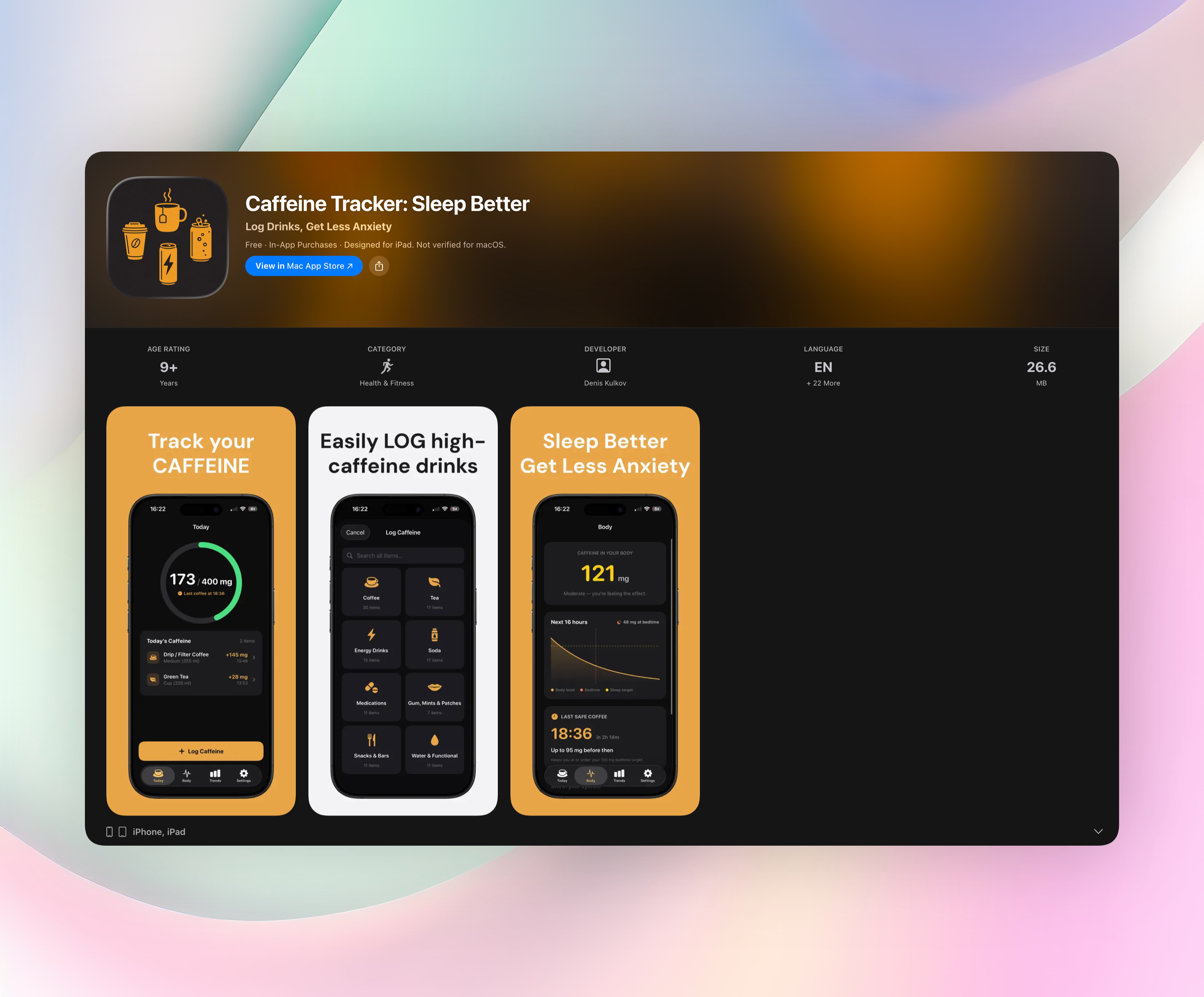
The fix is arithmetic, not abstinence: log the non-drink sources next to the drinks. Caffeine Tracker is a caffeine tracking app for iPhone, so the bars, the chocolate, and the pre-workout land in the same running total as the coffee.
FAQ
Does white chocolate have caffeine?
No. White chocolate is cocoa butter, sugar, and milk solids, with the cocoa solids removed — and the caffeine lives in those solids. It's the one chocolate that adds nothing to a daily total.
How much caffeine in chocolate compared to a cup of coffee?
An 8 oz cup of brewed coffee averages around 95 mg. Matching that takes roughly four ounces of 70–85% dark chocolate, or about a pound of milk chocolate. Chocolate matters as part of a total, not on its own.
Will eating chocolate before bed keep me awake?
A square or two of dark chocolate is 12–25 mg, small enough that most people won't notice. Half a bar plus a bowl of coffee ice cream can reach 80 mg late in the evening, which caffeine-sensitive sleepers tend to feel.
How do I find out how much caffeine is in a supplement?
Check whether the label declares milligrams — many don't. Then read the ingredient list for caffeine anhydrous, guarana, green tea extract, kola nut, and coffee bean extract. Inside a proprietary blend with no per-ingredient amounts, the amount is simply unknown.
Free Caffeine tools
- Caffeine Half-Life & Sleep CalculatorA caffeine half life calculator for bedtime. Enter how many mg you had, when you had it and when you plan to sleep, and see how much caffeine is still in your system at bedtime, the share of the dose that is left, and when it falls to 50 mg.
- Caffeine Withdrawal Timeline PlannerMap a gradual caffeine reduction from your current daily intake to a day-by-day target, with common caffeine withdrawal windows shown alongside each date.
- Caffeine in Chocolate CalculatorChoose a chocolate type and enter a serving size to estimate the caffeine in that chocolate serving.
- Coffee Caffeine CalculatorPick your brew method and cup size to see how much caffeine is in a cup of coffee — the total mg, the mg in a standard 8 fl oz serving, and how much of the FDA's 400 mg daily guidance that uses. Typical values, not a measurement of your specific cup.
- Coffee to Water Ratio CalculatorFind how much grounds per cup of coffee you need, with grams, approximate tablespoons, water and a 1:n ratio for your brew method.
- Daily Caffeine Limit CalculatorSee how much caffeine you can have a day according to published guidance for your life stage, with an adult weight-based single-dose figure and drip coffee equivalent.
- Energy Drink Caffeine CalculatorChoose a brand and product, then enter the number of cans or shots to estimate total caffeine, caffeine density and the share of the FDA 400 mg daily figure.
- Espresso Caffeine CalculatorWork out how much caffeine is in an espresso shot: choose how many shots you pulled, how you pulled them and which beans went in. You get the total in mg, the mg per shot and how much of the FDA's 400 mg a day it uses.
- Half-Life Formula CalculatorEnter a starting amount, half-life and elapsed time or target amount. See the remainder, decay table, curve and worked formula for any substance.
- Matcha & Tea Caffeine CalculatorEstimate how much caffeine is in matcha green tea and other teas from powder weight or brewed serving size. See the result in mg and as a share of the FDA 400 mg daily figure.
- Soda Caffeine CalculatorEstimate total caffeine intake from soda servings using typical caffeine values for common soft drinks.
- Yerba Mate Caffeine CalculatorEstimate yerba mate caffeine from the amount of dry leaf, water volume and number of servings. Results are typical estimates, not exact measurements.