How much caffeine in a shot of espresso, and in the drinks built from it
How much caffeine in a shot of espresso? About 63 mg in a single one-ounce shot, and roughly 125 mg in the double that most US cafés pull by default. Bean and dose move that number a little; cup size doesn't move it at all.
How much caffeine in a shot of espresso, compared to coffee
Per ounce, espresso is roughly five times as caffeinated as drip. Per serving, it loses. A one-ounce shot lands near 63 mg, while an 8-ounce cup of brewed coffee averages about 95 mg and a 12-ounce mug of the same brew clears 140 mg.
That gap explains the "espresso is stronger" instinct. It tastes stronger, it hits the palate harder, and it's gone in two swallows — but you drank one ounce. Concentration and total dose are different questions, and the one your body responds to is dose.
What changes the caffeine in an espresso shot
Four variables, in rough order of how much they matter.
Shot count. A single basket takes about 7 g of dry coffee; a double runs 14–20 g, with most specialty cafés today dosing toward the higher end. Most US cafés pull doubles as standard, so "one espresso" ordered at a counter is often already 125 mg. In Italy, a single is still the default. If it matters to you, ask which one you're getting.
Bean species. Robusta carries roughly twice the caffeine of arabica by weight. Traditional Italian-style blends often include robusta for crema and body, which pushes those shots toward the high end of the range.
Ristretto vs. lungo. A ristretto stops the pull early, sending about half the water through the same grounds. It holds slightly less caffeine than a full shot, but nowhere near half — caffeine extracts early and fast. A lungo runs extra water through and pulls a bit more.
Roast level. Less than people assume. Caffeine survives roasting nearly intact. Dark roast beans are less dense, so a scoop of dark roast holds fewer beans and a little less caffeine. Weigh the dose instead of scooping it and the difference mostly vanishes.
Put together: a single realistically runs 60–70 mg, a double 120–140 mg.
How much caffeine in a latte, cappuccino, flat white, or cortado
Milk has no caffeine. Neither does foam, oat milk, vanilla syrup, or ice. So how much caffeine in a latte comes down to one number — the shots.
| Drink | Typical shots | Caffeine |
|---|---|---|
| Espresso, single | 1 | ~63 mg |
| Doppio (double espresso) | 2 | ~125 mg |
| Macchiato, traditional | 1 | ~63 mg |
| Cortado / Gibraltar | 1–2 | ~63–125 mg |
| Cappuccino, 6 oz traditional | 1 | ~63 mg |
| Flat white | 2 ristretto | ~110–125 mg |
| Latte, any cup size | 1–2 | ~63–125 mg |
| Americano | 1–4 | ~63–250 mg |
| Mocha | 1–2 | shots, plus a little from the chocolate |
The consequence most drink menus obscure: a 16-ounce latte built on two shots and a 20-ounce latte built on the same two shots carry identical caffeine, about 125 mg each. The bigger cup is more milk. Ordering up gets you volume, not stimulant — unless the shop adds a shot with the size, which some do and some don't.
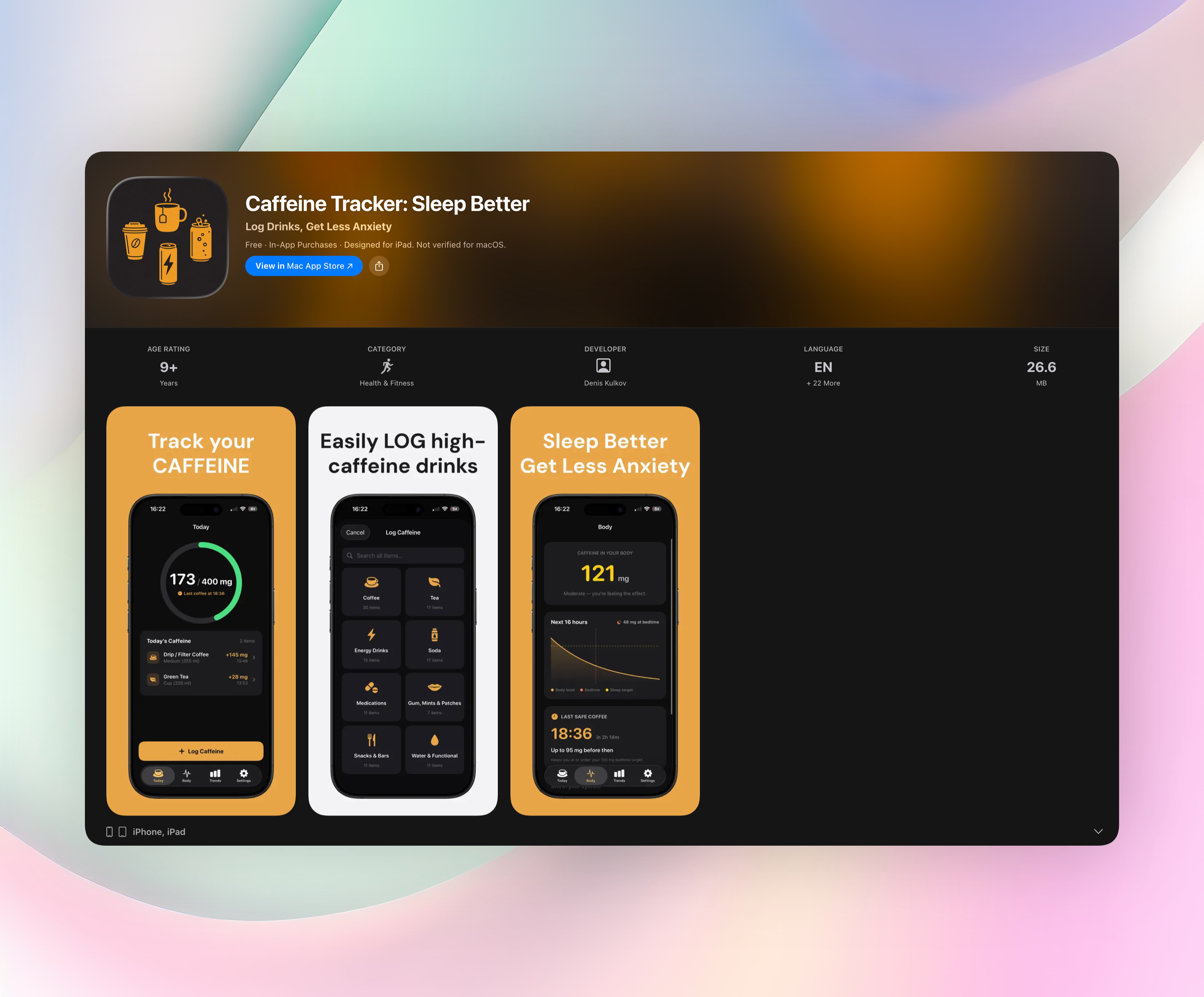
If you track intake, count shots rather than drink names. "Latte" spans 63 mg to 250 mg depending on whose counter you ordered it from. Caffeine Tracker is a caffeine tracking app for iPhone, and entering a double-shot latte as two shots keeps the daily total honest instead of averaging it into fiction.
How much caffeine in a Nespresso pod, by line
Nespresso publishes a figure for each capsule, and the spread between lines is wide enough that "a pod" is not a useful unit. Rough bands:
Original line — small capsules, you pick the cup volume:
- Espresso capsules: roughly 55–80 mg
- Lungo capsules: roughly 75–90 mg
- The high-intensity ones (Kazaar and similar): up to about 120 mg
Vertuo — the rim barcode sets the volume, so the pod size is the drink size:
- Espresso, 1.35 oz: ~60–80 mg
- Double Espresso, 2.7 oz: ~110–130 mg
- Gran Lungo, 5 oz: ~130–200 mg
- Mug / Coffee, 7.8 oz: ~170–200 mg
- Alto, 14 oz: ~200–250 mg
Two things follow. A Vertuo Coffee or Alto pod isn't an espresso shot at all — it's a full cup of coffee, and it should be counted like one. And two Original espresso pods land close to a single café double, which is why home machines often understate the day's total: the pods feel small.
How much caffeine in Starbucks coffee, counted in shots
Starbucks lists a solo shot at about 75 mg, above the 63 mg average, since the blend is roasted dark and pulled to their own spec. Their milk drinks then follow a size ladder that stops climbing sooner than the cup does:
- Tall, 12 oz: 1 shot
- Grande, 16 oz: 2 shots
- Venti hot, 20 oz: 2 shots
- Venti iced, 24 oz: 3 shots
So a hot venti latte and a grande latte carry the same ~150 mg. The extra 4 ounces are steamed milk. Iced venti breaks the pattern because the cup is bigger again and the build adds a third shot.
Espresso-forward drinks scale differently. An Americano gains a shot per size — tall 2, grande 3, venti 4 — and the flat white is built on ristretto shots, one more than the same-size latte. Brewed coffee is a different animal entirely: a grande Pike Place runs around 310 mg, more than double the grande latte beside it, and Blonde Roast sits higher still.
Worth holding against the FDA's 400 mg-a-day guideline for healthy adults. One grande brewed coffee already gets you most of the way there; a second puts you well past it. On espresso, it takes three to four doubles to reach the same line.
FAQ
How much caffeine is in a double shot of espresso?
Around 125 mg, with a realistic range of 120–140 mg depending on the beans and the dose. That's the standard pour at most US cafés, so a plain "espresso" ordered at a counter is usually a doppio unless you specify a single.
Does a latte have more caffeine than a straight espresso?
Only if it contains more shots. A one-shot latte and a single espresso are the same ~63 mg; a two-shot latte doubles it. Milk, syrup, and cup size contribute nothing.
How much caffeine in a decaf espresso shot?
Decaf isn't caffeine-free. A decaf shot typically holds somewhere in the 3–15 mg range, depending on the decaffeination method and the roaster. Several decaf drinks across a day still add up to a measurable amount.
Is a ristretto lower in caffeine than a normal shot?
Slightly, not dramatically. Caffeine is highly soluble and comes out in the first seconds of extraction, so cutting the pull short removes water and bitterness faster than it removes caffeine. Expect a modest reduction, not half.
Does an afternoon espresso affect sleep?
A double is roughly 125 mg, and caffeine clears slowly enough that a mid-afternoon shot can still be active at bedtime for many people. Sensitivity varies widely, which is why cutoff times are usually set by personal experiment rather than a single rule.
Free Caffeine tools
- Caffeine Half-Life & Sleep CalculatorA caffeine half life calculator for bedtime. Enter how many mg you had, when you had it and when you plan to sleep, and see how much caffeine is still in your system at bedtime, the share of the dose that is left, and when it falls to 50 mg.
- Caffeine Withdrawal Timeline PlannerMap a gradual caffeine reduction from your current daily intake to a day-by-day target, with common caffeine withdrawal windows shown alongside each date.
- Caffeine in Chocolate CalculatorChoose a chocolate type and enter a serving size to estimate the caffeine in that chocolate serving.
- Coffee Caffeine CalculatorPick your brew method and cup size to see how much caffeine is in a cup of coffee — the total mg, the mg in a standard 8 fl oz serving, and how much of the FDA's 400 mg daily guidance that uses. Typical values, not a measurement of your specific cup.
- Coffee to Water Ratio CalculatorFind how much grounds per cup of coffee you need, with grams, approximate tablespoons, water and a 1:n ratio for your brew method.
- Daily Caffeine Limit CalculatorSee how much caffeine you can have a day according to published guidance for your life stage, with an adult weight-based single-dose figure and drip coffee equivalent.
- Energy Drink Caffeine CalculatorChoose a brand and product, then enter the number of cans or shots to estimate total caffeine, caffeine density and the share of the FDA 400 mg daily figure.
- Espresso Caffeine CalculatorWork out how much caffeine is in an espresso shot: choose how many shots you pulled, how you pulled them and which beans went in. You get the total in mg, the mg per shot and how much of the FDA's 400 mg a day it uses.
- Half-Life Formula CalculatorEnter a starting amount, half-life and elapsed time or target amount. See the remainder, decay table, curve and worked formula for any substance.
- Matcha & Tea Caffeine CalculatorEstimate how much caffeine is in matcha green tea and other teas from powder weight or brewed serving size. See the result in mg and as a share of the FDA 400 mg daily figure.
- Soda Caffeine CalculatorEstimate total caffeine intake from soda servings using typical caffeine values for common soft drinks.
- Yerba Mate Caffeine CalculatorEstimate yerba mate caffeine from the amount of dry leaf, water volume and number of servings. Results are typical estimates, not exact measurements.