Does matcha have caffeine, and how much is in a serving?
Yes. Matcha contains roughly 38 to 88 mg of caffeine per teaspoon of powder, depending on grade and how heavily you whisk it. That's well above a cup of steeped green tea at around 28 mg, and at the top of its range it reaches brewed-coffee territory.
Does matcha have caffeine? Yes, because you drink the whole leaf
Steeped tea is an infusion. Hot water pulls part of the leaf's caffeine into the cup, and the leaf goes in the bin with the rest still inside it. Matcha is a suspension — the leaf is stone-ground into powder, whisked into water, and swallowed. Nothing is left behind.
Same plant, Camellia sinensis, same caffeine chemistry, different delivery. A gram of leaf steeped in a cup surrenders a fraction of what it holds; a gram of matcha gives you all of it. Shade-growing widens the gap further, since tea grown under cover for its last few weeks produces more caffeine and more amino acids than tea in full sun.
How much caffeine in matcha: grade, dose, and what a café pours
Published measurements land in a wide band — roughly 19 to 44 mg of caffeine per gram of powder. Serving size does the rest:
- Usucha (thin tea), ~2 g / 1 tsp: about 38–88 mg
- Koicha (thick tea), ~4 g / 2 tsp: about 75–175 mg
- Café matcha latte: whatever the shop scoops, commonly 1–2 tsp
Grade runs opposite to most people's intuition about gentle tea. Ceremonial grades come from the first harvest and the youngest leaves, which carry the most caffeine; culinary grades use later harvests and older leaves and generally test lower. Paying more buys a smoother, less astringent bowl with more stimulant in it.
Two consequences follow. The tin rarely prints a milligram figure, so any number for your specific matcha is an estimate. And the latte is the least predictable serving on any menu — one shop's scoop can be double another's.
Matcha vs coffee, espresso, and black tea
| Drink | Typical serving | Caffeine |
|---|---|---|
| Matcha, usucha | 1 tsp (~2 g) whisked | 38–88 mg |
| Matcha latte | 1–2 tsp | 38–175 mg |
| Brewed coffee | 8 oz | ~95 mg |
| Espresso | 1 oz shot | ~64 mg |
| Black tea, steeped | 8 oz | ~47 mg |
| Green tea, steeped | 8 oz | ~28 mg |
| Decaf coffee | 8 oz | 2–5 mg |
Read those as ranges, not verdicts. Weak culinary matcha sits below a cup of black tea, while a generous ceremonial scoop in a 16 oz latte can beat a cup of brewed coffee. "Matcha has less caffeine than coffee" is true on average and wrong often enough to matter.
L-theanine and caffeine: what theanine changes, and what it doesn't
Matcha carries roughly 20–45 mg of L-theanine per 2 g serving, again higher in shaded, early-harvest leaf. Theanine is an amino acid nearly unique to tea, it crosses the blood-brain barrier, and it's associated with a calmer quality of alertness. That's a large part of why a bowl of matcha and an espresso with identical milligrams don't feel identical.
What theanine and caffeine together change is the texture of the stimulation: less edge, a flatter perceived onset. Some of that is the amino acid and some is pace — you sip a hot bowl over several minutes instead of knocking back a shot, and slower intake means a slower rise.
What that pairing does not change:
- The dose. 70 mg from matcha is 70 mg. Theanine cancels none of it.
- The clearance. Caffeine's half-life runs roughly 5 hours in healthy adults, commonly cited as 4–6. Theanine doesn't touch that, and it's metabolized and gone long before the caffeine is.
- The bedtime math. Whatever is still circulating at 11 p.m. is still blocking adenosine, however smooth it tasted at 5 p.m.
That mismatch — feels mild, isn't mild — is the whole problem with matcha.
Matcha still counts toward your daily total
The FDA cites 400 mg a day as an amount not generally associated with negative effects in healthy adults. It's a population guideline, and it says nothing about timing. Two matcha lattes and one coffee can clear 250 mg before noon without any of it registering as much.
Timing is where the smoothness costs you. A 70 mg bowl at 5 p.m. leaves about 35 mg at 10 p.m. and roughly 17 mg at 3 a.m. — small numbers arriving during the hours that matter most for deep sleep. If you're working out your own caffeine cutoff before bed, matcha belongs on the list rather than in the exempt column.
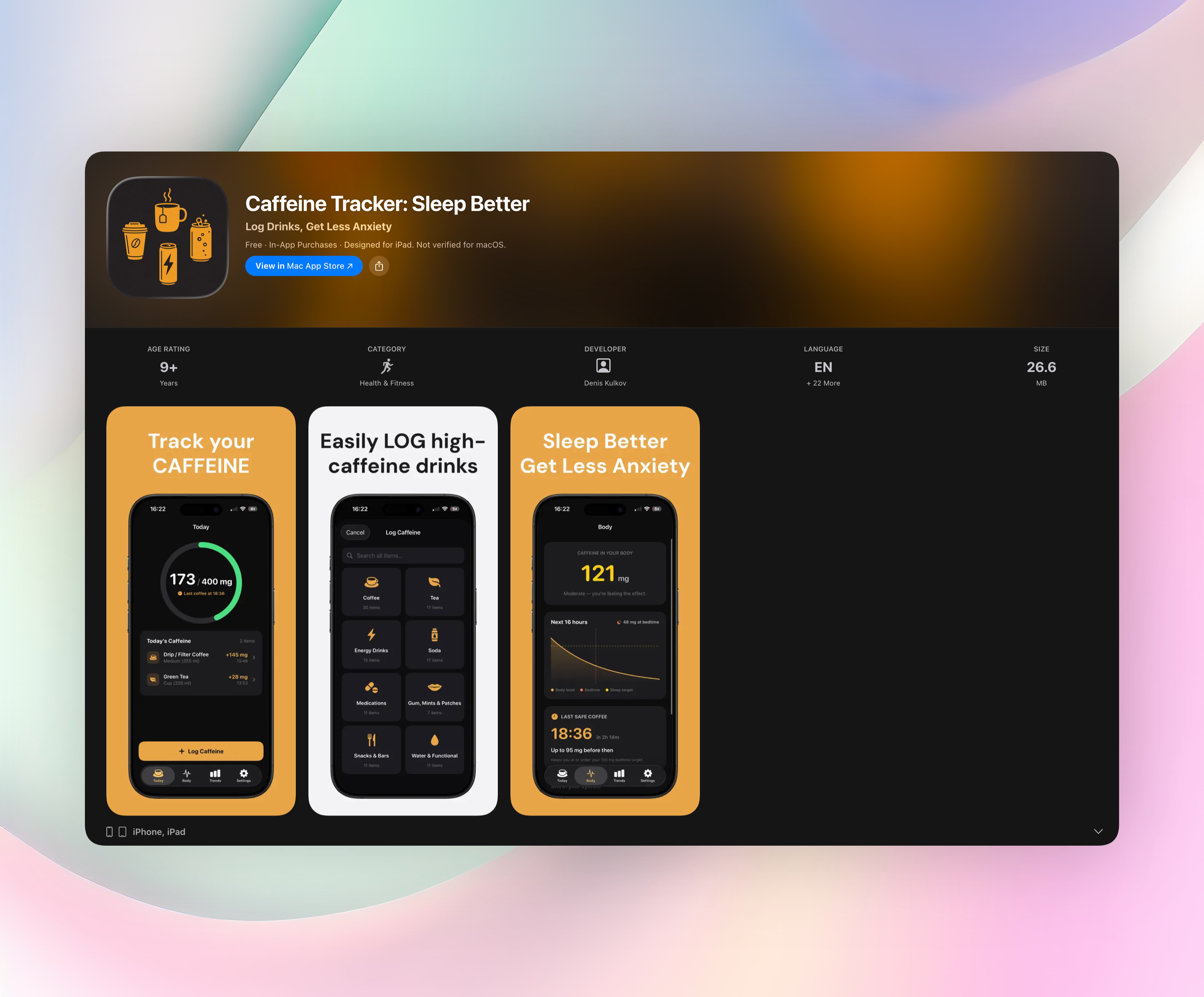
Because it's so easy to underestimate by feel, matcha is a good argument for writing intake down instead of judging it. Caffeine Tracker is a caffeine tracking app for iPhone, and putting an estimated milligram figure on each bowl stops a smooth-tasting drink from vanishing out of a running total.
FAQ
Does matcha have more caffeine than coffee?
Usually not, serving for serving. A teaspoon of matcha runs about 38–88 mg against roughly 95 mg for 8 oz of brewed coffee. A two-teaspoon ceremonial latte can pass a small coffee, so the answer depends on the scoop.
How much caffeine is in a matcha latte?
Roughly 38 to 175 mg. The variable is the powder, not the milk: a one-teaspoon latte sits at the low end, while cafés using two teaspoons in a large size land near a double espresso or above.
Does L-theanine cancel out caffeine?
No. It appears to change how caffeine feels — smoother, less jittery — without reducing the dose absorbed or how long it lasts. Treat theanine as a change in texture, not a discount on milligrams.
Does ceremonial matcha have more caffeine than culinary grade?
Generally yes. Ceremonial grades use young, first-harvest leaves grown under shade, which are higher in both caffeine and theanine. Culinary grades from later harvests usually test lower.
Is matcha a reasonable afternoon drink?
It's lower in caffeine than most coffee drinks, which helps, but it isn't caffeine-free and it clears on the same curve. A 3 p.m. bowl behaves like any other 50–80 mg dose taken at 3 p.m., whatever it tastes like.
Free Caffeine tools
- Caffeine Half-Life & Sleep CalculatorA caffeine half life calculator for bedtime. Enter how many mg you had, when you had it and when you plan to sleep, and see how much caffeine is still in your system at bedtime, the share of the dose that is left, and when it falls to 50 mg.
- Caffeine Withdrawal Timeline PlannerMap a gradual caffeine reduction from your current daily intake to a day-by-day target, with common caffeine withdrawal windows shown alongside each date.
- Caffeine in Chocolate CalculatorChoose a chocolate type and enter a serving size to estimate the caffeine in that chocolate serving.
- Coffee Caffeine CalculatorPick your brew method and cup size to see how much caffeine is in a cup of coffee — the total mg, the mg in a standard 8 fl oz serving, and how much of the FDA's 400 mg daily guidance that uses. Typical values, not a measurement of your specific cup.
- Coffee to Water Ratio CalculatorFind how much grounds per cup of coffee you need, with grams, approximate tablespoons, water and a 1:n ratio for your brew method.
- Daily Caffeine Limit CalculatorSee how much caffeine you can have a day according to published guidance for your life stage, with an adult weight-based single-dose figure and drip coffee equivalent.
- Energy Drink Caffeine CalculatorChoose a brand and product, then enter the number of cans or shots to estimate total caffeine, caffeine density and the share of the FDA 400 mg daily figure.
- Espresso Caffeine CalculatorWork out how much caffeine is in an espresso shot: choose how many shots you pulled, how you pulled them and which beans went in. You get the total in mg, the mg per shot and how much of the FDA's 400 mg a day it uses.
- Half-Life Formula CalculatorEnter a starting amount, half-life and elapsed time or target amount. See the remainder, decay table, curve and worked formula for any substance.
- Matcha & Tea Caffeine CalculatorEstimate how much caffeine is in matcha green tea and other teas from powder weight or brewed serving size. See the result in mg and as a share of the FDA 400 mg daily figure.
- Soda Caffeine CalculatorEstimate total caffeine intake from soda servings using typical caffeine values for common soft drinks.
- Yerba Mate Caffeine CalculatorEstimate yerba mate caffeine from the amount of dry leaf, water volume and number of servings. Results are typical estimates, not exact measurements.