Does caffeine cause anxiety — and why 200 mg hits people differently
Yes — past a certain dose, caffeine produces the physical symptoms of anxiety in almost anyone. The question "does caffeine cause anxiety" only has an answer once you attach a dose to it, because the threshold is personal. Some people cross it at 400 mg, some at 100.
Does caffeine cause anxiety, or does it just borrow the symptoms?
Caffeine's entire mechanism is a blockade. Adenosine accumulates in the brain across the waking day, and as it binds its receptors you feel the pull toward sleep. Caffeine fits those same A1 and A2A receptor sites without activating them, so the brake never engages and neurons keep firing at a rate adenosine was supposed to damp.
That part is the alertness. The anxiety comes from what happens downstream. With adenosine's braking action blocked, catecholamine activity rises: circulating adrenaline climbs, heart rate and blood pressure tick up, and skeletal muscle develops a fine tremor. Those are the same outputs a genuine stress response produces. The body isn't imitating fight-or-flight so much as sitting partway inside it.
Caffeine doesn't install an anxiety disorder. It generates anxiety's physiology, and at high enough intakes psychiatry treats that as its own diagnosis — the DSM-5 lists both caffeine intoxication, typically described above roughly 250 mg, and caffeine-induced anxiety disorder. The intoxication criteria include restlessness, nervousness, insomnia, flushed face, muscle twitching, a rambling flow of thought and speech, and tachycardia. Strip the word "caffeine" off that list and it reads like a panic attack.
Why the body can't tell the difference
Interoception — your sense of your own internal state — arrives without a label attached. A tight chest and unsteady hands are raw data, and the mind assigns a cause from whatever is nearby: the meeting at eleven, the inbox, the thing you've been putting off. What gets called caffeine anxiety is often that misattribution running at full speed.
The loop closes fastest in people high in anxiety sensitivity, who find bodily arousal alarming rather than merely annoying. For them the caffeine shakes aren't a side effect but evidence that something is wrong, and the worry stacks its own adrenaline on top of the drug's. Same 200 mg, completely different experience.
Why the same dose feels sharp to one person and awful to another
Two variables do most of the work: how fast you clear caffeine, and where your nervous system starts the day.
Clearance varies more than people expect. Caffeine's half-life averages around five hours in healthy adults, with a real spread running from roughly two hours to eight or more. CYP1A2, the liver enzyme responsible for most caffeine metabolism, varies genetically. Smoking induces it and can nearly halve the half-life; pregnancy and estrogen-containing contraceptives push hard in the other direction. Two people drinking identical cups can hold very different blood levels four hours later.
| Factor | Effect on your jitter threshold | Why |
|---|---|---|
| Regular daily intake | Raises it | partial tolerance to the jittery and blood-pressure effects |
| Smoking | Raises it | induces CYP1A2, so caffeine clears much faster |
| Pregnancy or estrogen-containing contraceptives | Lowers it | clearance slows sharply and caffeine lingers |
| Drinking on an empty stomach | Lowers it | faster absorption means a higher peak concentration |
| Short sleep the night before | Lowers it | more adenosine pressure to override, more arousal on top |
| Panic disorder or high anxiety sensitivity | Lowers it a lot | arousal symptoms get read as threat |
Coffee anxiety and the FDA's 400 mg line
The FDA's widely quoted figure is 400 mg a day for healthy adults — an amount not generally associated with dangerous, negative effects. That's a population safety guideline, not a comfort threshold, and it says nothing about any single serving. You can finish the day under the 400 mg daily limit and still have been far past your own line at 9:30 a.m., because most of it arrived at once.
Two groups sit below that number by convention. For pregnancy, the commonly cited ceiling is 200 mg a day. And the link between caffeine and panic attacks is distinct enough that a caffeine challenge is a recognized way to provoke panic symptoms in people prone to them, at doses other people drink without noticing. Anyone whose symptoms are frequent or frightening is in clinician territory rather than guideline territory.
How to get rid of caffeine jitters
Wait. That's the honest answer, and it disappoints people: there's no antidote and no reliable way to speed clearance up. Caffeine leaves on its own curve: 200 mg at 9 a.m. is roughly 100 mg still circulating at 2 p.m. and about 50 mg at 7 p.m., assuming an average five-hour caffeine half-life.
Water, food, and a walk are the standard advice. All three are fine; they just don't do what people assume:
- Water doesn't dilute or flush it out. Only a small fraction of caffeine leaves the body unchanged in urine; the rest waits on the liver.
- Eating afterward can't lower a peak that has already happened. Eating alongside caffeine does help, because food slows gastric emptying and flattens the absorption curve.
- Walking gives the adrenaline somewhere to go and makes the restlessness more bearable. Blood caffeine is unaffected.
The useful thing to know is that the worst stretch is short. Symptoms track the peak, which lands roughly 30 to 60 minutes after drinking, and the edge usually comes off within an hour or two — long before the caffeine itself is gone.
The levers that actually change the outcome
Because symptoms track peak concentration rather than the day's total, the adjustments that work are about serving size and spacing.
Smaller per serving. A 16-ounce drip coffee can carry 200 mg or more, while a single espresso lands closer to 60–65 mg despite tasting far stronger. How much caffeine is in a cup of coffee depends much more on volume and brew method than on strength of flavor.
Food alongside. Same dose, lower peak, and the climb is slower.
Spacing. Two 100 mg servings four hours apart never reach the maximum that one 200 mg serving does, even though the day's total is identical.
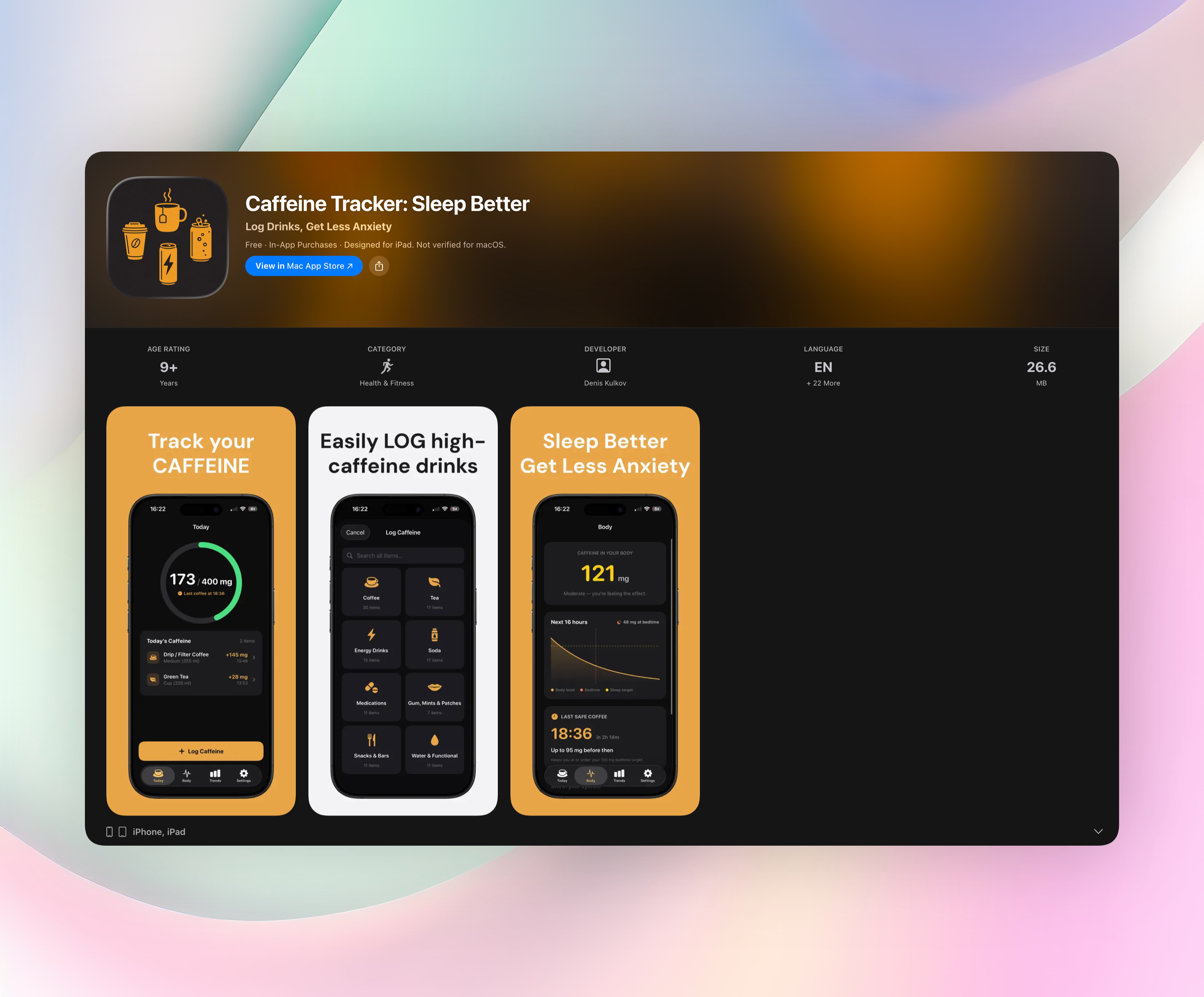
None of that tells you where your own line sits, and nobody can look it up for you. It takes writing down the milligrams and, next to them, how the day actually felt — a few weeks of that turns a guess into a number. Caffeine Tracker is a caffeine tracking app for iPhone, if a notes file isn't cutting it.
FAQ
How long do caffeine jitters last?
The sharp part usually runs one to three hours, though the caffeine itself circulates much longer. With a five-hour half-life, half of a morning dose is still in you at lunch. Bigger doses take longer to fall back under your symptom threshold, so the gap between 100 mg and 300 mg is measured in hours.
Can caffeine cause panic attacks?
It can provoke panic symptoms in people already prone to them, which is why caffeine challenges are used deliberately in panic research. The arousal caffeine creates resembles a panic attack's opening moments closely enough to start the same spiral. People with panic disorder frequently report a threshold well below the FDA's general 400 mg figure.
Does drinking water flush caffeine out faster?
No. Caffeine is cleared mostly by liver metabolism rather than by the kidneys, so extra fluid doesn't move the timeline. Water is still worth drinking, since caffeine is a mild diuretic and dehydration has its own unpleasant symptoms. It just isn't a reset button.
Why does coffee give me anxiety now when it never used to?
The usual explanations are a change in clearance or a change in baseline. Quitting smoking, pregnancy, or starting a hormonal contraceptive all slow caffeine's exit, so the same cup builds a higher level. On the other side, short sleep, a higher-stress stretch, or a bigger cup raises the effective dose relative to what your system has adapted to.
Free Caffeine tools
- Caffeine Half-Life & Sleep CalculatorA caffeine half life calculator for bedtime. Enter how many mg you had, when you had it and when you plan to sleep, and see how much caffeine is still in your system at bedtime, the share of the dose that is left, and when it falls to 50 mg.
- Caffeine Withdrawal Timeline PlannerMap a gradual caffeine reduction from your current daily intake to a day-by-day target, with common caffeine withdrawal windows shown alongside each date.
- Caffeine in Chocolate CalculatorChoose a chocolate type and enter a serving size to estimate the caffeine in that chocolate serving.
- Coffee Caffeine CalculatorPick your brew method and cup size to see how much caffeine is in a cup of coffee — the total mg, the mg in a standard 8 fl oz serving, and how much of the FDA's 400 mg daily guidance that uses. Typical values, not a measurement of your specific cup.
- Coffee to Water Ratio CalculatorFind how much grounds per cup of coffee you need, with grams, approximate tablespoons, water and a 1:n ratio for your brew method.
- Daily Caffeine Limit CalculatorSee how much caffeine you can have a day according to published guidance for your life stage, with an adult weight-based single-dose figure and drip coffee equivalent.
- Energy Drink Caffeine CalculatorChoose a brand and product, then enter the number of cans or shots to estimate total caffeine, caffeine density and the share of the FDA 400 mg daily figure.
- Espresso Caffeine CalculatorWork out how much caffeine is in an espresso shot: choose how many shots you pulled, how you pulled them and which beans went in. You get the total in mg, the mg per shot and how much of the FDA's 400 mg a day it uses.
- Half-Life Formula CalculatorEnter a starting amount, half-life and elapsed time or target amount. See the remainder, decay table, curve and worked formula for any substance.
- Matcha & Tea Caffeine CalculatorEstimate how much caffeine is in matcha green tea and other teas from powder weight or brewed serving size. See the result in mg and as a share of the FDA 400 mg daily figure.
- Soda Caffeine CalculatorEstimate total caffeine intake from soda servings using typical caffeine values for common soft drinks.
- Yerba Mate Caffeine CalculatorEstimate yerba mate caffeine from the amount of dry leaf, water volume and number of servings. Results are typical estimates, not exact measurements.