Does dark roast have more caffeine? What actually changes the mg
Not in any way you'd taste or feel. Roasting destroys only a small share of a bean's caffeine, so gram for gram a dark roast and a light roast land within a few percent of each other. The famous gap comes from scooping, not from roasting.
Does dark roast have more caffeine by weight?
Caffeine survives the roaster better than almost anything else in the bean. It's a stable alkaloid that doesn't break down much at normal roasting temperatures, while the sugars, acids, and water around it change completely. Beans lose roughly 12–20% of their mass in the roaster, and dark roasts sit at the high end of that range.
That mass loss is the interesting part. If a bean sheds more of everything except caffeine, the caffeine left behind makes up a slightly larger fraction of what remains. Careful measurements tend to put dark roast at or barely above light roast per gram — close enough that roasters and labs disagree about which way the sign points. Nobody credible claims the gap is large.
On a scale, then, roast level is close to irrelevant. Most of what you've read about light roast vs dark roast caffeine is measuring something else.
Why scoops and scales give opposite answers
Roasting doesn't only remove mass — it puffs the bean up. Cell walls fracture, trapped gases expand, and the bean grows even as it gets lighter. A dark roast bean is bigger and less dense than the same bean pulled early.
Density is what breaks the scoop. A tablespoon holds a fixed volume, so filling it with airy dark-roast beans gets you fewer grams than filling it with dense light-roast ones. Fewer grams means less caffeine in the cup — not because the roast destroyed anything, but because you brewed less coffee.
Weigh instead and the effect disappears. Eighteen grams is eighteen grams whether the beans are pale and cinnamon-colored or dark and oily.
That one difference explains most of the contradiction online. "Light roast has more caffeine" is true by the scoop. "Dark roast has a little more" is true by the gram. Both camps are right about different questions, and a kitchen scale settles it for good.
Bean species matters far more: arabica vs robusta caffeine
Roast is a rounding error next to species. Arabica beans run roughly 1.2–1.5% caffeine by dry weight. Robusta runs about 2.2–2.7% — call it double.
Caffeine works as a natural insecticide for the plant, and robusta's higher load is part of why it's hardier and cheaper to grow. It turns up in instant coffee, in supermarket blends, and in traditional Italian espresso blends, where a slice of robusta adds crema and body along with the strength.
The practical effect is large. Swapping a 100% arabica bag for a blend carrying 20–30% robusta moves your cup more than going from the palest roast to the darkest one ever could. Specialty bags usually name the species; grocery-shelf blends usually don't.
Dose and brew ratio come second
After species, the next lever is how much coffee you use and how much water you run through it.
Caffeine is very water-soluble and comes out early in the extraction. Normal brewing pulls the large majority of it out of the grounds regardless of method, so the dose sets the ceiling and the brew mostly decides how much water you dilute it into.
That's why brew ratio does so much of the work:
- Drip and pour-over sit around 1 part coffee to 15–18 parts water.
- Espresso runs about 1:2 — a little water through a big dose.
- Cold brew concentrate is often 1:4 to 1:8, then cut before serving.
Roast level comes third, and a distant third.
Which coffee has the most caffeine? Per ounce and per cup are different questions
Published figures vary by roaster, grind, and machine, but the typical numbers cluster tightly enough to be useful. For a fuller breakdown by cup size and brew method, see caffeine content by coffee type.
| Drink | Typical serving | Typical caffeine | Per fl oz |
|---|---|---|---|
| Espresso, single shot | 1 fl oz | ~65 mg | ~65 mg |
| Espresso, double shot | 2 fl oz | ~125 mg | ~63 mg |
| Drip coffee | 8 fl oz | ~95 mg | ~12 mg |
| Cold brew, ready to drink | 12 fl oz | ~150–200 mg | ~13–17 mg |
| Single-serve pod | 8 fl oz | ~75–150 mg | ~9–19 mg |
| Instant coffee | 8 fl oz | ~60–80 mg | ~8–10 mg |
| Decaf drip | 8 fl oz | ~2–5 mg | under 1 mg |
The drip coffee vs espresso caffeine argument lives entirely in those last two columns. Espresso is roughly five times as concentrated per ounce — but you drink one ounce of it. A single espresso shot at about 65 mg loses to an 8-ounce mug of drip at about 95 mg, while a double shot at about 125 mg pulls ahead of it. So does espresso have more caffeine than coffee? Per ounce, easily. Per serving, it depends on the shot: a single usually loses, a double usually wins.
Cold brew vs espresso caffeine works the same way. Cold brew isn't remarkable per ounce — it's brewed at a high ratio and then poured into a 12- or 16-ounce cup, so the total climbs fast. Serving size is doing the work, not some special property of cold extraction.
For a drink you'd actually order, a large cold brew or a multi-shot americano usually tops the list. For concentration in the glass, espresso wins and nothing else is close.
Why the ranges make 400 mg hard to apply
The FDA cites 400 mg a day — roughly four to five 8-ounce cups of drip coffee — as an amount not generally associated with negative effects in healthy adults. It's a clean number sitting on top of very messy inputs. "Three coffees" can mean 180 mg or 500 mg depending on whether they were pods at home or double-shot lattes from a café, and none of that shows up in the phrase itself.
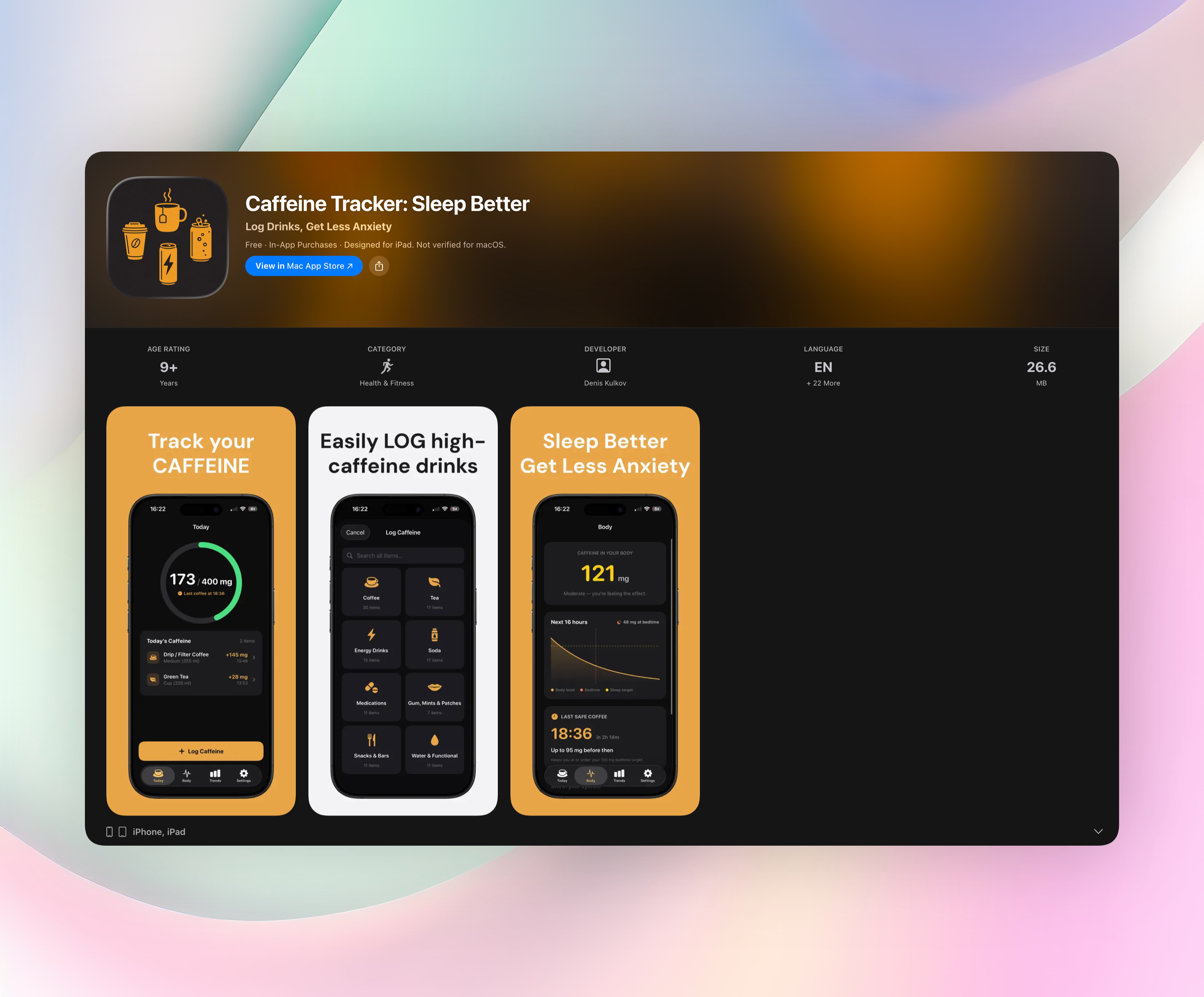
Closing that gap is mostly bookkeeping. Caffeine Tracker is a caffeine tracking app for iPhone where each drink is logged with its real mg instead of a generic cup that could mean anything from 60 to 200.
FAQ
Does dark roast have more caffeine than light roast?
Per gram, dark roast is equal to or a hair above light roast, and the difference is too small to notice. Per scoop, light roast wins, because denser beans pack more coffee into the same volume. Weigh the dose and the question stops mattering.
Which coffee has the most caffeine?
Among drinks you can order, a large cold brew or a multi-shot americano usually carries the most total caffeine. A robusta-heavy blend pushes any brew method higher. Per ounce, espresso is the most concentrated by a wide margin.
Does espresso have more caffeine than coffee?
It depends on the unit. An ounce of espresso holds roughly five times the caffeine of an ounce of drip coffee. But a single shot is about 65 mg against roughly 95 mg in an 8-ounce mug, so the mug usually wins on total.
Does a longer brew time mean more caffeine?
Somewhat, but it saturates quickly. Caffeine extracts early and close to completely in normal brewing, so stretching a brew adds bitterness faster than it adds milligrams. Cold brew's long steep compensates for cold water rather than pulling out more than hot brewing already does.
Is decaf actually caffeine-free?
No. Decaf typically carries about 2–5 mg per 8-ounce cup. US labeling rules require most of the caffeine to be removed — on the order of 97% — not all of it.
Free Caffeine tools
- Caffeine Half-Life & Sleep CalculatorA caffeine half life calculator for bedtime. Enter how many mg you had, when you had it and when you plan to sleep, and see how much caffeine is still in your system at bedtime, the share of the dose that is left, and when it falls to 50 mg.
- Caffeine Withdrawal Timeline PlannerMap a gradual caffeine reduction from your current daily intake to a day-by-day target, with common caffeine withdrawal windows shown alongside each date.
- Caffeine in Chocolate CalculatorChoose a chocolate type and enter a serving size to estimate the caffeine in that chocolate serving.
- Coffee Caffeine CalculatorPick your brew method and cup size to see how much caffeine is in a cup of coffee — the total mg, the mg in a standard 8 fl oz serving, and how much of the FDA's 400 mg daily guidance that uses. Typical values, not a measurement of your specific cup.
- Coffee to Water Ratio CalculatorFind how much grounds per cup of coffee you need, with grams, approximate tablespoons, water and a 1:n ratio for your brew method.
- Daily Caffeine Limit CalculatorSee how much caffeine you can have a day according to published guidance for your life stage, with an adult weight-based single-dose figure and drip coffee equivalent.
- Energy Drink Caffeine CalculatorChoose a brand and product, then enter the number of cans or shots to estimate total caffeine, caffeine density and the share of the FDA 400 mg daily figure.
- Espresso Caffeine CalculatorWork out how much caffeine is in an espresso shot: choose how many shots you pulled, how you pulled them and which beans went in. You get the total in mg, the mg per shot and how much of the FDA's 400 mg a day it uses.
- Half-Life Formula CalculatorEnter a starting amount, half-life and elapsed time or target amount. See the remainder, decay table, curve and worked formula for any substance.
- Matcha & Tea Caffeine CalculatorEstimate how much caffeine is in matcha green tea and other teas from powder weight or brewed serving size. See the result in mg and as a share of the FDA 400 mg daily figure.
- Soda Caffeine CalculatorEstimate total caffeine intake from soda servings using typical caffeine values for common soft drinks.
- Yerba Mate Caffeine CalculatorEstimate yerba mate caffeine from the amount of dry leaf, water volume and number of servings. Results are typical estimates, not exact measurements.