Does coffee dehydrate you, or does it count as water?
No. At the amounts most people drink, coffee doesn't dehydrate you — the water in the cup more than covers the mild diuretic effect of the caffeine, and that effect fades once you drink it regularly. Coffee counts toward your daily fluid, not against it.
Does coffee dehydrate you? Start with the fluid math
Brewed coffee is roughly 99% water by weight. A 12-ounce cup delivers about 350 mL of fluid along with the caffeine. For that drink to leave you in deficit, the caffeine would have to drive out more than 350 mL of extra urine — not close at that dose.
Controlled trials have tested it directly: give habitual coffee drinkers several cups a day, then an equal volume of plain water on a separate occasion, and compare hydration markers — body mass, total body water, blood and urine concentration. Across several days the two conditions come out the same. Coffee behaves like water with caffeine in it, because that's what it is.
Where the "coffee dehydrates you" idea started
The claim traces back to a small experiment from 1928 that has been repeated secondhand ever since. A few participants went without caffeine for a stretch, then took a substantial dose, and their urine output rose. The finding was real. Two conditions attached to it didn't survive the retelling: the subjects were caffeine-naive, and the dose was far larger than a single cup.
That early work also recorded the other half of the story — repeat the dose day after day and the response shrinks. The tidy version that made it into common advice, drink an extra glass of water for every coffee, kept the result and dropped the conditions.
Is coffee a diuretic? Technically yes, mildly, and only above a dose
Caffeine blocks adenosine receptors in the kidney. With that signal suppressed, the tubules reabsorb less sodium, water follows the sodium out, and urine output ticks up. So pharmacologically, yes — the real question is how much, and in whom.
Reported thresholds vary between studies, worth saying plainly rather than picking one number and calling it settled. In people who've been off caffeine, measurable increases in urine output tend to appear somewhere above roughly 250–300 mg taken at once. A clear, consistent diuretic response is a high-dose phenomenon — the 500 mg range, on the order of five cups of brewed coffee in one sitting. Below that, in regular drinkers, the effect disappears into ordinary day-to-day variation in bathroom trips.
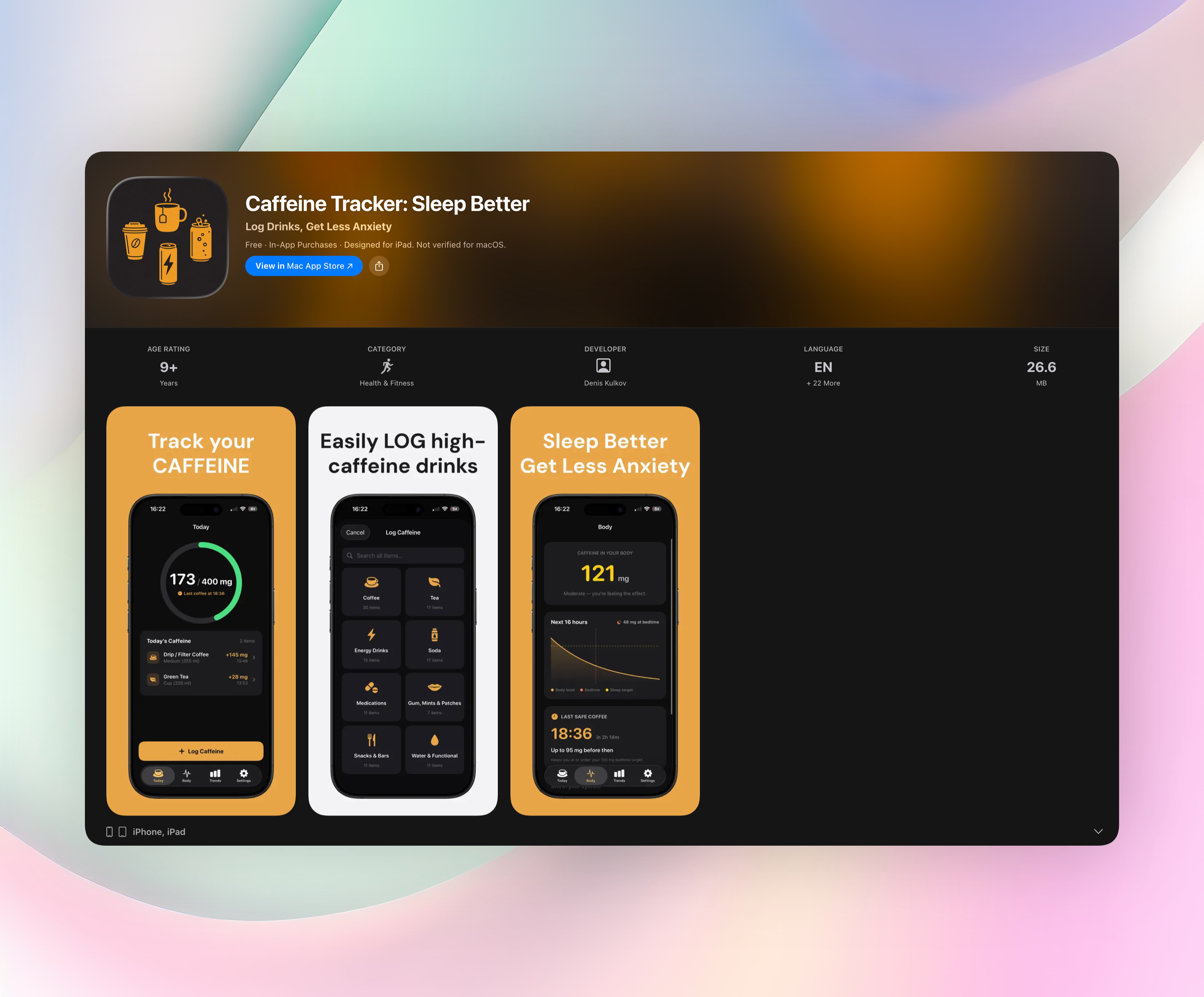
That gap between one cup and 500 mg at once is where the confusion lives, which is why how much caffeine is actually in your coffee matters more than how many cups you counted — a weak drip and a large cold brew can differ several times over. Caffeine Tracker, a caffeine tracking app for iPhone, adds up the milligrams across everything you drink — the only way to see whether a day came anywhere near the dose where diuresis matters at all.
Tolerance to the diuretic effect shows up within days
The diuretic response is one of the fastest caffeine effects to habituate. In dosing studies, most of it is gone after a few consecutive days of regular intake, and it returns after a long enough break. In practice, the person who notices extra bathroom trips after coffee usually drinks it rarely, or is coming back from a week off. Daily drinkers have already adapted.
That is also why caffeine and dehydration is a mostly hypothetical pairing for regular coffee drinkers: the dose that produces the effect is high, and the tolerance blunting it is already in place.
Does coffee count as water intake?
Yes. At normal serving sizes, caffeinated drinks count toward daily fluid on close to the same footing as plain water, and fluid guidance from health agencies generally counts all beverages.
| Drink | Typical serving | Caffeine | Contribution to daily fluid |
|---|---|---|---|
| Brewed coffee | 8 oz / 240 mL | ~80–100 mg | Nearly the full volume |
| Espresso | 1 oz / 30 mL shot | ~60–75 mg | Full volume, but a small one |
| Black tea | 8 oz / 240 mL | ~40–70 mg | Nearly the full volume |
| Green tea | 8 oz / 240 mL | ~30–50 mg | Nearly the full volume |
| Cola | 12 oz / 355 mL | ~30–45 mg | Nearly the full volume |
| Energy drink | 8–16 oz / 240–475 mL | ~80–160 mg | Nearly the full volume |
The pattern holds for tea as much as coffee: less caffeine per cup, the same volume of water carrying it.
How this sits next to the 400 mg guideline
The FDA describes 400 mg a day — roughly four to five cups of brewed coffee — as an amount not generally associated with negative effects in healthy adults. That figure covers caffeine broadly and says nothing about fluid balance on its own. It's still relevant here: 400 mg spread across a day is a different exposure from 400 mg in one sitting, and the diuretic effect tracks the single dose, not the daily total.
What's usually behind that dehydrated feeling
When a coffee-heavy day ends with a headache and a dry mouth, the cause is normally somewhere else:
- Alcohol. It suppresses vasopressin, the hormone that tells the kidneys to hold water. The effect is dose-dependent and doesn't fade with habit the way caffeine's does — this is the drink that actually earns the label.
- Heat and sweat. A hot day or a hard session moves far more fluid than any cup of coffee.
- Displacement. Four coffees and nothing else is simply a low-volume day. Nothing was taken away; not much was added.
FAQ
How much coffee would it take to actually dehydrate you?
More than most people drink at once, and it depends on whether you drink caffeine regularly. Clear diuretic effects cluster around large single doses near 500 mg, and even then the water in those five-odd cups offsets much of what's lost. For habitual drinkers, the bar sits higher still.
Does caffeine dehydrate you during exercise or in hot weather?
Trials of caffeine before endurance exercise have not found worse hydration status or higher core temperature compared with a placebo. Sweat losses in the heat dwarf anything caffeine does to urine output, so what you drink during the session is the variable that matters.
Why do I need the bathroom so soon after a coffee?
Mostly volume. A large coffee is a lot of liquid arriving quickly, and a full bladder follows. Caffeine adds a little on top, and that addition is more noticeable in people who don't drink it often.
Should I drink extra water for every cup of coffee?
There's no physiological requirement to match coffee with water, since the coffee already is water. Drinking some anyway is harmless and helps if coffee is the only thing you drink all day, but it isn't compensation for a loss.
Free Caffeine tools
- Caffeine Half-Life & Sleep CalculatorA caffeine half life calculator for bedtime. Enter how many mg you had, when you had it and when you plan to sleep, and see how much caffeine is still in your system at bedtime, the share of the dose that is left, and when it falls to 50 mg.
- Caffeine Withdrawal Timeline PlannerMap a gradual caffeine reduction from your current daily intake to a day-by-day target, with common caffeine withdrawal windows shown alongside each date.
- Caffeine in Chocolate CalculatorChoose a chocolate type and enter a serving size to estimate the caffeine in that chocolate serving.
- Coffee Caffeine CalculatorPick your brew method and cup size to see how much caffeine is in a cup of coffee — the total mg, the mg in a standard 8 fl oz serving, and how much of the FDA's 400 mg daily guidance that uses. Typical values, not a measurement of your specific cup.
- Coffee to Water Ratio CalculatorFind how much grounds per cup of coffee you need, with grams, approximate tablespoons, water and a 1:n ratio for your brew method.
- Daily Caffeine Limit CalculatorSee how much caffeine you can have a day according to published guidance for your life stage, with an adult weight-based single-dose figure and drip coffee equivalent.
- Energy Drink Caffeine CalculatorChoose a brand and product, then enter the number of cans or shots to estimate total caffeine, caffeine density and the share of the FDA 400 mg daily figure.
- Espresso Caffeine CalculatorWork out how much caffeine is in an espresso shot: choose how many shots you pulled, how you pulled them and which beans went in. You get the total in mg, the mg per shot and how much of the FDA's 400 mg a day it uses.
- Half-Life Formula CalculatorEnter a starting amount, half-life and elapsed time or target amount. See the remainder, decay table, curve and worked formula for any substance.
- Matcha & Tea Caffeine CalculatorEstimate how much caffeine is in matcha green tea and other teas from powder weight or brewed serving size. See the result in mg and as a share of the FDA 400 mg daily figure.
- Soda Caffeine CalculatorEstimate total caffeine intake from soda servings using typical caffeine values for common soft drinks.
- Yerba Mate Caffeine CalculatorEstimate yerba mate caffeine from the amount of dry leaf, water volume and number of servings. Results are typical estimates, not exact measurements.